



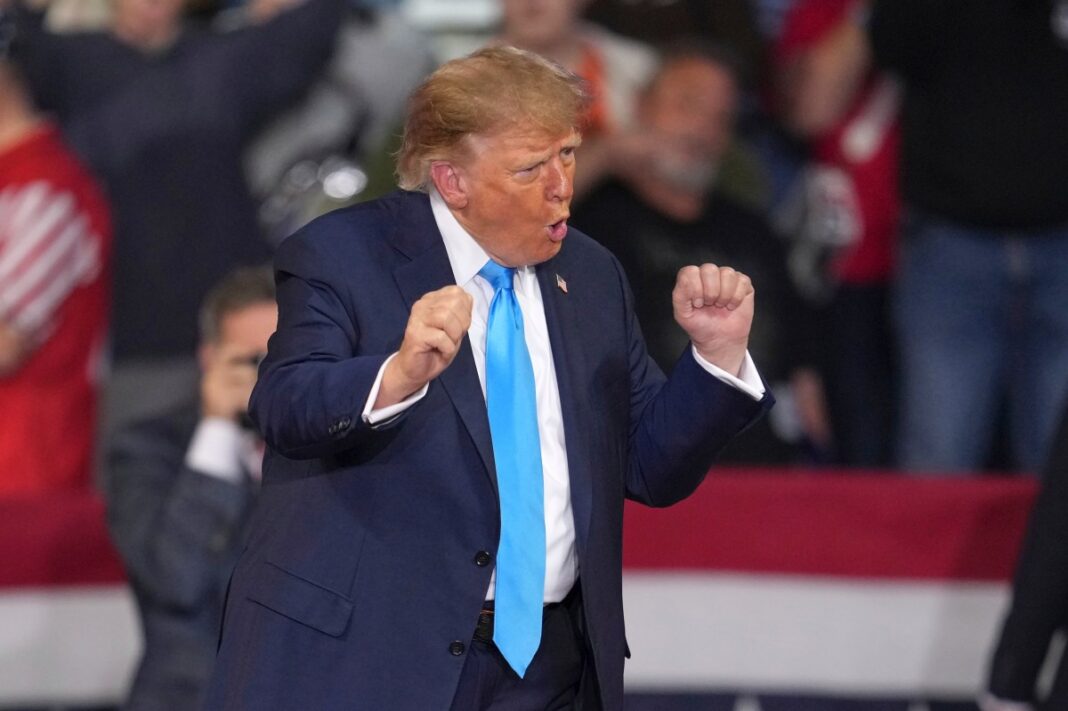
Trump told a Kentucky crowd that every adult American would receive a $5,000 dividend if Republicans keep Congress — a proposal that would still require lawmakers to approve more than $1 trillion in spending.
Donald Trump has found an extremely simple closing argument for the midterms: vote Republican and, according to him, Americans could get $5,000 checks. Nothing says “please read the policy details” quite like putting four digits and a dollar sign on the campaign stage.
At his Kentucky rally Saturday, Trump again promised a $5,000 “dividend” for every adult American if Republicans retain control of Congress. He framed the money as a benefit made possible by tariff revenue and other federal gains.
The catch is fairly large. Congress would have to approve the payments, and many Republican candidates have not endorsed the idea.
Associated Press reporting notes that sending $5,000 to every adult could cost well over $1 trillion. That is a lot of money even by Washington standards, where numbers generally stop feeling real somewhere around the second comma.
Trump has promoted versions of the dividend proposal for months. He presents the checks as a direct way to share government revenue with households and says Republicans can deliver them if voters keep the party in power.
Economists and budget analysts have questioned whether tariff collections could realistically finance the program at the scale Trump describes. Tariffs are taxes on imported goods, and much of the cost is ultimately absorbed by American businesses and consumers.
Republican candidates have mostly treated the proposal with caution. Some support the concept of returning revenue to taxpayers, while others avoid committing to a specific $5,000 payment that Congress has not authorized.
Trump’s Kentucky pitch also included another unusually explicit election-year promise. He tied a $100 million Defense Department investment in a Kentucky pharmaceutical facility to a Republican victory.
That drew attention because presidents normally try to separate federal spending decisions from direct partisan conditions. Trump, characteristically, was less interested in pretending the two conversations were unrelated.
The $5,000 check is the easier message to sell. Voters do not need a white paper, a think-tank panel or a cable-news explainer to understand “you get five grand.”
The problem comes when the rally ends and Congress enters the sentence. A president can propose payments, campaign on them and pressure lawmakers, but the federal government cannot simply send more than $1 trillion in checks because an arena applauded.
Democrats have attacked the idea as an election-year giveaway that lacks a credible funding plan. Republicans who support Trump face the opposite problem: they risk disappointing voters if the checks become a campaign promise that never survives the legislative process.
Trump appears comfortable with that risk. His political style has always favored the giant promise first and the implementation meeting later.
For now, nobody should start spending the money. There is no enacted $5,000 dividend program, no approved payment date and no guarantee Congress would pass one.
But as an email subject line, “Vote Republican, Get $5,000” is brutally efficient. Somewhere, a campaign consultant is angry they spent six months building a message deck.