



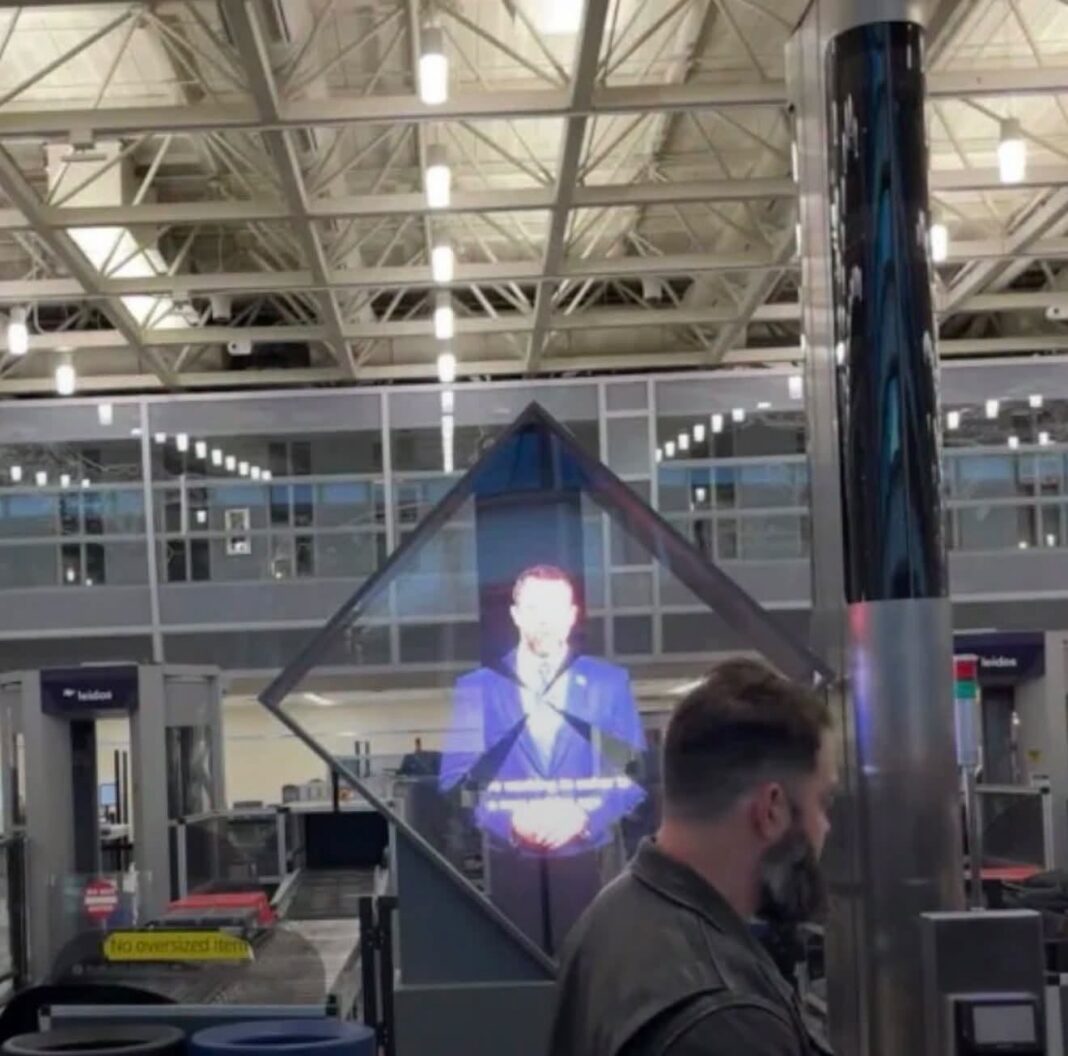
America's airports have acquired a new feature for travelers who are already juggling boarding passes, luggage and Thanksgiving logistics: a digital version of Homeland Security Secretary Markwayne Mullin. The Cabinet official has been appearing in hologram-style displays near airport security lines. If you wanted to get away from Washington for the holiday, Washington has apparently arranged to meet you at the airport.
A Cabinet secretary without a boarding pass
The U.S. Sun reported on November 24 that the displays had been seen at Chicago O'Hare and Minneapolis–Saint Paul International Airport. The prerecorded greeting promotes the administration's travel agenda and recognizes the work of Transportation Security Administration personnel. It does not represent a live conversation with the secretary.
DHS defended the appearance as part of an established practice of welcoming passengers. There is nothing inherently unusual about an agency head appearing in a public information video. The novelty here is the presentation: a government official rendered like a visitor from the future at a place where many customers would settle for a power outlet that works.
The displays themselves are not necessarily new this week. The Sun traced online discussion back to October, making the Thanksgiving coverage a renewed spotlight rather than proof that the devices were just installed. The distinction matters because the display should not be presented as a newly announced emergency response.
The timing could hardly be more awkward
The attention comes during a difficult period for aviation systems. Recent disruptions have included a nationwide FAA ground stop and separate airline technology problems. At just the moment travelers want reassurance about their flights, the image of a Cabinet member materializing beside the security line is an irresistible contrast.
A functioning aviation network involves far more complicated infrastructure than a video display. Showing a prerecorded message and directing thousands of aircraft safely through crowded airspace are fundamentally different engineering tasks. The existence of one does not demonstrate that money was diverted away from the other.
Still, the contrast is excellent material for airport humor. Nobody standing in a long line is necessarily yearning for a more technologically sophisticated way to hear from the federal government. They generally want their flight to leave, their luggage to arrive and their relatives to stop asking what time they will be home.
Washington sends in a Tiger Team
The administration has also assembled a cross-agency group to address aviation technology failures. The Sun reported that the initiative involves transportation, defense and intelligence officials alongside the FAA. Its purpose is to reduce the likelihood of similar disruptions, particularly during a busy holiday period.
That effort is separate from the Mullin display. The DHS oversees transportation security through TSA, while the FAA belongs to the Department of Transportation and handles air traffic operations. Airlines also maintain their own systems. The fact that all these activities happen in the same airport does not make them interchangeable responsibilities.
The distinction is especially important when a delay occurs. A checkpoint staffing problem, an airline computer failure and an air traffic restriction may look identical to a traveler whose departure board keeps changing, but they require different solutions. A smiling secretary on a screen cannot identify which problem is affecting an individual itinerary.
What travelers actually need
Public information has a useful role at airports, particularly when it explains security procedures or tells passengers where to go. A clear message can reduce confusion and make an unfamiliar terminal easier to navigate. Whether a political official's greeting accomplishes the same thing depends on what it communicates.
There is also a reasonable argument for thanking the employees who work through major holidays. Airport staff are dealing with the same seasonal pressures as passengers, often while missing celebrations of their own. Recognition for that work need not be controversial simply because it comes from an administration official.
The question is whether the elaborate presentation adds value beyond the novelty. A government interested in reassuring travelers might find that accurate notices, reliable operations and straightforward explanations make a stronger impression than any visual effect.
For now, travelers encountering digital Mullin can appreciate the peculiar spectacle without mistaking it for an operational upgrade. America's airports may have discovered a way to make a secretary appear in several places without buying him a plane ticket. Getting the actual passengers to their destinations remains the rather more important assignment.