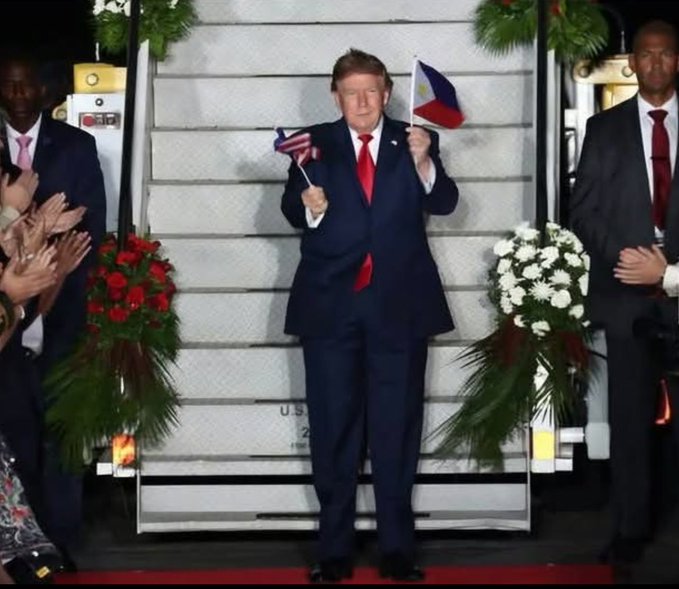




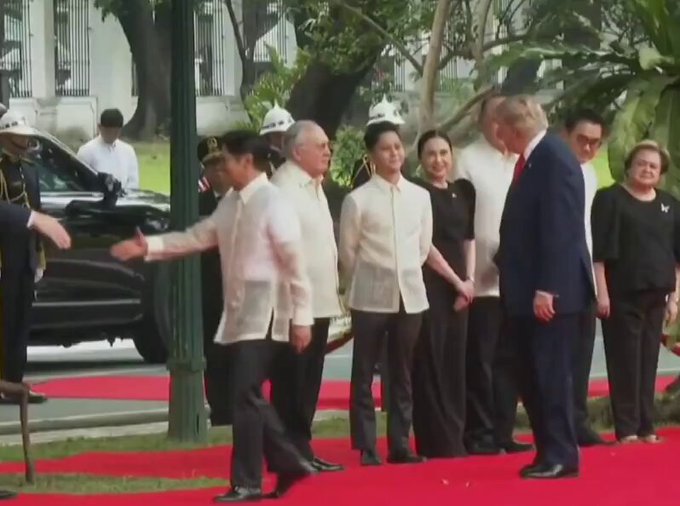
A diplomatic welcome can involve elaborate choreography, but Donald Trump’s November 18 visit to Malacañang Palace in Manila delivered a receiving-line moment that looked as if somebody had misplaced the stage directions. Video circulating online appeared to show the president following Philippine President Ferdinand Marcos Jr. and shaking hands with people who had traveled with Trump himself. The spectacle was tailor-made for a political internet that can turn a few seconds of ceremonial footage into a full day of arguments.
The scene had an unusually recognizable supporting cast. ABC News reported that Secretary of State Marco Rubio, Treasury Secretary Scott Bessent, Commerce Secretary Howard Lutnick, Trade Representative Jamieson Greer, Stephen Miller and Dan Scavino were among the U.S. officials present for the welcome. They were not mysterious foreign dignitaries waiting to be introduced. They were members of Trump’s own entourage, which explains why the clip became such irresistible material for critics.
A Receiving Line With an Unexpected Twist
The important distinction is between what the footage shows and what online commentators claim it proves. The video shows Trump moving through a diplomatic greeting sequence and appearing to shake hands with his own officials. It does not establish that he forgot their identities, failed to recognize them, or experienced a medical event. In formal ceremonies, leaders sometimes follow a host’s lead through greetings even when the participants are already acquainted.
That sensible explanation may be less entertaining than the jokes, but it matters. A president can look awkward in a receiving line without losing track of who runs the State Department. The internet, meanwhile, is not famous for waiting until all diplomatic-protocol questions have been resolved before publishing its verdict. The visual alone was enough to get people talking.
IBTimes UK described the reaction as allegations of a cognitive slip, while acknowledging that the clip cannot establish Trump’s reason for the behavior. That is the proper boundary for reporting this story. The action is visible; the diagnosis offered by strangers watching it is speculation. The difference may be boring to viral accounts, but it is the difference between a funny video story and an unsupported health claim.
The Walk Became Its Own Story
The receiving line was not the only visual attracting attention. Another clip showed Trump walking beside Marcos during the palace arrival ceremony. The Daily Beast reported that some viewers focused on the president’s wide steps and side-to-side movements, with social-media users mocking what they considered an unusual gait. The White House had shared footage of the appearance, ensuring that the material was hardly hidden from public view.
Again, a brief clip is not a medical examination. Camera motion, walking pace, perspective and the ceremonial setting can all affect how movement appears. What can be said with confidence is that critics noticed the walk and circulated the footage. What cannot be responsibly said from the images alone is that Trump has a particular condition. A viral video is not a neurological workup, even when thousands of amateur specialists volunteer their services in the replies.
The combination of the two moments made the visit an especially rich target. First there was the walk, then the apparent meet-and-greet with people Trump already knew. It was the kind of double feature that leaves political communications staff wishing the public would focus on the actual bilateral meeting instead. Unfortunately for them, awkward ceremonies have a much shorter route to the trending page than trade details.
What the Palace Visit Was Actually About
Beyond the online jokes, the meeting was a significant diplomatic engagement. ABC News reported that Trump and Marcos discussed cooperation on energy, defense and technology, including artificial intelligence. Trump also announced what he called a major trade agreement with the Philippines, although details were not immediately available in the reporting at the time. The administration clearly wanted the visit to project close ties and presidential authority.
The ceremony itself featured national anthems, a military honor guard and a 21-gun salute. Marcos welcomed Trump at the palace and the two inspected troops before entering the building. The president later signed a photo book and toured part of the residence. There was plenty of conventional state-visit material available for an official recap, if conventional state-visit material were what people wanted to share.
Instead, the internet found its favorite images in the margins. It is a recurring feature of modern politics that a carefully arranged international event can be eclipsed by a few seconds of unscripted movement. The planners build the grand backdrop; social media notices the handshake sequence. Everyone gets a different show.
The Real Takeaway
There is a fair story here about public appearances and how presidents are scrutinized. There is also a fair story about how quickly commentators leap from odd-looking footage to confident claims about cognition. Both are worth telling. Neither requires pretending that a camera has revealed what someone was thinking while following a host through a receiving line.
Trump’s Manila visit may ultimately be remembered by diplomats for meetings and announcements. Online, it may be remembered for a president apparently greeting his own team like newly arrived guests and for a walk that launched a thousand slow-motion analyses. The ceremony was designed to display the choreography of international friendship. The internet preferred to review the choreography itself.