



Black Friday shoppers at an Oregon mall got a terrifying surprise that had absolutely nothing to do with the price of televisions. Police responded to reports of gunfire at Clackamas Town Center on Friday, only to discover that the commotion was allegedly the work of two men trying to make a viral video with a piñata filled with money. The shopping trip ended with two arrests and a police explanation that probably required a second reading.
Authorities confirmed that no shooting occurred. That is the most important fact in a story whose other details sound like a rejected sketch about the lengths people will go to for internet attention. For the shoppers who thought they were in danger, however, the experience was anything but a comedy.
A shopping trip takes a frightening turn
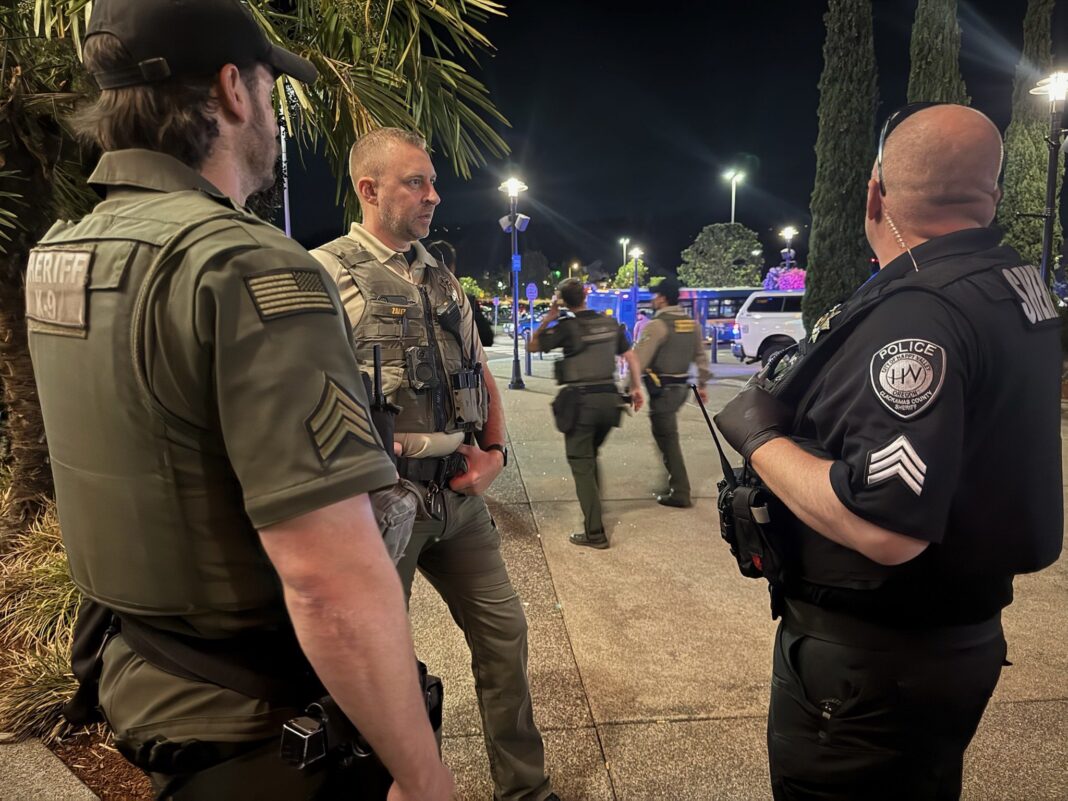
According to reporting citing the Clackamas County Sheriff’s Office, emergency calls began coming in during the afternoon of November 27. Deputies responded quickly and established that there was no active shooter. Investigators then turned their attention to the very different event that had apparently generated the alarm.
Authorities say two men were attempting to record a stunt involving cash inside a piñata. Some people moved toward the money, while others interpreted the noise and sudden movement as evidence of a shooting. The combination created enough confusion to generate genuine emergency calls.
That is the peculiar intersection of two different instincts. One group of people sees money and wants to get closer; another sees people moving suddenly in a crowded public space and wants to get as far away as possible. Neither group necessarily knows what the other is reacting to. In that environment, a situation can become frightening long before anyone understands its actual cause.
The sheriff’s office reportedly released photographs of the objects involved after explaining what had happened. Local television station KOIN also covered the incident. The resulting story has the unusual distinction of making the phrase “nothing more than a piñata” sound like the most reassuring sentence in a police announcement.
The viral video has a legal sequel
The men arrested were identified in reporting as Seth Anthony Henry, 26, and Josiah Samuel Bridges, 28, both of Portland. Both were booked on allegations of second-degree disorderly conduct, with Henry also facing an outstanding warrant. The arrests are not convictions, and the men are entitled to contest the allegations in court.
Police did not report that the men were carrying out an actual shooting. Nor does the available information establish that they intended to make shoppers believe one was occurring. The reported purpose of the activity was filming a video intended to attract widespread attention online.
Intent and consequences are different things. A prankster might believe that a stunt is harmless because it involves no actual weapon or physical attack. Other people, who have not been briefed on the production schedule, may reasonably interpret the situation differently. A court will ultimately determine the legal significance of the alleged conduct.
There is no verified figure for how much money the piñata contained in the material reviewed for this article. There is also no independently verified copy of the footage the pair allegedly intended to make. We cannot tell whether they achieved the shot they wanted, but they certainly generated a news story that was much less flattering than a conventional influencer video.
Why the location matters
Black Friday is a particularly awkward time to conduct an unscheduled public spectacle. Shopping centers are crowded, people are moving quickly and visitors are concentrating on purchases rather than paying attention to somebody else’s social media production. A noise or sudden disturbance may be difficult to interpret immediately.
The public’s reaction also reflects a reality that cannot simply be dismissed as an overreaction. Americans have experienced serious violence in public gathering places. People who believe they might be in danger are not expected to investigate whether a disturbance is sponsored content before deciding how to protect themselves.
For that reason, the people who called emergency services should not be the targets of ridicule. They were responding to what they understood to be a potentially dangerous situation. The absurdity lies in a stunt whose participants allegedly underestimated how their activity would be perceived by strangers.
Emergency responders also have a responsibility to treat reports of gunfire seriously until they can establish otherwise. That means an ill-considered prank can consume public resources even when there is ultimately no physical threat. The resulting disruption is not erased simply because the original plan involved something normally associated with birthday parties.
The internet’s expensive appetite for attention
Public stunts have become a familiar feature of online entertainment. The economics can be tempting: a dramatic clip might deliver followers, advertising revenue or a temporary burst of fame. But the people who happen to be nearby have not necessarily volunteered to participate in that business model.
There is a difference between filming an amusing interaction with consenting participants and making an entire shopping center part of a video without warning. The latter may produce a more unpredictable reaction, which is exactly why it can look attractive to a creator. It is also why the consequences can extend far beyond the intended audience.
The Oregon incident offers a particularly vivid example of how badly that calculation can go. The alleged creators wanted attention, while the shoppers wanted either a bargain or an ordinary afternoon. Police had to intervene in a situation that authorities ultimately determined involved no gunfire at all.
Thankfully, the central fear behind the emergency calls proved unfounded. The criminal allegations will now be addressed through the legal process, rather than through likes and comments. In the meantime, there is one fairly obvious lesson for aspiring creators: if the success of your video depends on strangers having no idea what is happening, perhaps the shopping mall is not your studio.