



King Charles III did not attend the funeral of Norway’s King Harald V. This was not a scheduling conflict, a diplomatic snub or a sudden discovery that Oslo is inconvenient. It was protocol. Buckingham Palace said Prince William would represent his father because, under longstanding precedent, the British sovereign does not attend the funerals of other heads of state. So when one king dies, another king sends the man who is scheduled to become king later. Monarchy has spent centuries proving that even grief can benefit from a succession plan.
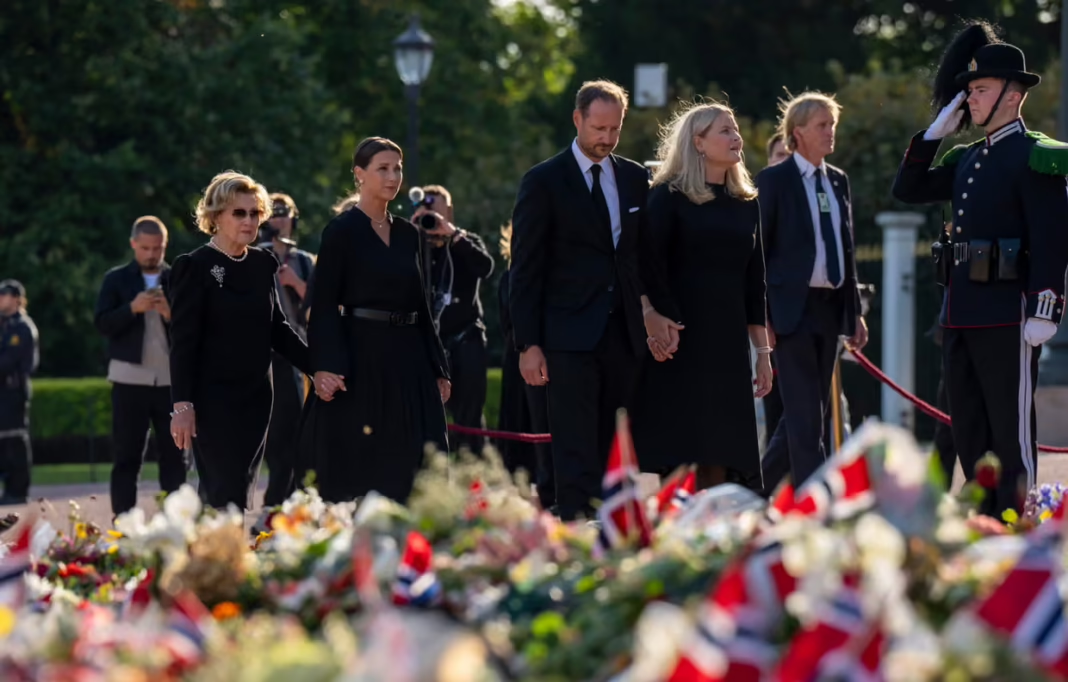
Harald died on Aug. 28 at 89 after a 35-year reign. Norway mourned him as a popular, modernizing monarch, and his funeral on Sept. 9 drew political leaders and royal families from across Europe and beyond. William joined the procession behind Harald’s coffin through Oslo alongside his aunt, Princess Anne. Kings and queens from Spain, Sweden, Denmark and the Netherlands were there. Charles was not. The rule is apparently that a reigning British monarch can be related to the deceased, call him a dear cousin and much-loved friend, and still observe the occasion most appropriately by assigning the trip to his eldest son.
That is the target here: royal protocol, the only bureaucracy that can make a family funeral sound like a staffing decision. Charles issued a warm tribute after Harald’s death, praising his dedication, kindness, compassion and sense of duty. The two royal families have longstanding ties, and Charles and Harald were relatives. None of that defeated precedent. The institution that exists to embody continuity decided continuity required the current king to stay home while the next king went in his place. Somewhere, presumably, there is a very old folder explaining why this counts as respect.
Princess Anne made the arrangement even better. She attended the same funeral, but Buckingham Palace said she was going in a private and personal capacity because she is godmother to Harald’s son and successor, King Haakon VIII. William was therefore there officially for his father. Anne was there personally for her godson. Both walked behind the same coffin. This is what happens when family relationships and state offices occupy the same seating chart. Normal families ask who is driving to the funeral. Royal families first determine which constitutional capacity will be getting into the car.
The precedent is not new, which is precisely why it is funny. William also represented Charles at Pope Francis’s funeral in 2025. The heir has become the monarchy’s designated representative for solemn international occasions where the king himself is apparently too sovereign to appear. That does not make the rule sinister. It makes it magnificently institutional. Britain maintains a hereditary head of state partly to provide continuity at major moments of national life, then maintains another tradition explaining why that head of state should sometimes be represented by his hereditary replacement.
Norway offered the contrast in unusually clear form. Harald was remembered as a people’s king who helped modernize his monarchy. Tens of thousands lined Oslo’s streets, and more than 46,000 people had visited the royal chapel while he lay in state. His son Haakon, now king, walked directly behind the coffin. The ceremony was full of the things monarchies say they preserve especially well: family, history, ritual, national memory and public symbolism. Britain arrived with all of those things too, plus a technical distinction about why its king was represented by a prince while the king’s sister attended as somebody’s godmother.
There is a serious thread underneath the pageantry. Modern monarchies survive partly by insisting that ritual still has meaning, even when the rules behind it are invisible to almost everyone watching. Protocol can provide stability. It can keep diplomatic expectations predictable and stop every royal occasion from becoming an improvisation. But protocol also has a habit of revealing how much of monarchy is devoted to maintaining distinctions that exist because earlier monarchies maintained them. The system can look timeless right up until somebody asks why the king cannot go to his cousin’s funeral and the answer begins with, ‘In keeping with precedent.’
William’s role also quietly previews his future. He was not simply a grieving relative or a famous guest. He was there because he is the Prince of Wales and the heir to the British throne, carrying out a duty on behalf of the sovereign. One day the same machinery will apply to him, and another heir may be dispatched because King William is constrained by a rule inherited along with the castles, titles and ceremonial uniforms. That is monarchy’s great efficiency. Every strange custom comes with a built-in succession mechanism.
None of this diminished Harald’s funeral, which was plainly a serious national event and a moment of real grief for his family and country. The absurdity belongs to the British institution that can take a straightforward human act, paying respects when someone dies, and divide it into official representation, private capacity, dynastic relationship and sovereign precedent. The royals often argue that ceremony gives public life dignity. Fair enough. But when ceremony requires an explanation of why the king cannot attend a king’s funeral while his son attends for him and his sister attends for herself, how much protocol can monarchy accumulate before the protocol becomes the main event?
Sources
The Guardian: Prince William to represent King Charles at funeral of Norway’s King Harald V
The Guardian: Tens of thousands line the streets as Norway bids farewell to King Harald V
The Independent: Prince William walks behind King Harald’s coffin in solemn procession at funeral