



The White House has not explained what the new AI Force will actually be, but Trump has already announced the hiring standard.
Donald Trump has decided the federal government needs an AI Force. What exactly an AI Force is remains unresolved. Who should run it, however, apparently has one requirement already: a very high I.Q.
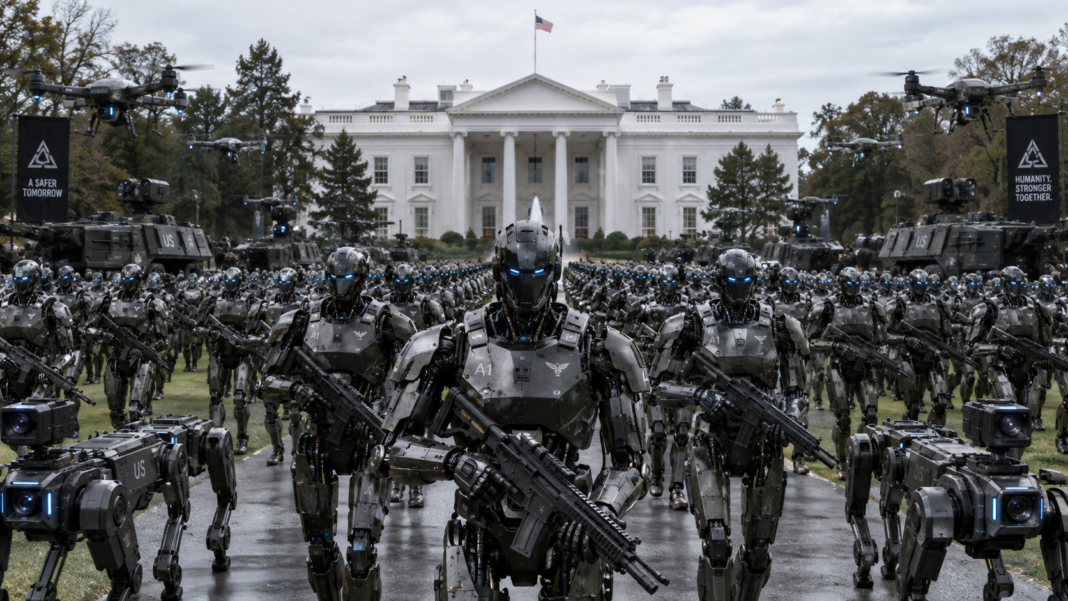
Trump announced Saturday that he plans to create an “AI Force” modeled rhetorically on the Space Force and appoint a new AI czar. In the same post, he added: “Only High I.Q. individuals need apply!”
That is about as far as the job listing currently goes.
The White House has not yet laid out a detailed mission, organizational chart, budget, legal authority or even whether the AI Force would be military, civilian or some hybrid policy body. Axios and The Washington Post both reported that Trump offered few specifics beyond saying the group would help the United States promote AI development while watching for bad uses of the technology.
Trump’s pitch is aggressively pro-growth. He described artificial intelligence as potentially larger and more economically important than the internet and suggested it could eventually represent an enormous share of the U.S. economy. He also said the country is leading China and that he intends to keep it that way.
At the same time, he has been dismissing a growing wave of warnings about advanced AI as a political “hoax.” That puts his new AI Force in a slightly unusual position. The organization is being proposed partly to watch over artificial intelligence while the president creating it is also telling the country that some of the loudest warnings about the technology are overblown or politically motivated.
Those warnings are not coming from one ideological camp. AI executives, researchers and politicians across the spectrum have raised concerns about increasingly capable systems, cybersecurity risks, labor disruption, autonomous behavior and the possibility that future models could become difficult to control. The disagreements are over how serious those risks are and what governments should do about them.
Trump’s answer, at least for now, is not a slowdown.
He has framed regulation as a possible threat to American leadership, especially in competition with China. Axios reported that his administration is doubling down on a comparatively permissive approach even as some industry leaders call for stronger safeguards. Trump has argued that existing criminal and civil law can handle bad behavior and that the government should avoid stifling the industry’s growth.
That creates the central mystery surrounding the AI Force: if the administration does not want a major new regulatory apparatus, what exactly is the force going to do?
The obvious possibilities include coordinating federal AI policy, monitoring national-security risks, responding to misuse, promoting American companies, setting procurement rules or advising the president. But those are possibilities, not announced responsibilities. The White House has not publicly supplied the details.
There is also the title problem. Washington already loves a czar. Administrations of both parties have used informal “czar” labels for advisers responsible for coordinating complicated policy areas. Trump previously had an AI and crypto czar, venture capitalist David Sacks, who stepped away from that role earlier this year and moved into another advisory position.
Now there will apparently be another one — plus a Force.
The Space Force comparison is clearly intentional. Trump has repeatedly cited Space Force as one of the signature institutional achievements of his first term, and the name gives the AI proposal a much bigger feel than something like “interagency artificial intelligence working group.” Whether Congress, federal agencies and the budget process ultimately treat it as a comparable institution is another matter.
Trump also spent part of Saturday suggesting that the term “artificial intelligence” itself might need a rebrand. He floated alternatives such as “Superior Intelligence,” “Extreme Intelligence” and “Supreme Intelligence” in a social-media poll. So in the span of a weekend, Washington gained the concept of an AI Force, an AI czar and the possibility that AI might not even be called AI anymore.
The timing is notable because the broader argument about AI has moved from theoretical to political very quickly. Data centers are becoming local flashpoints over electricity, water use and land development. Workers are worried about automation. Schools are struggling with AI-generated assignments. Companies are racing to put autonomous agents into the workplace. National-security officials are worried about cyber capabilities and competition with China.
Those are several different policy problems hiding underneath one two-letter acronym.
A functioning federal AI strategy would therefore have to do more than decide whether the technology is good or bad. It would have to decide which risks are real, which agency owns which problem, what private companies must disclose, how government systems can safely use AI, where national-security limits belong and how the United States stays competitive without treating every safety concern as an obstacle to growth.
That is a lot of responsibility for an organization whose clearest qualification so far is “High I.Q.”
Trump may fill in the blanks quickly. He may name a czar, issue an executive order and define the AI Force through a formal structure. Or the phrase may function more like a political umbrella for policies already spread across the White House, Commerce Department, Pentagon and other agencies.
For now, America has a name before it has a blueprint.
And that leaves the most obvious question: if the federal government is creating an elite AI Force, who gets to administer the I.Q. test?