



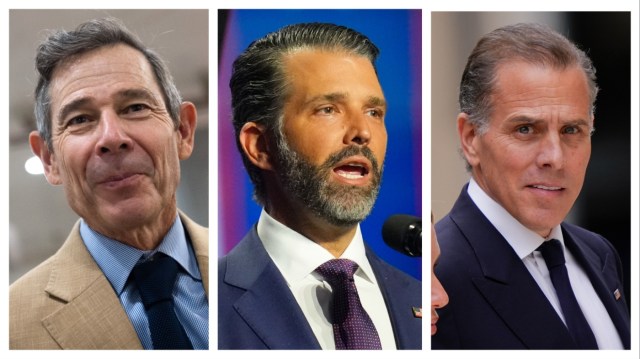
Sen. John Curtis says the same scrutiny Republicans aimed at Hunter Biden should also apply to Donald Trump Jr. — and he wants both men under subpoena.
Washington has spent years turning the phrase “president’s son” into its own investigative genre. Now one Republican senator wants to make the franchise bipartisan.
Sen. John Curtis of Utah is calling on the Senate Judiciary Committee to subpoena both Donald Trump Jr. and Hunter Biden as part of an examination of whether either man benefited financially from his father’s political power and access. Curtis made the request in a letter to Judiciary Chairman Chuck Grassley and ranking Democrat Dick Durbin.
The symmetry is the point. Republicans spent years investigating Hunter Biden’s overseas business dealings, financial relationships and proximity to then-President Joe Biden. Curtis is now arguing that Donald Trump Jr. should face comparable scrutiny rather than getting a family-name exemption simply because Republicans control the government.
The immediate trigger is reporting about Trump Jr.’s wedding celebrations in the Bahamas. ProPublica reported that Russian businessman Umar Kremlev paid for expensive post-wedding festivities, including the use of a private island. Trump Jr.’s wife, Bettina, has said Kremlev is a close friend and described the celebrations as a wedding gift.
The factual distinction is important: the reporting concerns celebrations surrounding the wedding, not evidence that Kremlev secretly financed the wedding ceremony itself. There is also no established finding that the gift bought a government favor or constituted corruption.
But it gave Curtis an opening to make a much broader argument. If Congress believes presidential relatives deserve scrutiny when foreign money, expensive gifts or unusual business access are involved, Curtis says that standard cannot magically change depending on the surname printed on the invitation.
Axios reports that Curtis wants senators to examine whether Trump Jr. or Hunter Biden received preferential treatment, access or financial benefit because of their relationships to presidents. That is a much wider question than the Bahamas parties alone.
It is also politically awkward for nearly everyone involved. Republicans spent years insisting that Hunter Biden’s financial dealings justified aggressive subpoenas, testimony and document demands. Democrats argued those investigations were often designed to damage Joe Biden politically. Now a Republican senator is effectively saying: fine — use that same microscope on Trump’s family too.
Trump Jr. is not a government employee, but he is hardly detached from politics. He is one of his father’s most visible political surrogates, regularly appears at major conservative events and maintains relationships with donors, business figures and political actors around the world. The same basic complication existed with Hunter Biden: adult children are private citizens, but being the adult child of a president can create opportunities that ordinary private citizens do not receive.
That still does not make every business deal or expensive gift improper. Rich people give each other absurdly expensive things. Political families know other powerful families. Sometimes a private island celebration is simply a private island celebration, which is a sentence most Americans will never have the opportunity to test personally.
The congressional problem is figuring out when ordinary rich-person behavior crosses into access trading. That requires evidence, not vibes. Who paid? Why? Was anything requested in return? Did the person providing the benefit have business before the government? Were government officials involved? Did policy change afterward? Those are the questions an investigation is supposed to answer before anyone starts shouting “corruption” into a cable-news camera.
Curtis’ proposal is notable because it tries to apply that test across party lines. Hunter Biden has already been the subject of extensive congressional investigation. Trump Jr. has not faced anything comparable from the Republican-controlled Congress, even as the Trump family’s business and foreign relationships have expanded during the second Trump presidency.
Whether Grassley actually issues the subpoenas is another matter. Asking for bipartisan scrutiny is easier than persuading a committee controlled by your own party to drag the president’s son into a hearing room.
Still, Curtis has created a wonderfully uncomfortable benchmark: if presidential family money is a legitimate congressional concern, it has to remain legitimate after the party in the White House changes. Otherwise it is not really an ethics standard. It is just a jersey color.
Should Congress create one permanent set of disclosure and subpoena rules for presidential family members instead of reinventing the standard every time the White House changes parties?