



Texas Republican Daniel Wong’s campaign shared an AI-generated video of Black residents praising him for jobs, food and help paying bills. After viewers spotted the fake imagery, the video disappeared and Wong’s campaign said a Democrat created it.
Political campaigns have spent years worrying about deepfakes attacking their candidates. In Texas, Republican Daniel Wong’s campaign has found an entirely different problem: an AI-generated video praising him appeared on his own campaign page.
The video showed Black residents talking about how Wong had supposedly helped them find jobs, buy food and keep the lights on. It was shared by Wong’s campaign Facebook account and by the Fort Bend County Republican Party as evidence of community support.
Then viewers started looking at it for longer than several seconds. Backgrounds warped, clothing looked wrong, voices sounded suspiciously similar and the entire production began developing the unmistakable texture of political content made by a computer that has never actually met a human wrist.
The video was removed after criticism spread. Wong’s campaign then issued a statement saying it had not produced the clip and claimed that a Democrat created it before it was shared with the campaign.
The statement did not identify that Democrat. It also did not explain why the campaign had promoted the video before apparently determining who made it, which is usually a useful question to answer before posting testimonials from synthetic supporters.
Houston Chronicle reporting adds an important wrinkle: some of the people represented in the video appear to correspond to real supporters, including a woman who has worked as a Wong poll worker. The imagery and statements, however, showed clear signs of AI manipulation rather than straightforward filmed testimonials.
That makes the scandal weirder than a simple fake-person ad. The problem is not necessarily that every character was invented from scratch; it is that a political campaign promoted artificial footage that presented supportive statements as though voters were naturally delivering them on camera.
Wong’s campaign responded by attacking Democratic opponent Dexter McCoy and accusing Democrats of playing the “race card.” McCoy answered with his own video showing himself interacting with actual residents, with text effectively asking viewers whether they could tell the difference.
This is the point where local politics becomes a Black Mirror episode with yard signs. One campaign is defending an AI endorsement video, the other is advertising that its humans are verifiably human, and voters are expected to somehow return to property taxes afterward.
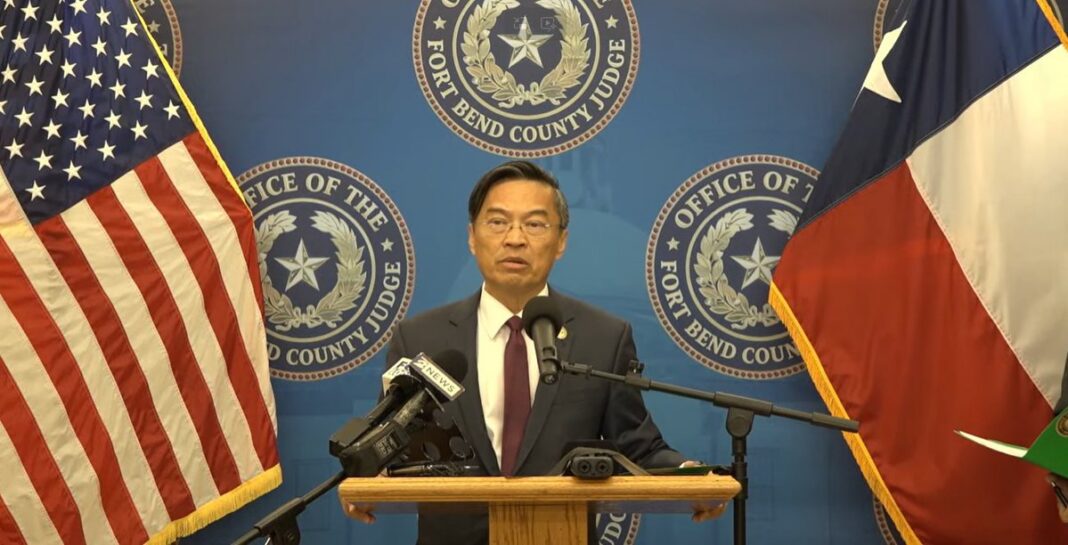
Wong is the interim Fort Bend County judge and is seeking a full term in the November election. He was appointed after former county judge K.P. George was removed following a money-laundering conviction, so the office was already operating with a slightly higher-than-average drama budget.
There is no evidence in the available reporting that Wong personally created the AI content. His campaign’s position is that somebody else made it and that a Democrat was responsible, but it has not publicly provided details establishing who that person was.
The central question is therefore simpler than the partisan finger-pointing. If a campaign cannot authenticate glowing testimonials before publishing them, voters have no obvious reason to trust the testimonials after an explanation appears.
AI was supposed to make political advertising cheaper and faster. It has apparently also made “are those supporters real?” a normal question that campaign reporters now have to ask.
For Wong, the video is gone but the screenshot era is undefeated. The artificial supporters may have disappeared from Facebook, but the very real controversy is now doing their campaigning for them.