



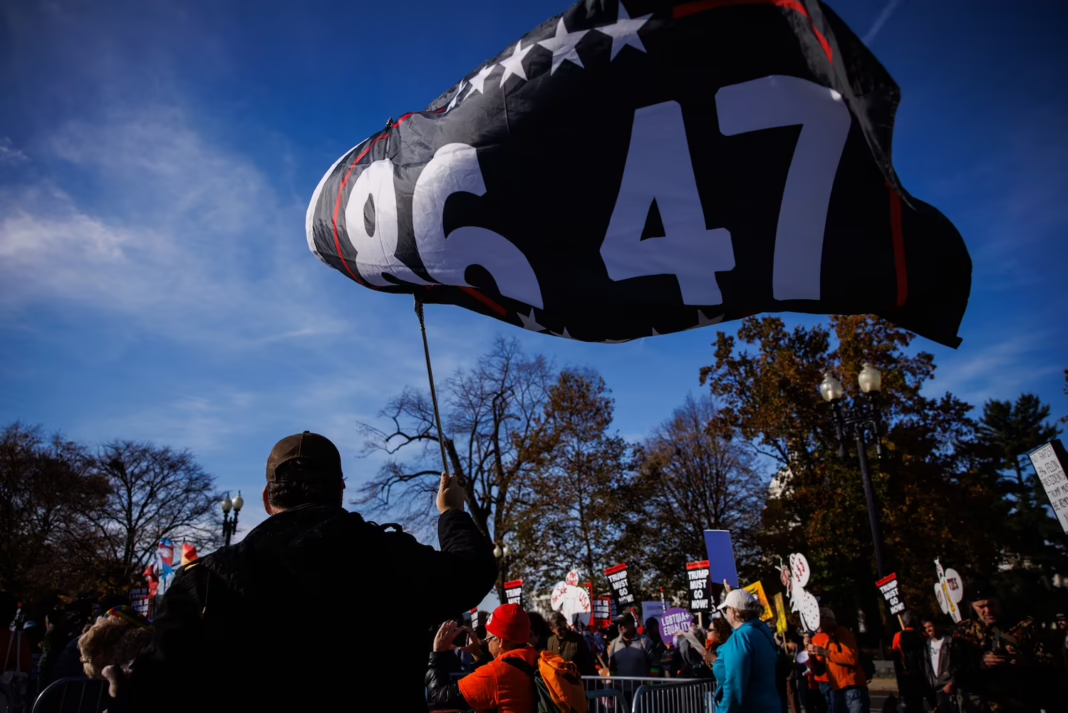
A federal judge in Washington has ruled that an activist group may fly a flag reading “86 47” near the Capitol, rejecting arguments that the message constitutes a threat against the 47th president. The phrase, borrowed from restaurant slang meaning to remove something from the menu, has become shorthand in certain circles for opposition to Donald Trump’s second term. The government argued the flag created a security risk. The judge disagreed.
The case arrived in court after the National Park Service denied the group’s permit application, citing concerns that the displayed message could be interpreted as incitement. The ruling centered on whether the phrase “86 47” constituted protected political speech or crossed into the territory of true threat. The judge found it was the former, and that denying the permit would amount to viewpoint discrimination.
The decision is narrow but the implications are not. It establishes that coded political slogans, even ones that express a desire to see a sitting president removed from office, enjoy First Amendment protection so long as they do not meet the legal standard for incitement or direct threat. It also puts the administration in the position of either appealing the ruling or allowing a highly visible expression of opposition to fly within sight of federal buildings.
The line between protest and threat
What makes this ruling noteworthy is not the flag itself, but the framework the government used to challenge it. The Park Service did not argue that “86 47” was offensive or distasteful. It argued that it was dangerous. That framing required the court to evaluate whether a reasonable person would interpret the slogan as a call to violence rather than a call to vote, organize, or simply express disdain.
The judge concluded that the phrase, while confrontational, did not meet that threshold. Restaurant workers across the country use “86” to mean removal from service, not harm. Political activists have adopted it to mean electoral defeat or impeachment. The government’s position was that context doesn’t matter when the subject is the president. The court’s position was that context is precisely what matters.
If “86 47” qualifies as protected speech, so does a wide range of slogans, chants, and symbolic gestures that express opposition in blunt or combative terms. If it doesn’t, then federal authorities gain significant leeway to suppress political expression based on their own interpretation of intent. That’s the tension the ruling leaves unresolved.
What comes next
The administration has not yet signaled whether it will appeal. If it does, the case moves to the D.C. Circuit, where the question will be whether the district court applied the correct legal standard. If it doesn’t, the flag flies, and the precedent stands, at least within this jurisdiction.
Either outcome creates friction. An appeal keeps the case in the news cycle and frames the administration as opposing political dissent in the nation’s capital. Letting it go creates a visible, ongoing protest in one of the most symbolically significant locations in the country. Neither option is clean.
The group that sought the permit has already indicated it plans to display the flag as soon as logistically possible. Other groups are watching. If this ruling holds, expect similar permit applications, similar slogans, and similar legal challenges testing where the line actually is.
The unresolved question
The broader issue is not whether one slogan gets flown. It’s whether the government can preemptively block political speech on the grounds that someone, somewhere, might take it the wrong way. Courts have long held that the answer is no, unless the speech is likely to incite imminent lawless action. But “likely” is a judgment call, and “imminent” is increasingly hard to define in an era when a slogan can travel from a flagpole to a million screens in minutes.
The Park Service made a calculation that “86 47” was too risky to allow. A federal judge made a different calculation. The flag will likely fly. What remains to be seen is whether this becomes the standard, or the beginning of a much longer argument about what opposition is allowed to look like when it’s this visible and this close to power.
So here’s the question: if a judge ruled that “86 47” is protected speech today, what happens when the next slogan is less coded, the next protest is louder, and the next administration decides the risk is real?
Sources: