




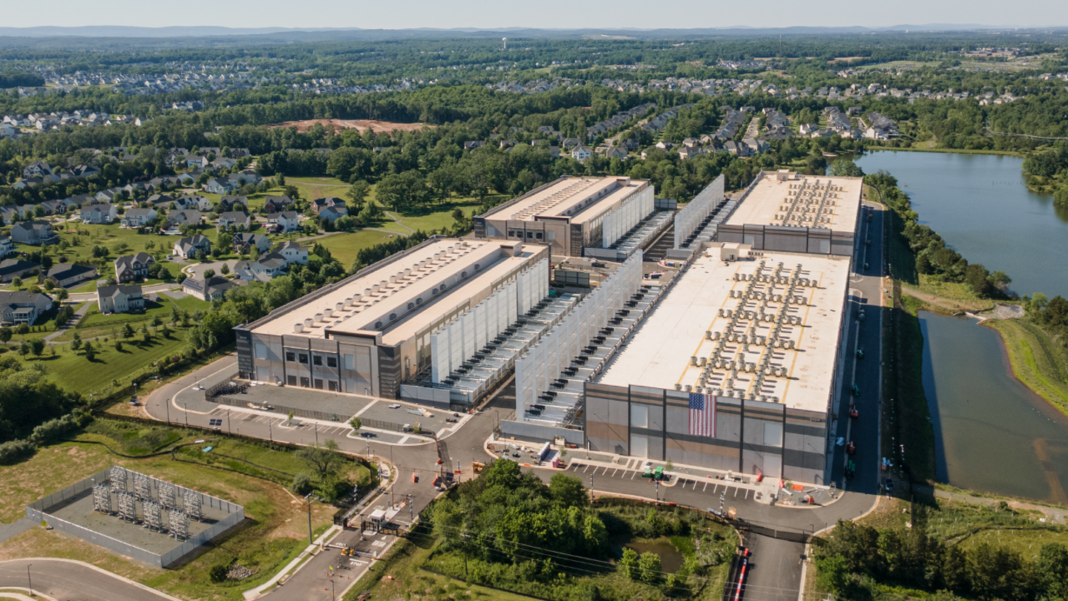
Republicans spent years selling artificial intelligence as part of the next American industrial boom. Then voters saw the data centers. Fox News reports that Republican candidates in several states are now putting distance between themselves and Donald Trump’s enthusiastic support for rapid construction as local opposition grows over power use, water, land and utility costs. Trump’s message this week was simple: let data reign. Candidates facing actual homeowners have discovered a competing philosophy. Perhaps data could reign somewhere slightly farther from the subdivision.
A Fox News poll cited in the report found 70 percent of voters wanted to slow new data-center construction in their communities. Republican Senate candidate Mike Rogers in Michigan has called for a temporary pause. Other candidates have emphasized local control or tougher conditions. Breitbart reported that even Democratic Sen. John Fetterman sided with Trump on the broad need for data centers while criticizing Pennsylvania Gov. Josh Shapiro for responding to polling. When Fetterman is defending the MAGA infrastructure agenda more directly than some Republicans on the ballot, the coalition has encountered a zoning meeting.
The underlying policy problem is real. AI systems require enormous computing capacity. Data centers create construction work, tax revenue and demand for electricity infrastructure. They can also consume large amounts of power and water, reshape local grids and arrive with fewer permanent jobs than the scale of the buildings suggests. Communities do not experience ‘the AI race’ as an abstract contest with China. They experience a utility bill, a transmission line and a planning board packet thick enough to injure somebody.
Trump’s instinct is national. Build fast, build big, beat competitors and treat resistance as fear of prosperity. Local Republican candidates have a different incentive. They need people who already live beside the proposed site to vote for them in November. That is the moment when a party famous for property rights and local control discovers those slogans were not intended only for arguments about Washington. A voter who opposes a 500-acre server complex is still a voter even if the White House has declared the complex patriotic.
The target is the contradiction. MAGA politics celebrates deregulation until deregulation produces something unpopular in a Republican county. Then suddenly permitting deserves a second look and local voices become sacred. This is not unique to Republicans. Every movement loves infrastructure in theory and discovers environmental review when the bulldozer reaches its own street. But the right has spent years mocking progressive resistance to energy and construction projects as elite obstruction. It is harder to use that line when the obstruction is wearing a Trump hat.
There is also a consumer problem. The AI boom is being financed partly through expectations that electricity supply can expand quickly enough to support it. If utilities must build new generation and transmission, customers will watch closely to see who pays. Trump says data centers will bring jobs and lower taxes. Local opponents worry they may bring higher rates or strain existing resources. Both claims can be tested. The politically dangerous period is the years before the promised benefits arrive, when the concrete has arrived but the tax relief has not.
Republican candidates are therefore performing a delicate dance. They want the national party’s pro-growth message, the tech industry’s investment and the president’s blessing. They also want to be able to tell a homeowner that the giant humming building across the road was not their idea. This is the governing equivalent of supporting the airport while opposing every flight path. Eventually the map runs out of empty space. Republican candidates have noticed because voters do not experience infrastructure as an abstract national strategy. They experience it as a power bill, a zoning hearing and a construction site. That makes local consent a political input, not an obstacle that can be tweeted away.
Trump has made loyalty central to Republican politics, so even modest disagreement attracts attention. That makes data centers a useful test. This is not a dispute over personality or old primary grudges. It is a concrete local issue where Republican politicians can see polling and construction proposals in their own states. If they break with Trump here, it suggests the movement’s discipline weakens when national ambition collides with municipal consequences. The local backlash also scrambles the usual culture-war script. Data centers are not a symbolic fight over a classroom poster or a corporate training slide. They require land, transmission lines, electricity and sometimes substantial water. Those costs arrive in counties represented by Republicans as readily as Democrats. A voter can love artificial intelligence, Trump and economic growth while still objecting to a giant industrial project beside the subdivision. Ideological loyalty becomes less reliable when the transformer is visible from the kitchen window.
The technology will not wait for the politics to become tidy. Companies are already planning enormous investments, and the United States does face a genuine competitive challenge. Slowing every project could carry economic costs. Approving every project could create a backlash that makes future construction harder. The adults in the room must do the boring work of grid planning, siting, water policy and cost allocation. ‘Let Data Reign’ does not specify a transformer budget.
Republicans may ultimately find a durable compromise between rapid AI development and local consent. First they have to admit the trade-off exists. The voters appear to have noticed it already.
If Republicans believe the AI buildout is a national necessity, what are they prepared to require from the industry so their own voters will actually accept it locally?
Sources
Fox News: MAGA begins to crack as 2026 GOP roster backs away from Trump’s tech vision
Breitbart: Fetterman: Trump’s Right on Data Centers, Gov. Shapiro ‘Scared by the Polls’