



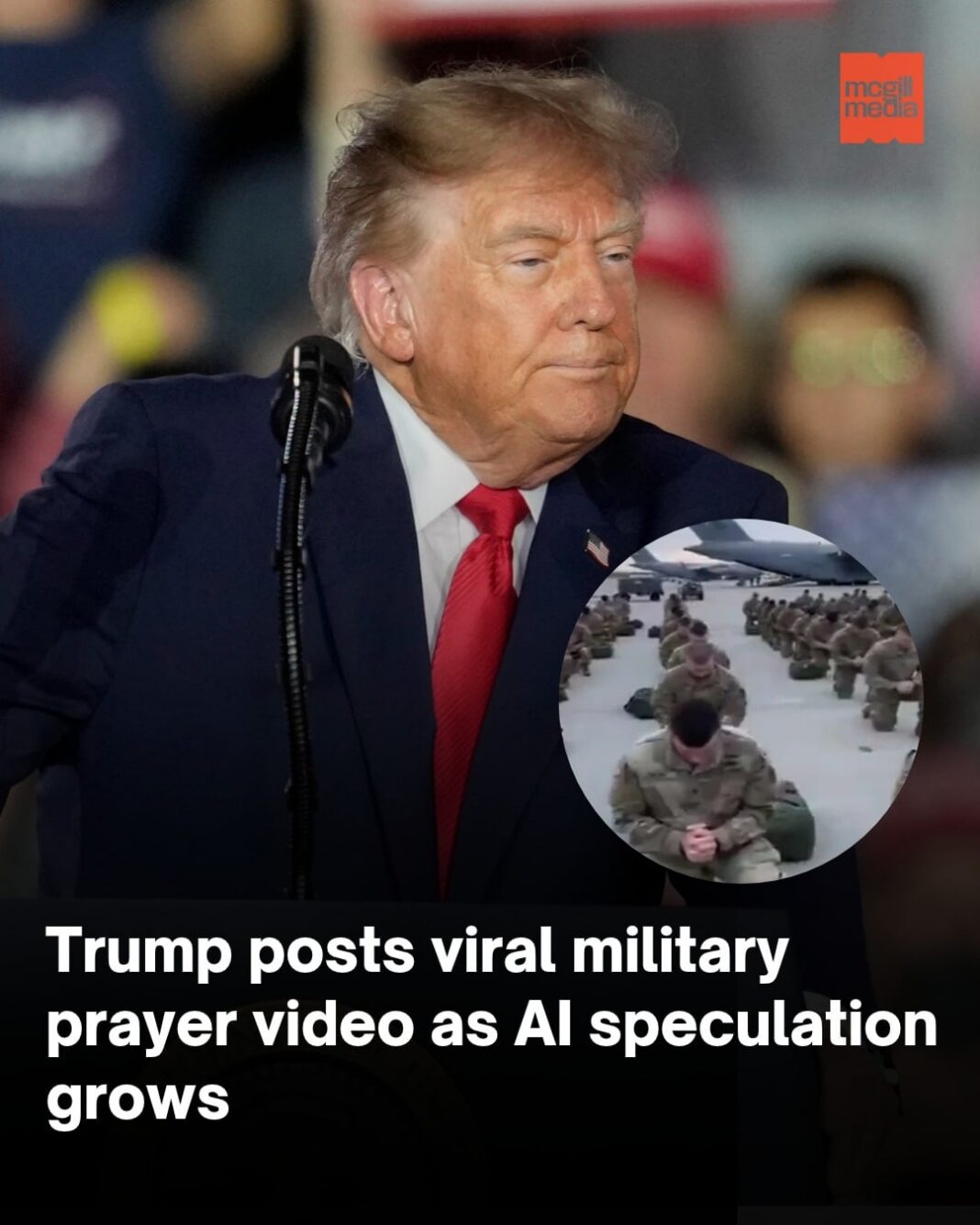
A synthetic video of praying troops appeared on Trump’s feed after 60 Minutes documented extensive attacks on American positions in the Middle East.
An Artificial Image Meets a Real War
President Donald Trump shared an artificial-intelligence video of American troops praying beside military aircraft on Sunday night. Less than an hour earlier, CBS’s 60 Minutes had aired a sobering investigation into the damage suffered by U.S. military positions during the war with Iran. The contrast was difficult to miss: a polished, emotionally uplifting synthetic scene on one screen and evidence of damaged facilities, injured service members and grieving families on another. The internet did not need a film critic to explain the difference between the two.
The video depicted rows of Air Force personnel praying on a tarmac near two C-17 transport aircraft. Reporting said the clip had previously appeared online with a label identifying it as computer-generated. Trump also shared a message asking for prayers for troops. Nothing about the clip establishes that the depicted gathering actually occurred. AI images can express a sentiment, but they are not documentary evidence, and that distinction becomes especially important during an ongoing war.
The CBS investigation reported that Iranian attacks had reached at least 31 American military and diplomatic sites across the Middle East. Using satellite imagery, video and reporting, the network described damage that had not always been clearly disclosed to the public. Those findings are the network’s documented analysis, not an admission that every reported strike was acknowledged in the same terms by the Pentagon.
What 60 Minutes Found
CBS reported that the war had cost the United States $47 billion according to the latest Pentagon figure cited in its broadcast. It also reported 23 American service members killed and more than 800 wounded. Those numbers make the argument over online imagery feel painfully small. Behind each statistic is a person whose family cannot be reassured by a stirring video of aircraft and digitally rendered uniforms.
One focus of the investigation was a March 1 drone attack on an Army command post at Port Shuaiba in Kuwait that killed six U.S. service members. Major Stephen Ramsbottom, a survivor, alleged that the facility lacked adequate protection against aerial threats and that warnings had not produced sufficient defenses. Those are serious allegations about military preparation, not findings that every official accused of failing to act has been proved negligent.
The Pentagon has defended aspects of the site’s protection, while the accounts of survivors and families raise difficult questions about what commanders knew and what options were available. CBS’s reporting included families seeking answers about the deaths. In a political environment where war is often reduced to maps, slogans and declarations of victory, those families represent the part of the story that cannot be compressed into a triumphant social-media post.
The Damage Beyond a Single Base
An Associated Press examination of satellite imagery and regional accounts also documented extensive damage from Iranian and Iran-backed strikes across American facilities. That separate analysis described more than a hundred strikes affecting dozens of sites through August. The AP and CBS counts cover different methodologies and periods, so they should not be treated as interchangeable totals. Together, however, they reinforce the central point that the conflict’s impact on U.S. infrastructure has been broad and costly.
Air defenses, radar installations, hangars and other structures have been among the targets described in reporting. Drones and missiles can force a military to spend heavily on protection while attackers exploit vulnerabilities in fixed facilities. The tactical details matter because they challenge the idea that technological superiority automatically makes every American position safe. A powerful military can still have exposed buildings and imperfect warning systems.
Trump has repeatedly projected confidence about the war’s outcome. His critics say the emerging damage assessments complicate that message, while supporters argue that wartime losses do not by themselves determine whether strategic objectives are being achieved. Both claims require evidence about objectives, costs and results. The immediate reporting does not settle the entire war’s strategic outcome. It does establish that American personnel and installations have paid a substantial price.
Why the AI Clip Became the Story
Sharing a prayer-themed video is not inherently inappropriate. Many Americans sincerely want to express solidarity with troops and their families. The controversy comes from presenting synthetic imagery in a context where real service members have suffered and the public is trying to understand what happened. A viewer encountering the clip without its provenance could easily assume it showed an actual military gathering. That is a communications problem even if the underlying sentiment is genuine.
There is no verified evidence that Trump personally watched the CBS segment before posting the video, or that he intended the clip as a direct rebuttal to the investigation. The close timing is notable, but timing alone cannot establish motive. That distinction protects the story from becoming the very thing it is criticizing: an emotionally compelling narrative that races ahead of what can be verified.
The questions raised by CBS deserve more attention than the aesthetics of the president’s post. Why were certain sites vulnerable? Which warnings were raised? What did commanders and civilian leaders know? How are the wounded being supported, and what have families been told? Those are questions a real investigation can answer. Artificial soldiers can bow their heads on command, but they cannot testify, rebuild a radar system or explain a decision made before a deadly attack.
The families interviewed by CBS are seeking answers about decisions made before the attack, not merely symbolic statements after it.