



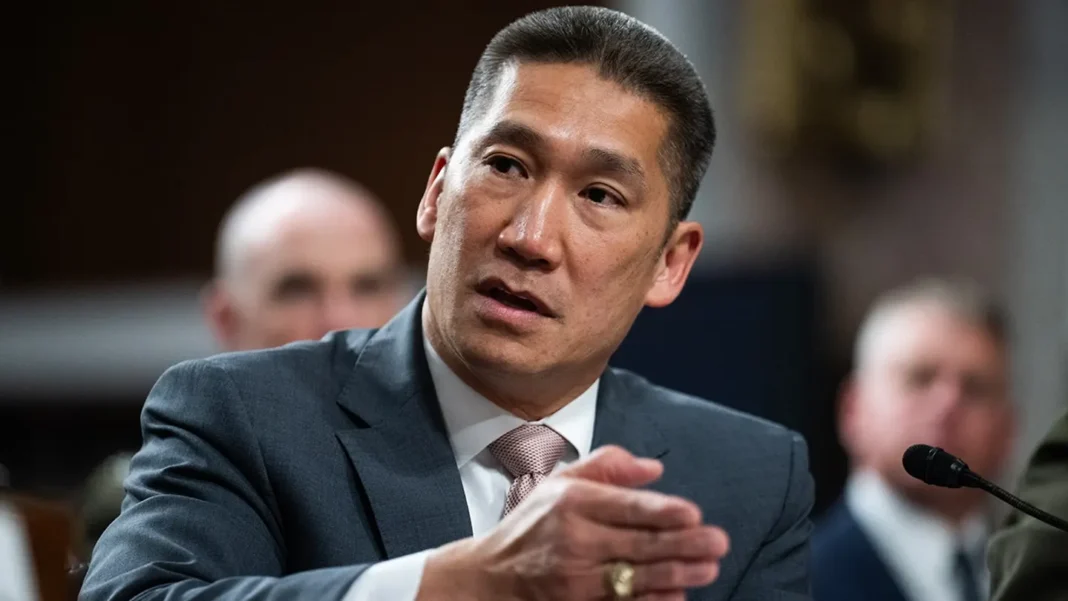
Donald Trump has nominated Hung Cao to become permanent secretary of the Navy, promoting the acting secretary after four months in the job and calling him a “true WARRIOR.” Cao is a retired Navy captain with 25 years of service, including special operations work, so the résumé is not the joke. The joke is the workplace. Cao is being asked to provide permanent leadership to a department inside a Pentagon where senior leaders have recently developed the shelf life of supermarket sushi. The Navy job opened after John Phelan left unexpectedly in April. Army Secretary Dan Driscoll has now resigned amid reported clashes with Pete Hegseth. Stability, apparently, is whatever happens between resignation announcements.
Fox News reported Trump’s praise for Cao and noted his military background. The Guardian put the nomination in the broader context of an overstretched Navy and upheaval in senior defense leadership. Those facts matter because this is not a ceremonial personnel shuffle. The United States is fighting Iran, sailors have been deployed for extraordinary stretches, and lawmakers have raised questions about conditions aboard the USS Abraham Lincoln. In that environment, the administration’s preferred management language remains less about boring institutional competence and more about finding another warrior to enter the building while somebody else carries a box out.
Cao may prove perfectly capable. In fact, his military experience makes him an unusually conventional choice by recent standards. But Trump’s announcement still sounded like casting for a summer blockbuster. The president urged the Senate to confirm the “Warfighter, ASAP,” because apparently the constitutional advice-and-consent process now comes with action-movie copy. A Navy overseeing nuclear submarines, carrier groups, shipbuilding, personnel and a live regional conflict does not need a mascot. It needs leadership that can survive contact with the leadership above it.
That is where the Too Red target comes into focus. The administration sells constant churn as evidence of toughness. Officials leave after disagreements, replacements are praised as loyal fighters, and every new appointment is presented as proof that the machine is becoming more lethal. In most organizations, repeatedly replacing senior executives during a crisis would trigger questions about management. In Trumpworld, it triggers another Truth Social post about how the incoming person is the greatest warrior anyone has ever seen. Human resources has been replaced by entrance music.
The timing is especially rich because Cao inherits a Navy under real strain. The Guardian reported concerns over the Lincoln’s lengthy deployment, including reports of deteriorating mental health and shortages of food and hygiene products. Democratic senators have demanded accountability. Whatever one thinks of those lawmakers, sailors do not become more rested because their civilian boss has been described in capital letters. Readiness is not a branding exercise. You cannot put “FIERCEST” on a press release and expect the laundry machines, supply chains and deployment calendars to salute.
Cao also steps into a Pentagon where Hegseth’s relationships with senior officials have repeatedly become stories of their own. Driscoll’s resignation followed reported tension over Army leadership and transformation. Phelan’s departure from the Navy post came without a public explanation. The administration can argue that presidents are entitled to officials who execute their agenda. Of course they are. But when departures become a governing rhythm, the question stops being whether each person was sufficiently loyal and becomes whether the management structure itself is producing the instability.
Conservatives used to make a virtue of institutional seriousness in national security. Chain of command. Readiness. Discipline. Clear missions. Now the political presentation often treats the Pentagon like a reality show where the audience is told the latest contestant is tougher than the last one and should be confirmed immediately. The irony is that Cao’s biography represents the old standard better than the rhetoric surrounding him. He spent decades doing the unglamorous work of military service. His nomination is being packaged by people who cannot resist turning even administrative continuity into a loyalty spectacle.
None of this is an argument against Cao. It is an argument against pretending personnel turbulence is strength. A competent Navy secretary could help address shipbuilding delays, sailor welfare, procurement and the enormous demands of the Iran conflict. That work requires continuity, candor and the ability to tell political leaders things they may not want to hear. If the administration truly wants a warrior, it should give Cao enough institutional room to behave like a secretary rather than another character in the president’s permanent audition for loyalty.
The conservative case for competent administration should be especially obvious during wartime. The Navy cannot pause deployments while Washington sorts out another personality dispute. Shipyards do not accelerate because an acting secretary receives a permanent title. Recruiting problems, maintenance backlogs and munitions demand do not respond to political adjectives. A serious America First defense policy would judge leadership by whether ships are ready, sailors are supplied and commands can plan beyond the next personnel headline. That is less exciting than calling everyone a warrior, but militaries have traditionally been fond of boring things such as logistics. Trump’s talent is turning personnel announcements into rallies. The harder task is creating a chain of command where talented people can disagree, solve problems and remain employed. Cao’s confirmation may be a chance to do that. If every dispute above him still becomes a loyalty test, the title on his office door will be the most permanent thing about the arrangement.
Can the Trump Pentagon keep a strong leader long enough to fix anything before the next loyalty fight starts?
Sources
Fox News: Trump taps ‘true warrior’ Hung Cao as Navy secretary after 4 months as acting leader
The Guardian: Trump nominates loyalist Hung Cao to be permanent navy secretary
Washington Examiner: Army Secretary Dan Driscoll resigns after monthslong rift with Hegseth