



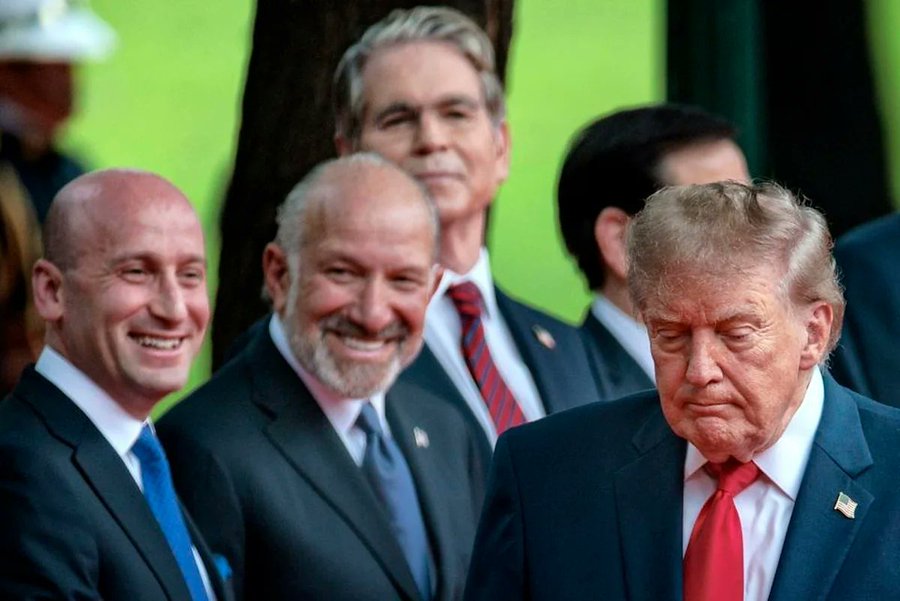
Commerce Secretary Howard Lutnick reportedly came close to losing his job over his connection to Jeffrey Epstein. Then came a $25 million contribution to Donald Trump's planned presidential library, and the president stopped talking about replacing him, according to a new Wall Street Journal account. It is the kind of Washington timeline that makes even veteran scandal watchers check whether they have added an extra zero.
The Journal's November 22 profile describes a commerce secretary who has outlasted critics, rivals and repeated questions about his judgment. Among the most striking details: Trump was reportedly upset after Lutnick acknowledged having visited Epstein's private island, despite earlier descriptions of a much more limited relationship with the disgraced financier. People familiar with the president's thinking told the paper that his anger subsided after the library contribution.
That sequence deserves attention, but it also deserves precise language. Reporting that the donation preceded a change in Trump's attitude does not establish a bargain, a criminal transaction or a proven exchange of money for employment. Neither the Journal account nor subsequent coverage established that the president explicitly demanded the donation as a condition of keeping Lutnick. The reported timing is remarkable on its own.
The broader picture is almost as colorful. Lutnick has been feuding with influential figures inside the administration, defending controversial chip-export decisions and managing questions about his former Wall Street firm's interests. Yet the commerce secretary remains in place. Washington has seen survivors before; Lutnick is reportedly conducting a master class in staying power.
The Epstein Connection Comes Back to Haunt Him
Lutnick and Trump have known each other for roughly two decades. The commerce secretary arrived in government with a fortune and a long career at Cantor Fitzgerald, the financial firm he previously led. His public association with Epstein became a more serious problem as new records and photographs revived scrutiny of who spent time with the convicted sex offender.
Lutnick had previously described recoiling from Epstein after an uncomfortable encounter in 2005. But records and his later testimony complicated that account. In February, he acknowledged to a Senate committee that he had traveled to Epstein's island with his wife, children and their nannies. Publicly reported correspondence also showed contact extending beyond the earlier break he had suggested.
A visit to Epstein's property is not by itself proof of involvement in his crimes. Lutnick has not been shown to have participated in Epstein's abuse. The relevant political issue is the discrepancy between the impression left by earlier public statements and the fuller account that emerged later. For a cabinet official, credibility can be a problem even without an accusation of criminal wrongdoing.
According to the Journal's reporting, that episode nearly exhausted Trump's patience. The president considered dismissing the longtime friend. Then Lutnick made the large presidential-library contribution, a figure the Journal said had previously appeared in a book about the administration. A $25 million donation would be an attention-grabbing act of support under almost any political circumstances; surrounded by an employment scare, it became national news.
A Presidential Library and a $25 Million Question
Presidential libraries are ordinarily associated with archives, history and a carefully curated version of a president's legacy. They can also be expensive undertakings, supported by private donors. But when a sitting cabinet secretary contributes a reported $25 million while facing questions about his job security, the transaction invites exactly the sort of scrutiny Washington's ethics lawyers might prefer to encounter before lunch.
Those questions are not settled accusations. The available reporting does not identify a written agreement, an instruction from Trump to buy his way back into favor or evidence that the library fund was used unlawfully. The safest conclusion is narrower: journalists report an extraordinary contribution, an earlier firing discussion and a subsequent change in tone. The public can judge the optics without turning an inference into a verdict.
For his part, Trump publicly praised Lutnick at Friday's White House news conference, calling him a good businessman and saying he was doing a very good job. A White House official told the Journal the president maintained confidence in his commerce secretary. That defense matters because it sits alongside, rather than erases, the paper's account of earlier private dissatisfaction.
The Nvidia Fight and the Cabinet Survival Game
Lutnick's problems do not begin and end with Epstein. He has faced criticism over restrictions on advanced semiconductor exports, a subject that moved into the spotlight during the Nvidia controversy. Officials have argued over how aggressively to restrict technology transfers to China and how to assess the national-security risks of sales involving sophisticated chips.
Treasury Secretary Scott Bessent has publicly blamed Commerce for slow progress on certain controls, according to the Journal. At one event during Trump's Asia trip, the two reportedly appeared to avoid engaging each other. It is a distinctly awkward image: officials charged with managing enormously consequential economic policy behaving like relatives assigned adjacent chairs at a wedding after a family dispute.
The Journal also reported scrutiny of Cantor Fitzgerald, which Lutnick handed over to his adult sons after entering government. The firm's connections with businesses in the artificial-intelligence economy have sharpened questions about potential conflicts. Cantor has denied conflicts of interest, and suspicions from other officials should not be confused with demonstrated personal gain.
Some Republicans have expressed frustration. Senator Thom Tillis told the Journal that the department needed better leadership, while Senator John Kennedy voiced concerns about whether the agency mishandled warning signs around technology controls. In other words, the pressure is not simply a partisan attack from Democrats. Lutnick has critics inside the broader political team that installed him.
Still Standing After Everyone Else Leaves the Room
One reason Lutnick appears durable is his access to Trump. The Journal described private, sometimes late meetings between the two men after other White House staff had left, allowing the commerce secretary to make his case directly. Such access can be an enormous advantage when other officials are trying to influence a president who puts considerable weight on personal relationships.
The departure of former chief of staff Susie Wiles and the elevation of Stephen Miller also reportedly changed the internal climate. Wiles had tried to supervise Lutnick's communications more closely. He has a friendlier relationship with Miller, and the Journal reported that he told associates he was not going anywhere after the transition. His confidence may have been well placed, at least for now.
The result is a Washington survival story with several distinct parts: an Epstein-related political scare, a colossal library contribution, arguments over chip exports and continued presidential protection. The unanswered questions are real. So are the boundaries of what has been proved. A factually careful article can acknowledge both without sanding off the extraordinary nature of the tale.
For now, Lutnick still has his cabinet job, Trump has publicly defended him, and a reported $25 million library donation sits in the middle of the story like the world's most expensive conversation starter. In most workplaces, an awkward performance review might end with an improvement plan. In this one, the number being discussed has eight digits.