



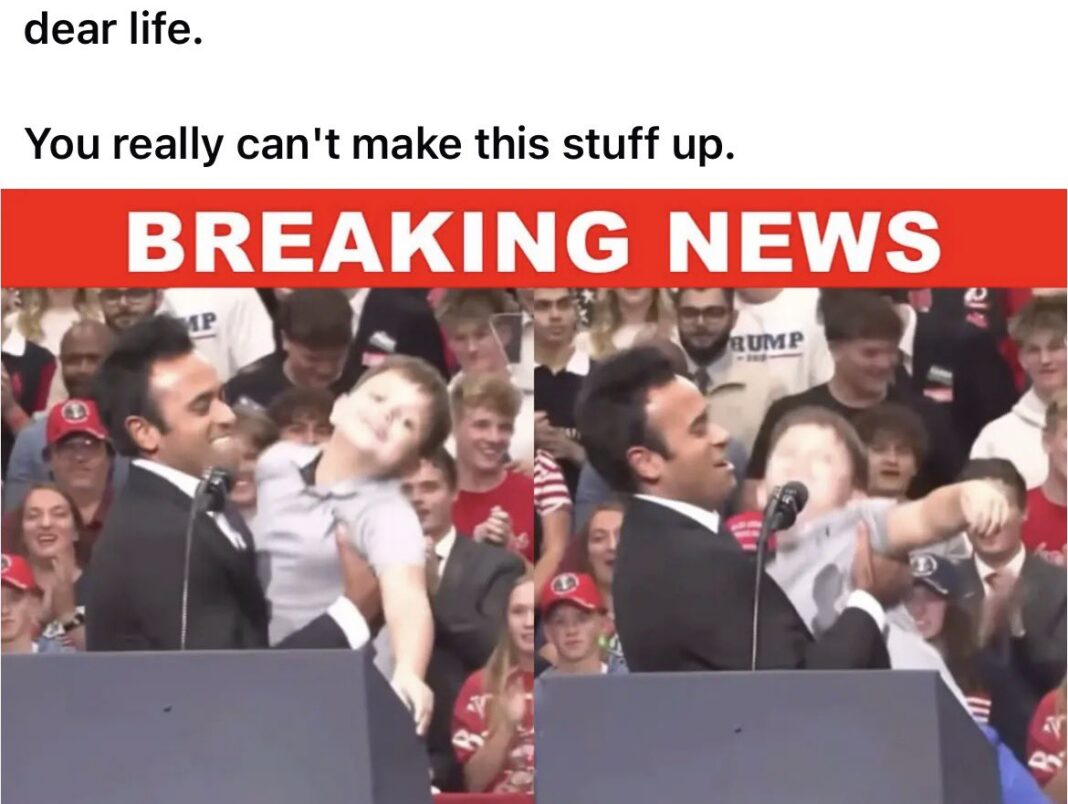
Ramaswamy invited a young Trump supporter onto the stage at an Ohio rally, tried to hoist him for a photo and badly misjudged the maneuver. The child was fine. The clip was merciless.
Political campaigns spend enormous amounts of money trying to manufacture the perfect wholesome image: candidate, child, flag, smile, applause. Vivek Ramaswamy managed to assemble every ingredient at a Trump rally in Ohio and still somehow ended up with a video that looked like the first five seconds of an insurance claim.
Ramaswamy spotted a 10-year-old boy in the crowd holding a pro-Trump sign and invited him onto the stage. The boy had mentioned that his father was deployed, giving Ramaswamy the kind of made-for-campaign moment consultants normally dream about. Then Ramaswamy decided the photo needed one extra element: he tried to pick the child up.
The lift did not go smoothly. Video from the event shows Ramaswamy badly misjudging the boy’s weight and balance, struggling with the maneuver and appearing to nearly drop him before recovering. The boy was not reported injured, but the clip immediately began circulating online because there are few things the internet enjoys more than a politician discovering gravity in real time.
Ramaswamy is running for governor of Ohio and appeared at the Vandalia event as part of Trump’s midterm campaign swing through the state. The rally was intended to help Republican candidates and energize conservative voters. Ramaswamy’s brief wrestling match with a fifth-grader was not listed in the advance program.
The moment became instant social-media material because it was visually simple. No policy explanation was required. No context thread was necessary. A politician tried to lift a kid. The politician nearly lost control of the kid. Everyone watching understood the problem within approximately half a second.
That simplicity is what makes minor campaign mistakes so durable. A candidate can deliver a 45-minute speech on taxes and education, but if he spends three seconds nearly dropping a child, guess which part reaches TikTok before the motorcade gets to the interstate.
The Daily Beast framed the incident as another awkward campaign-media moment for Ramaswamy, who has already been mocked online for heavily produced social videos. In September, one batting-cage clip drew attention for its staged feel while he tried to explain his gubernatorial agenda between swings.
None of this says anything meaningful about whether Ramaswamy would be an effective governor. It is not a policy scandal, ethics complaint or criminal allegation. It is simply one of those perfectly visual campaign mishaps that becomes much bigger than its actual significance because politics is now partly conducted through memes.
Ramaswamy also did what politicians have done since the invention of babies at county fairs: tried to create a warm personal connection with a child in the crowd. The mistake was assuming the traditional handshake needed to become an overhead strength test.
Campaign professionals usually obsess over staging because the visual matters more than anyone wants to admit. Where does the candidate stand? Who is behind him? Are the signs readable? Is the lighting good? Does anyone in the background have a shirt that will become tomorrow’s headline? Add “confirm the child is liftable” to the checklist.
The boy appeared unfazed, which is probably the best possible ending. Children have a remarkable ability to recover from adult awkwardness, especially when the adults are surrounded by cameras and pretending everything went exactly as planned.
Ramaswamy kept moving through the event, and the rally continued. There was no medical emergency and no suggestion that he intentionally put the child in danger. The entire episode belongs in the category of political embarrassment rather than political misconduct.
That distinction is worth maintaining because viral clips encourage everyone to overstate everything. Ramaswamy did not “attack” a child, and the child was not seriously dropped. He attempted a photo-op lift, misjudged it and produced a clip that was much funnier than the one his campaign presumably imagined.
The political damage, if there is any, comes from repetition. Candidates can survive one awkward video easily. A series of awkward videos starts becoming a character narrative, especially when opponents can package them as evidence that the candidate is overly performative or disconnected from ordinary interactions.
For now, this one is mostly a reminder that campaigns cannot control every moment. Sometimes the kid is heavier than he looks, the cameras are already rolling and the internet gets a new favorite GIF before anyone can call for a retake.
The question is whether voters actually care about moments like this — or whether campaigns are simply terrified of them because political professionals spend far more time online than normal people do.