




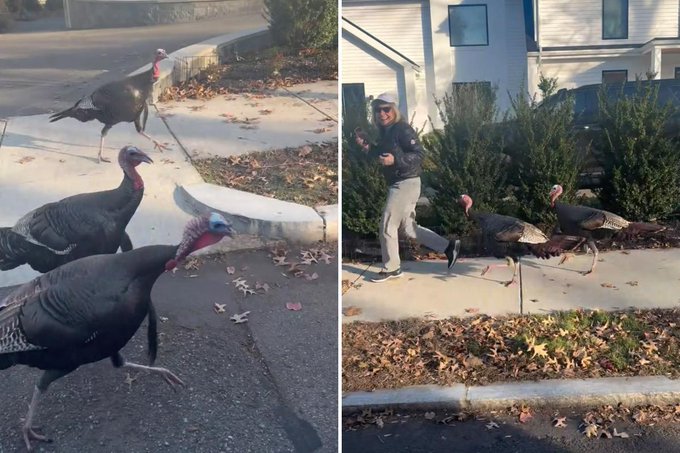
Thanksgiving is still two days away, but a group of wild turkeys in Massachusetts has already managed to turn the traditional holiday relationship between humans and poultry upside down. A woman out walking in Newton on Saturday found herself pursued by a determined group of birds, and the encounter ended with strangers offering her an emergency ride. Thankfully, she escaped without injury.
The footage, recorded by Taryn Laprade, is an extraordinary advertisement for staying indoors until the leftovers are gone. Instead of a leisurely walk through a Boston suburb, the woman found herself in a chase involving birds that apparently had no interest in respecting pedestrian etiquette. The fact that this happened just before the holiday makes the timing almost too perfect.
A wrong turn becomes a rescue mission
Laprade told WHDH that she and her pastor were returning from a volleyball game when a navigational mistake brought them into the woman’s path. What might ordinarily have been a minor inconvenience turned out to be a fortunate accident for the pedestrian. The people in the vehicle noticed the escalating encounter and decided to intervene.
Laprade began recording and tried to establish whether the woman had been offering food to the birds. The woman said she had not. Eventually, the people in the vehicle offered her a way out, and Laprade’s companion intervened to help keep the turkeys away while she climbed inside.
There is an important distinction between watching this encounter on a screen and actually being the person on the sidewalk. From a comfortable sofa, a turkey looks like an unlikely opponent. When several large birds are repeatedly coming toward you, however, the prospect of getting into a passing vehicle starts to look like a perfectly reasonable transportation decision.
Boston 25 News and CNN Newsource also covered the rescue. Laprade told WHDH the woman was unharmed and grateful for the assistance. There is no need to invent a motive for the birds or suggest that they were plotting revenge for Thanksgiving. The real footage supplies quite enough comedy without adding a fictional turkey manifesto.
Cambridge has a turkey surveillance network
Newton is not the only Massachusetts community where wild turkeys have become a subject of public fascination. NBC Boston reported Tuesday that a nearby city has something decidedly more sophisticated than an occasional warning from a neighbor: Cambridge Turkey Watch, a website dedicated to documenting encounters with the birds.
The project is the work of Dr. Doug Rubinson, an oncologist who has taken up turkey tracking outside his regular professional duties. Participants can submit details of sightings, including photographs and observations of the birds’ behavior. NBC reported that the project received hundreds of submissions in its first month, and that reports of particularly hostile behavior can trigger a warning on the website.
It is a delightful use of technology at a moment when seemingly every new digital service promises to revolutionize civilization. Here is a service with a comparatively modest ambition: helping people share information about turkeys. Nobody needs a corporate presentation explaining how that will transform the future of work. The appeal is immediately obvious to anyone who has just had to reconsider their walking route because of a bird.
Rubinson described the project to NBC as a welcome break from the pressures of everyday news. There is something appealing about a community conversation in which nobody has to settle a national political argument. Residents can simply discuss the local wildlife, compare experiences and perhaps agree that a particularly assertive turkey is having a difficult afternoon.
Why a turkey might pick a fight
Massachusetts wildlife officials explain that wild turkeys establish a social hierarchy within their flocks. Their tendency to assert dominance can extend to encounters with humans. The state’s wildlife guidance notes that such behavior is particularly common during the breeding season, although the Newton incident demonstrates that unpleasant encounters are not confined to the spring.
These birds also adapt well to a variety of environments. Landscapes with a mixture of vegetation, food and shelter can support them, including developed areas. Seeing a turkey on a suburban street is therefore not necessarily a sign that something has gone wrong. Having to arrange an unscheduled evacuation from that street is another matter.
The important thing is not to encourage close encounters by feeding wild birds. Massachusetts officials recommend standing one’s ground and making noise when faced with aggressive turkeys, rather than running away. People should give wildlife room and avoid deliberately provoking it. There is no prize for winning an argument with a bird, and certainly no reason to create one for a social media video.
A Thanksgiving story with a happy ending
The rescue is a reminder that being helpful does not always require a heroic speech or a grand plan. Sometimes it means noticing that somebody is having an unusually bad day and offering a seat in your vehicle. The strangers in Newton did just that, and their intervention gave this story the happy ending that makes it possible to laugh at the circumstances.
It also provides a refreshing alternative to the usual holiday arguments. Families preparing for Thanksgiving can debate whether the stuffing belongs inside or outside the bird, or whether cranberry sauce should retain the shape of its can. In Newton, at least one resident has had a much more immediate reason to think about turkeys this week.
Cambridge’s tracking project concerns live wildlife rather than the food on anybody’s dining table, and the distinction is worth remembering. These are animals going about their lives in an environment they share with humans. They are not seasonal decorations, even if their appearance in a neighborhood at this particular time of year seems like an elaborate joke.
For now, the woman is safe, the footage is making the rounds, and Massachusetts has a community of people documenting the movements of its feathered neighbors. As Americans prepare to spend Thursday discussing the best way to cook a turkey, the residents of Newton have a slightly different question to consider: what happens when the turkey decides it would rather chase you?