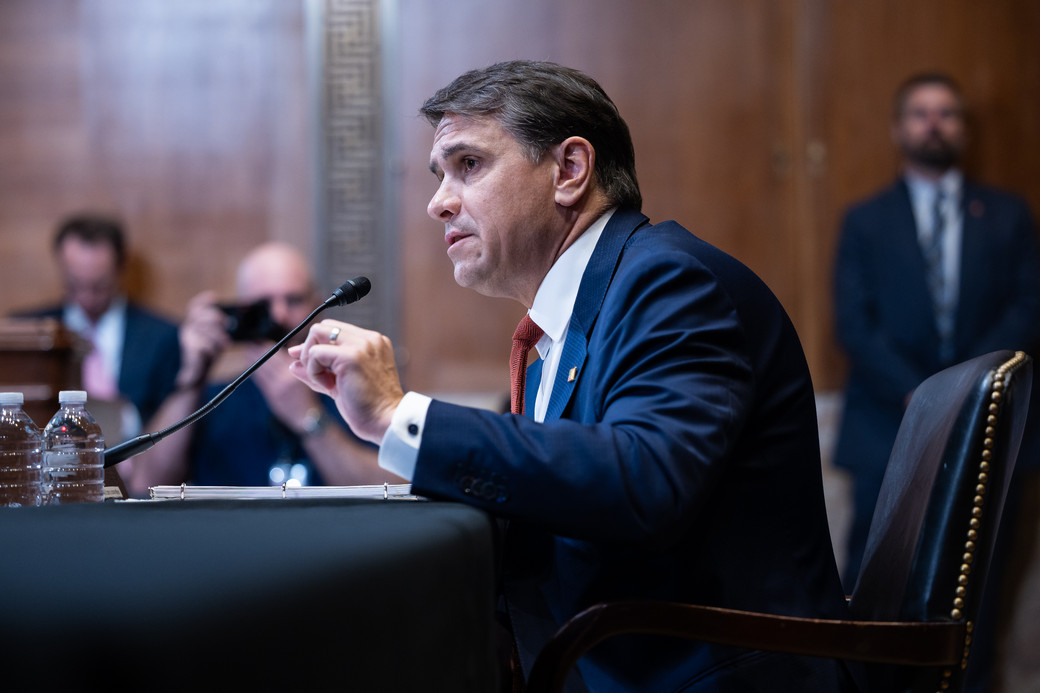




President Donald Trump announced Tuesday that Bill Pulte, the director of the Federal Housing Finance Agency, will serve as acting director of national intelligence following Tulsi Gabbard’s resignation at the end of June. Pulte will hold both jobs simultaneously, overseeing the nation’s intelligence apparatus while continuing to run Fannie Mae, Freddie Mac, and the agency that regulates more than ten trillion dollars in mortgage markets.
The move bypasses Senate confirmation by installing Pulte in an acting capacity. It also installs a close Trump ally with no intelligence background into a role created after the intelligence failures that preceded September 11th.
Trump wrote in a Truth Social post that Pulte has “deep experience managing the most sensitive matters in America, the safety and soundness of the Markets, and over 10 Trillion Dollars at Fannie Mae/Freddie Mac.” The president did not mention intelligence work, counterterrorism experience, or national security credentials. He mentioned mortgage markets.
What Pulte has actually been doing
Pulte was confirmed to lead the Federal Housing Finance Agency in March 2025 in a 56-43 Senate vote. Three Democrats crossed over to support him. Since then, his tenure has been less about housing policy innovation and more about targeting Democrats Trump considers political enemies.
In March, Pulte made two criminal referrals against New York Attorney General Letitia James for alleged insurance fraud, months after Trump’s Justice Department declined to prosecute her for a third time. James’ attorney called the allegations baseless.
In May 2025, Pulte sent a criminal referral to the Justice Department for Sen. Adam Schiff of California, alleging mortgage fraud. The probe stalled. Schiff denied the allegations.
In November 2025, then-Rep. Eric Swalwell sued Pulte, claiming he used his position to “concoct fanciful allegations of mortgage fraud” against the congressman. Swalwell, who recently resigned following sexual misconduct allegations he also denied, argued Pulte was weaponizing a housing agency for political purposes.
Pulte was also central to the controversy surrounding the Federal Reserve headquarters renovation, a project Trump has repeatedly suggested required an investigation into former Fed Chair Jerome Powell. Two independent reviews by the Fed’s inspector general found no wrongdoing. The Justice Department dropped the probe into Powell in April, though the U.S. Attorney for D.C. left the door open to reopening it.
This is the résumé Trump is citing as qualification to oversee the CIA, NSA, and the rest of the intelligence community.
The reaction from the Senate
Sen. Mark Warner of Virginia, the top Democrat on the Senate Intelligence Committee, issued a statement that read less like a critique and more like a warning. The concern, Warner said, is not only that Pulte “lacks the ‘extensive national security experience’ required by statute for the job,” but that “he appears to have been selected precisely because the White House believes he will provide the narrative it wants, not the intelligence we need.”
Warner continued: “That is how intelligence becomes politicized, how inconvenient facts disappear, how agencies charged with protecting our democracy instead become tools to manipulate it, and how Americans are left more vulnerable to a terrorist attack.”
Senate Minority Leader Chuck Schumer was less diplomatic, calling Pulte a “partisan thug with no experience in intelligence.”
Even Senate Majority Leader John Thune, a Republican, was notably careful. When asked if he was concerned Pulte could weaponize the intelligence community, Thune replied: “Well, we don’t need a weaponized DNI. We need professionals there.” He added that if Pulte wants the job permanently, “he’s got, as you all know, a lengthy road ahead of him.”
That road is Senate confirmation, which Trump has sidestepped for now by naming Pulte in an acting capacity. It was not immediately clear whether Pulte will be Trump’s permanent nominee or whether this is a placeholder appointment designed to keep the seat warm while someone else is vetted.
What we’re watching
The director of national intelligence coordinates the work of seventeen intelligence agencies. The role was created in response to the intelligence breakdowns that allowed the September 11th attacks to occur. It requires, by statute, extensive national security experience.
Pulte’s experience is in housing finance and, more recently, in pursuing criminal referrals against Trump’s political opponents. He has overseen mortgage markets. He has not overseen covert operations, signals intelligence, or counterterrorism strategy.
What makes this appointment particularly notable is not just the lack of traditional qualifications. It is the pattern. Pulte has demonstrated a willingness to use the tools of his current office in service of Trump’s political grievances. The question Senate Intelligence Committee members now face is whether they believe that pattern will hold when the tools at his disposal include the nation’s most classified intelligence and the agencies that gather it.
The acting designation buys Trump time, but it does not resolve the underlying tension. If Pulte is nominated permanently, the Senate confirmation process will force a public accounting of what qualifications matter for the job and whether loyalty to the president outweighs experience in the field. If he is not nominated, the question becomes who Trump believes can pass Senate scrutiny while still delivering the kind of intelligence assessments the White House appears to want.
Either way, the intelligence community now reports to someone whose professional track record involves mortgages and partisan legal referrals. The agencies that brief the president on threats to national security will do so through a director whose primary qualification appears to be his willingness to use the tools of government against Trump’s critics.
The question is no longer whether this is unusual. It is whether anyone with the authority to object believes the risk is worth the fight.
Sources: