




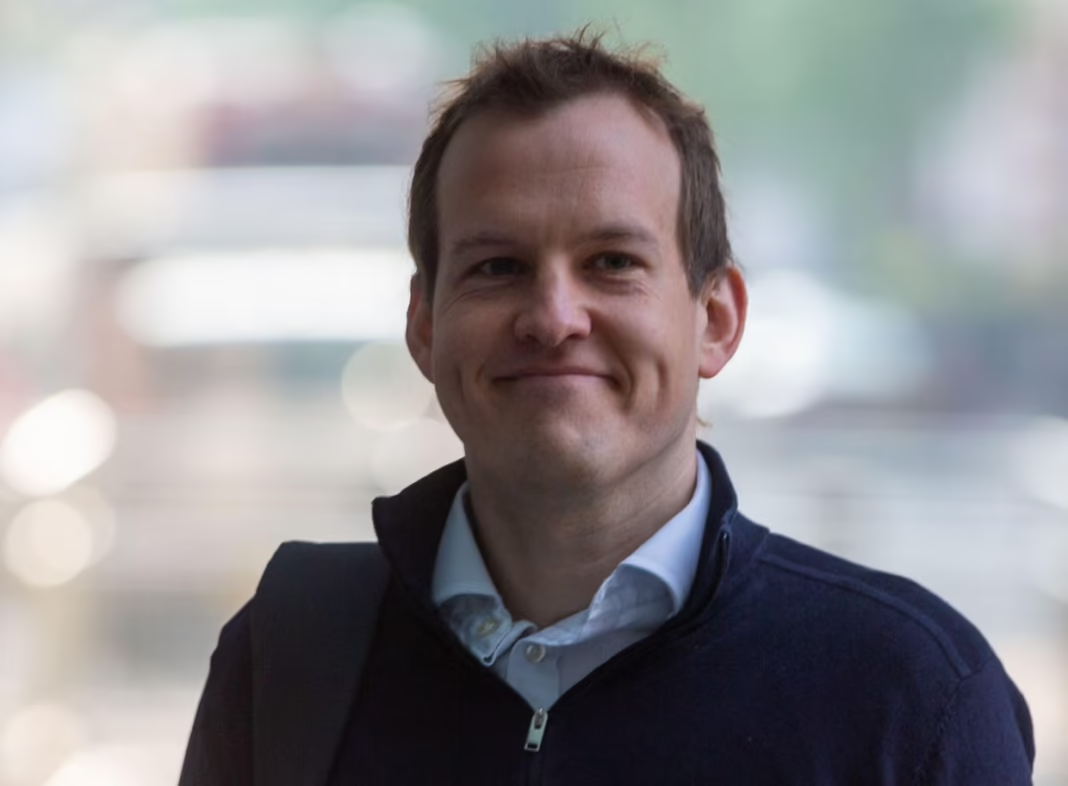
Matt Clifford helped write Britain’s AI strategy. Now he has joined Anthropic to lead the company’s international government engagement. This is the sort of career transition that makes LinkedIn glow and ethics committees reach for stronger coffee. Clifford advised both Rishi Sunak and Keir Starmer, helped organize the 2023 AI Safety Summit and authored the government’s AI Opportunities Action Plan. Anthropic has now hired that accumulated policy knowledge, contact list and institutional memory in one convenient human subscription.
The Guardian reported that Clifford will become Anthropic’s managing director of international affairs, covering government engagement in the UK, Europe, Asia-Pacific and India. The Telegraph reported that he had previously argued for copyright rules favorable to AI developers, including an opt-out approach to training data. None of that automatically means misconduct. Governments need people who understand technology, companies need people who understand governments, and talented people are allowed to change jobs. The problem is that Clifford also intends to remain chair of Aria, a taxpayer-funded research agency that backs cutting-edge technology, much of it AI-related.
That last detail moved the story from normal revolving door to revolving door with a reserved parking space. Dame Chi Onwurah, chair of the Commons science committee, called Clifford’s continued Aria role a “clear conflict of interest” and asked for robust safeguards. Anthropic says Clifford will recuse himself from matters involving the company. Recusal is a familiar Washington and Westminster word meaning everyone agrees the conflict exists but hopes a sufficiently stern calendar invitation can keep it contained.
Clifford’s defenders have a point. Artificial intelligence policy is technically complicated, and governments routinely struggle to recruit people who understand the industry well enough to regulate it. Banning every former adviser from ever joining a technology company would shrink the talent pool and encourage officials to know less about the industries they oversee. That would be a strange victory. But the opposite extreme is also strange: letting the architect of public AI strategy join a frontier AI company as a government-relations executive while continuing to chair a public technology fund.
The larger thread is how quickly AI policy has become an insiders’ economy. Governments announce growth zones, safety institutes, compute investments and public-private partnerships. Companies hire former ministers, advisers and regulators. The same small circle appears at summits, writes frameworks, critiques frameworks and then recruits one another to navigate the frameworks. The technology may be frontier. The personnel model is extremely vintage. Railroads, banks, defense contractors and telecom companies would recognize it immediately.
Anthropic has every reason to want Clifford. The company operates in a world where access to governments can shape copyright law, safety rules, procurement, energy policy, data-center approvals and national-security relationships. A former adviser who knows how Whitehall thinks is not merely a communications hire. He is strategic infrastructure with a phone. That does not make the hire improper. It does make the public interest in clear boundaries much larger than the standard corporate assurance that everybody will behave professionally.
The episode also exposes a tension in the AI debate. Industry leaders frequently argue that policymakers do not understand the technology and therefore risk writing bad rules. Fair complaint. But when governments recruit people who do understand it, those people become extremely valuable to the companies being regulated. Expertise becomes a public asset temporarily housed in government before the private market makes a better offer. If every successful regulator eventually becomes a prized regulatory navigator, the public sector starts to resemble a training academy funded by taxpayers for future lobbyists.
There are workable answers. Strong disclosure rules. Real recusals with published boundaries. Independent oversight of Aria decisions. Cooling-off periods where appropriate. None requires treating Clifford as a villain or Anthropic as uniquely sinister. The issue is structural. AI companies are becoming some of the most powerful institutions in the world while the rules governing them are still being written. Public confidence depends on believing those rules are not simply a collaborative draft between government and the next employer of the person holding the pen.
Clifford’s continued Aria chairmanship is what makes this more than another former adviser cashing in on experience. Aria distributes public money to ambitious research projects and is supposed to make independent bets on technologies that could shape Britain’s future. Anthropic is one of the world’s most prominent frontier AI companies and has an obvious interest in the direction of research, regulation and government partnerships. Even if Clifford never touches a decision involving Anthropic, conflicts can be broader than a single grant application. Agenda setting matters. Networks matter. Knowing which questions government is preparing to ask matters. The Commons committee chair’s concern is therefore not an accusation that Clifford has secretly rigged anything. It is a warning that public institutions should not require citizens to perform advanced mental gymnastics to understand whose interests an official is serving at any given meeting. If the arrangement is defensible, the safeguards should be specific enough to explain in plain English and strong enough that they do not depend on everyone simply trusting the people inside the room.
AI companies say trust is essential because their systems are moving faster than law. That makes visible institutional trust even more important. The public should not need an AI model to diagram the recusals required by the person who helped write the AI plan.
When the people designing AI policy can immediately become the industry’s guides through that policy, who exactly is the system being designed for?
Sources
The Guardian: Architect of UK’s AI strategy joins Anthropic amid conflict of interest warning
The Telegraph: Starmer and Sunak adviser critical of copyright laws joins AI giant