




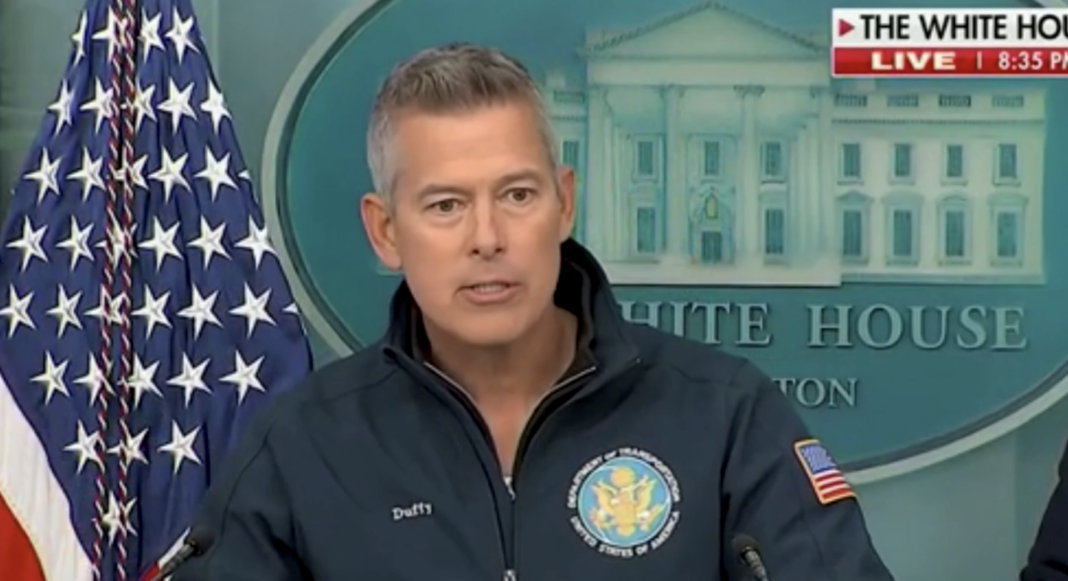
Sean Duffy went before reporters to explain how an aging technology system had helped shut down air travel across the United States. Then the technology at his own news conference decided to join the demonstration. The Transportation secretary’s Saturday briefing was interrupted by microphone trouble, creating a painfully neat visual metaphor for the previous day’s nationwide FAA ground stop.
The technical hiccup did not cause the aviation outage, of course. But after travelers spent Friday staring at airport departure boards, the spectacle of the man explaining a communications failure struggling with his own microphone was almost too perfect. Somewhere in America, a delayed passenger probably watched the clip and asked whether the federal government had considered buying a spare cable.
The microphone picked an extraordinary moment
Duffy began the November 14 briefing at Transportation Department headquarters by thanking air traffic controllers for handling the emergency. According to The Washington Post, feedback interrupted him, and the microphone trouble returned when he tried to continue. He asked whether the equipment was operational, then observed, “This is our kind of, um, day.” That is an unfortunate sentence to deliver into an unreliable sound system, although it might also be the most economical summary of the entire aviation crisis.
The livestream briefly went down and came back a few minutes later. Duffy tested the microphone by counting, technicians worked on the setup, and the briefing resumed. No grand conspiracy was necessary to make the scene memorable. It was just a public official describing a national communications breakdown while a much smaller communications breakdown unfolded at arm’s length.
That sequence matters because the administration was trying to reassure people that aviation systems were safe and under control. A microphone glitch does not tell us anything about the safety of air traffic control. It does, however, make an already difficult public-relations job significantly harder, especially when millions of viewers are in no mood for another demonstration of how equipment can suddenly stop cooperating.
What actually grounded the country
The real problem began Friday, November 13. Duffy said instability appeared at about 3:36 p.m. Eastern in communications and radar data flowing through air traffic control facilities. The FAA ordered a nationwide ground stop for departures as a precaution. The government said roughly 3,500 aircraft were already in the air when controllers began implementing the response, and crews safely managed the situation.
The ground stop was lifted at 8:15 p.m. Eastern, but that did not mean the nation’s airline network could instantly reset. Aircraft, flight crews and passengers were now in the wrong places, and airlines had to work through the backlog. Anyone who has watched a delayed flight become a missed connection understands that a four-hour interruption can produce a much longer argument with an airline app.
Duffy and Homeland Security Secretary Markwayne Mullin held a White House briefing Friday evening. Mullin addressed security concerns while Duffy described the problem as inconsistent radar and communications inputs, not a total blackout. The government emphasized that the system had safety procedures and that planes already flying could be handled safely while departures were stopped. That distinction is important: the order was disruptive precisely because officials did not want to gamble with aviation safety.
A copper-wire problem meets the modern world
At the Saturday briefing, Duffy supplied a more detailed preliminary explanation. He said a contractor working at a remote FAA site was switching a telecommunications connection from aging copper wire to fiber. The contractor, L3Harris, had long provided the legacy network. During that work, he said, a router started flooding other routers with connection attempts, disrupting communications and radar feeds.
The secretary described more than 1,000 connection attempts every four or five seconds. He said investigators still had not determined whether the initial fault came from installation error, user error or a defective router. Those are possibilities under investigation, not established findings of negligence. Blaming a particular worker before the evidence is in would be a lousy way to improve public confidence, even by Washington standards.
Duffy said officials did not believe the incident was a cyberattack because systems came back after the problematic work was isolated. That was the administration’s assessment at the time, not a final independent investigative finding. The central point remained that legacy equipment and a troubled transition between old and new technology were capable of causing widespread instability in an enormously consequential network.
There is something especially maddening about the alleged trigger. The country did not lose access to air travel because someone unveiled an impossibly advanced science-fiction machine. Officials were investigating trouble during a migration from copper to fiber, a transition much of the business world has been making for years. Commercial aviation is an astonishingly sophisticated operation, yet parts of its infrastructure are apparently still trying to leave the analog age without knocking over the furniture.
The political pitch started immediately
Duffy used the crisis to renew his argument for money to modernize air traffic control. He said Congress had provided $12.5 billion as a partial investment and argued that substantially more was needed. He also listed upgrades the department says it has made, including replacing copper communications links and improving tower technology. Those are administration-reported figures, and the long-term results of that program cannot be established by a single press conference.
There is an understandable case for upgrading aging safety-critical infrastructure. There is also a fair question about why a single troubled maintenance operation could ripple through the country’s aviation network. And there is a separate political question about how effectively officials, regardless of party, have prioritized those systems over decades. A technical failure can demand urgent investment without requiring the public to treat every spending proposal as automatically perfect.
Meanwhile, Duffy and other officials credited pilots, controllers and airport workers for managing the emergency. They deserve to be distinguished from the embarrassing optics of the briefing. The people keeping airplanes separated were handling a serious safety situation, not playing a part in the comedy of the malfunctioning podium.
The crisis is over only when the disruption is
The FAA reopened airspace Friday night, and the department said more than 8,000 flight operations resumed afterward. Saturday’s advisory nevertheless warned passengers to expect additional delays and cancellations as the network recovered. Reopening the system was a major milestone, but travelers stuck in airports were unlikely to consider the problem solved just because the federal announcement had shifted from emergency to recovery mode.
The communications glitch at Duffy’s briefing may ultimately be remembered as a strange footnote to a much larger episode. It was not evidence of sabotage, a second FAA failure or anything more dramatic than a microphone problem. But sometimes public events produce a visual punch line that no satirist could improve. When the transportation secretary needs technical assistance to explain why transportation technology failed, the metaphor has already written its own headline.
Sources
- Washington Post — Duffy briefing interrupted by audio problems (Nov. 14 event)
- U.S. Department of Transportation — Saturday investigation and recovery briefing
- U.S. Department of Transportation — Friday nationwide ground-stop update
- White House — Duffy and Mullin video briefing
- Roll Call Factba.se — Transcript of November 13 FAA briefing