




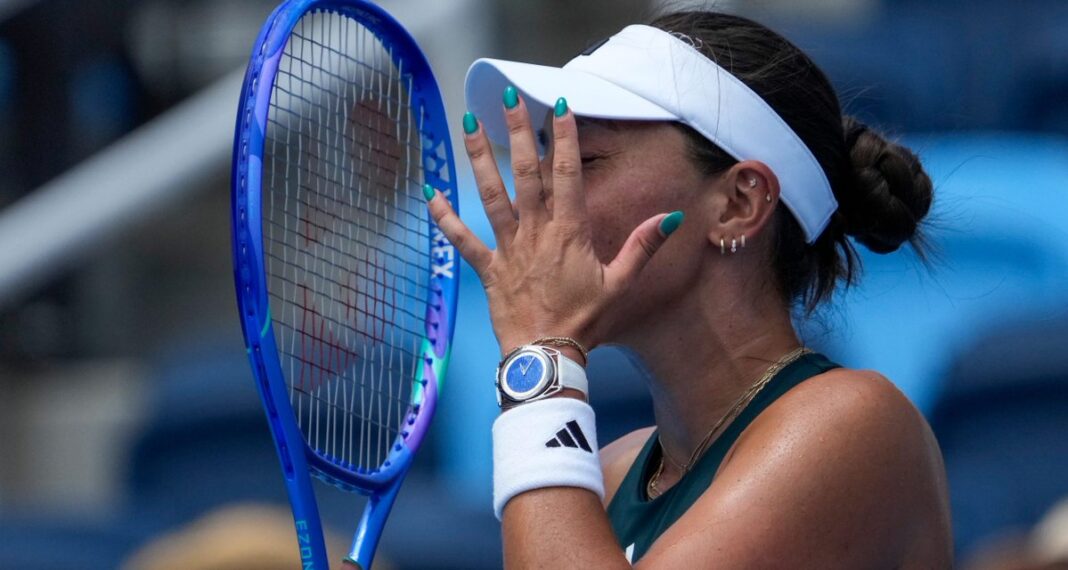
Jessica Pegula thought she was talking privately with her coach. The WTA was livestreaming, and her comments about Mirra Andreeva went everywhere.
Jessica Pegula went to tennis practice and accidentally became the main event in a sport-wide discussion about privacy, gossip and microphones that should have stayed off. The American star was caught on a livestream calling teenage rival Mirra Andreeva a “diva” and saying she needed to be humbled. The Women’s Tennis Association then admitted the central problem: it had not told players and coaches that their practice-court conversations were being broadcast to the public.
It is a particularly brutal way to discover that a private remark is no longer private. Most people have experienced the sudden horror of realizing the meeting microphone was on. Pegula experienced that sensation in front of a global tennis audience, with the additional complication that the subject was one of the sport’s brightest young champions. In professional sports, apparently, the walls do not have ears. The practice courts have streaming infrastructure.
The conversation happened Wednesday, November 4, at Indian Wells, California, during preparations for the season-ending WTA Finals. As The Guardian reported, Pegula was talking with coach Mark Knowles while practice footage was carried on the WTA’s YouTube channel. Clips spread across social media, turning an offhand critique into a full-blown controversy before the tournament had even begun.
The conversation nobody was supposed to hear
Pegula’s criticism went beyond one colorful adjective. She discussed Andreeva’s behavior toward coach Conchita Martínez and described the teenager as needing a different mentality. The National’s account includes remarks in which Pegula said she had lost some respect for Martínez, whom she believed was indulging Andreeva’s on-court behavior. In other words, an informal player-to-coach conversation suddenly became a public performance review of somebody else’s player-coach relationship.
The comments were blunt, but the full picture is not quite as simple as a one-note takedown. Reuters reporting carried by The Japan Times noted that Pegula also described Andreeva in positive terms, including calling her smart and wonderful. A few clipped insults travel much farther than a balanced conversation. The social-media algorithm rarely stops to ask whether there were compliments somewhere between the complaints.
Andreeva, 19, entered the event as a major young talent and reigning French Open champion, a player whose intensity has sometimes been visible on court. Pegula, meanwhile, is an established American contender and member of the WTA Players’ Council. Their roles make the exchange particularly awkward: one competitor was assessing another’s temperament while preparing to compete in the same elite event. It is not a criminal investigation or a formal complaint, just a conversation that escaped its intended audience.
The WTA’s apology made the essential point unusually clear. The organization said it took full responsibility for failing to warn players and their teams that microphones intended for a fan-facing practice livestream were active. It also announced that practice streams would continue without audio. That seems like a sensible compromise: fans still get to watch forehands, and players can discuss colleagues without a global audience silently leaning over their shoulders.
The apology has an important target
Pegula’s agent, Chris McCormack, told reporters she had been unaware the conversation could be heard by fans, much less broadcast live. Her representative said she contacted the people involved to apologize. The BBC’s account, republished by Yahoo Sports, emphasized that the central mistake was the lack of notice from the governing body. That doesn’t make the comments magically disappear; it does change the circumstances under which the public first heard them.
There are two legitimate reactions here, and they are not mutually exclusive. Pegula’s remarks were harsh enough to sting, especially with the sport’s attention fixed on Andreeva. At the same time, athletes and coaches have to be able to talk candidly during training without assuming each observation will become a worldwide headline. A locker room does not become a public press conference merely because someone installed a camera nearby.
Tennis has been debating that boundary for some time. At the Australian Open earlier in the year, players expressed discomfort with backstage cameras filming moments they believed were private. Coco Gauff’s reaction after a racket-smashing incident helped push the issue into public view, while Iga Świątek also questioned how closely athletes were being watched. The Pegula incident gives the privacy debate a new example, one with a soundtrack and an extraordinarily unfortunate choice of adjectives.
It is easy to imagine why a sports organization would want more behind-the-scenes access. Practice sessions provide content between matches, bring fans closer to athletes and can make a tournament feel alive before the first competitive ball is struck. But the commercial value of a livestream is not a substitute for consent or clear notice. The line between access and surveillance gets thin when a player doesn’t know which parts of her day are effectively on television.
A tournament begins with a trust problem
The WTA Finals were scheduled to start Sunday, November 8, at Indian Wells, with the season’s top singles competitors and doubles teams competing through mid-November. Instead of a quiet final week of preparation, the participants inherited a debate about broadcasting policy. Pegula and Andreeva were in different opening groups, so a direct singles meeting would require both to advance far enough. The controversy might produce more anticipation than either athlete wanted, but it does not predict what will happen on court.
The player-to-player consequences remain largely private, as they probably should. Pegula’s representative says she reached out, but neither a public apology tour nor a televised reconciliation is required to satisfy the internet’s appetite for a neat ending. Andreeva is entitled to respond, stay silent or simply focus on competing. The sporting world could use an occasional reminder that not every awkward moment needs a second season.
What is confirmed is that the WTA acknowledged an avoidable failure and changed its audio policy. What is not confirmed is any lasting feud between the players, a disciplinary case or an inevitable showdown. The remarks were embarrassing, the privacy breakdown was real, and the internet had a field day; none of that justifies inventing a rivalry bigger than the evidence supports.
Pegula may now think twice before critiquing anyone within a tennis court’s radius of a microphone. The WTA, one hopes, will think twice before turning those microphones on without telling the people next to them. And fans have learned something useful: the most explosive shot of the week did not come off a racket. It came through a speaker that nobody realized was live.