




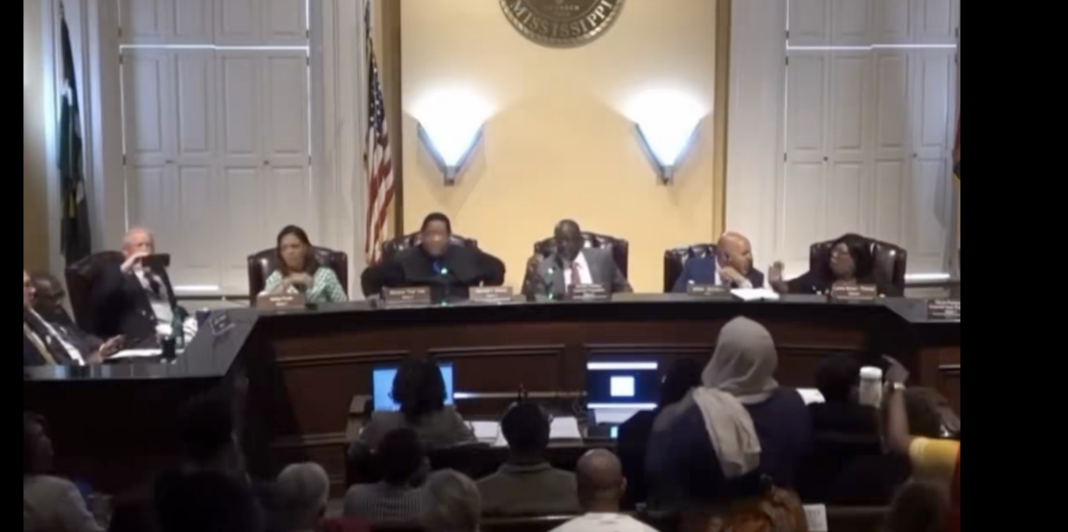
A Mississippi city council meeting was supposed to be about whether Jackson should open the door to more data centers. Instead, it became a public meltdown featuring a councilman, an insult about his mother, a profane outburst and remarks aimed at Muslim women in the audience. By the time the shouting subsided, several council members had walked out and police were clearing the room. Anyone hoping for a quiet discussion of zoning rules had apparently attended the wrong meeting.
The confrontation unfolded November 3, after Ward 3 Councilman Kenneth Stokes introduced a proposal to undo Jackson’s 183-day moratorium on data centers. Protesters objected to the idea, raising concerns about the effects of massive computing facilities on the city. During the dispute, Stokes said he did not fight women but would ‘cut that b—- out,’ according to video and reporting by Jackson television station WLBT. He also told women wearing Muslim head coverings to remove what he called ‘rags’ from their heads.
The exchange spread beyond Mississippi after clips circulated online, including a CBS News video shared this week. But the incident was not a spontaneous argument over religion. It began with a concrete local policy question: should Jackson allow developers to pursue data-center projects while officials and residents are still debating the rules? The answer became difficult to hear over the shouting. That is an unfortunate outcome for a meeting whose central purpose was supposed to be public business.
A data-center debate turns into a personal feud
Stokes wanted to rescind the temporary ban so Jackson could compete for investments that have been landing in surrounding communities. Data centers can bring construction spending, property-tax revenue and jobs, but residents also worry about electricity demand, water use, noise and how much of the promised economic upside actually reaches nearby neighborhoods. The argument is playing out across the country as artificial-intelligence companies seek space for ever-larger computing facilities.
At the Jackson meeting, activist Candace Abdul-Tawwab, executive director of Mississippi for a Just World, used part of her public-comment time to play an audio recording that she said illustrated the constant noise produced by data centers. Other speakers challenged the economic case for development. One resident compared the pursuit of data-center money to ‘pimping out’ the state. Whatever anyone thought of the analogy, the meeting was already tense before Stokes began answering critics.
The flash point came when a protester made a remark about Stokes’s mother. Abdul-Tawwab later told WLBT that she was not the person who made that comment; she said another protester accused the councilman of being willing to sell out his mother for a dime. Stokes reacted angrily. He said his mother had been a teacher and insisted that bringing her into the argument crossed a line. His response, however, immediately became the story.
Stokes delivered the profanity-laced remark about a woman, then turned his attention toward Muslim protesters. He told them to take off their head coverings and questioned whether they were Muslim. The distinction between criticizing someone’s political position and attacking their religious identity is not especially subtle. Yet the discussion had somehow traveled from the economic merits of server farms to who was entitled to wear a headscarf inside City Hall.
Council President Vernon Hartley tried to restore order with the gavel. Councilwoman Tina Clay called for a recess. Several council members left their seats as people in the audience chanted for Stokes to be removed. Jackson Police Chief RaShall Brackney and officers moved to clear the chambers. The council recessed for an hour and eventually postponed the meeting until November 5, with much of its ordinary business unfinished.
Stokes says he meant words, not violence
The day after the blowup, Stokes disputed the interpretation that he had threatened to physically cut a woman. He told WLBT that he had meant he would cuss her out, not attack her. That explanation matters: the recorded phrase sounded threatening to some listeners, but Stokes explicitly denied intending physical violence. The reporting available does not establish that he assaulted anyone or that a criminal charge resulted from the exchange.
He also defended his reaction to the reference to his mother. Stokes said he would not accept that kind of personal attack while carrying out his duties. He noted that his mother and brother had died around that time of year, making the subject especially painful. Residents are not entitled to unlimited abuse of public officials, and council meetings can require firm enforcement of speaking rules. The controversy is whether a councilman can demand civility while answering a personal insult with language that many residents found degrading.
Abdul-Tawwab rejected the religious remarks in a television interview, calling them an insult to her as a Muslim. She said she had stood up to demand Stokes’s removal when he directed the comments about head coverings toward her. She also said the original remark about his mother came from someone else. Her organization argued that public officials have a responsibility to respect residents who participate in government, including residents challenging proposals that elected leaders support.
Stokes did not retreat from his position on the religious confrontation during his next-day comments. According to WLBT, he again questioned whether Abdul-Tawwab was Muslim while insisting that he had been defending himself against disruptive behavior. Those statements are his account of the incident, not evidence about anyone else’s faith. A city council meeting is a place to debate ordinances; it is not an audition for an elected official to adjudicate who qualifies as a member of a religion.
Now the council has to deal with the fallout
Hartley said after the incident that he would bring the matter before the council for review and possible disciplinary action. Council Vice President Kevin Parkinson later explained that he had walked out because he did not want to sit through the behavior as though it were acceptable. Clay also said she had explored what action could be taken. Those statements signaled concern inside the council itself, although a proposal to consider discipline is not the same thing as a completed disciplinary decision.
The public-policy question did not disappear while everyone argued about the outburst. Stokes maintained that Jackson should pursue data centers rather than watch neighboring counties collect the revenue. Critics remained concerned that large facilities could burden communities without providing enough lasting benefit. A moratorium is designed to give local government time to establish rules before projects proceed. Ending it early could change how and when the city considers developers’ applications.
The ordinance was being introduced at the November 3 meeting, not finally adopted. Under the council’s normal process, it would move forward for later consideration rather than take effect immediately. That detail is easy to lose in the viral video. Despite all the shouting, the dramatic meeting did not itself settle whether Jackson would lift its temporary restriction. The city still had a substantive decision to make after the cameras captured the spectacle.
The viral clip may introduce a national audience to Kenneth Stokes, but the bigger question belongs to Jackson. Can the council debate a complicated development proposal without turning public comment into a personal grudge match? The city’s data-center decision will affect residents long after this week’s video stops circulating. For now, the meeting produced one unmistakable result: the loudest thing in the room was not a server farm.