



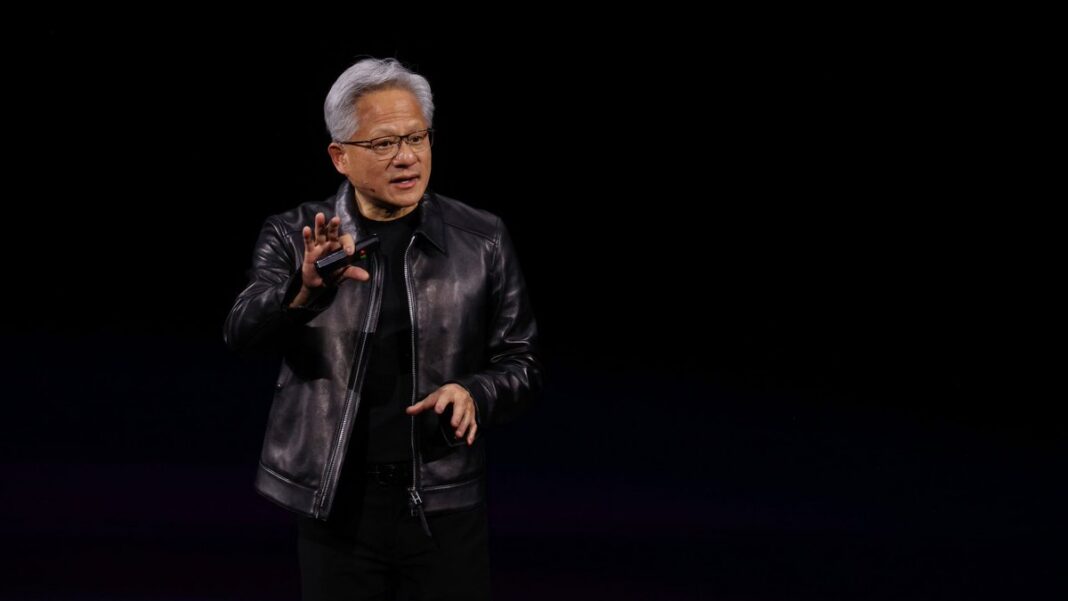
The man who helped turn computer chips into the hottest commodity on the planet has been brought down by a scandal involving sex, suspected espionage and a corporate board suddenly facing the most expensive personnel problem imaginable. Nvidia co-founder Jensen Huang resigned as chief executive Thursday, November 12, after reports of extramarital relationships collided with an investigation into possible Chinese intelligence activity. It is a stunning reversal for the leather-jacketed executive who had become almost synonymous with the artificial-intelligence boom.
Nvidia announced that Huang had stepped down as president and CEO, with longtime chief financial officer Colette Kress taking over on an interim basis. The departure followed days of intense scrutiny and a Wednesday report that directors were weighing his future. Huang had led the company since its founding in 1993, a run that took Nvidia from graphics cards for gamers to chips powering some of the world’s most advanced AI systems. A company built around one indispensable leader now has to demonstrate that it can function without him.
The allegations are extraordinary, but the distinctions matter. Huang publicly acknowledged being unfaithful to his wife. Reporting has linked one relationship to Alice Huang, a former executive associated with Singapore-based Megaspeed whom U.S. officials reportedly suspect of ties to Chinese intelligence. Another reported relationship involved an Nvidia executive who reported to him. Suspicion of espionage is not proof that Alice Huang was a spy, and no public finding establishes that Jensen Huang knowingly disclosed secrets.
An affair becomes a national-security headache
The controversy gathered momentum after reporting raised questions about Alice Huang and the business network surrounding Megaspeed, a company involved in acquiring powerful AI chips. U.S. export restrictions make certain advanced chips difficult to ship legally to China. Investigators have examined whether companies in the region helped restricted technology reach Chinese buyers, while Megaspeed has disputed allegations of illicit exports. That combination turned a private relationship into an issue for regulators, investors and lawmakers.
On November 8, Huang issued an unusually personal message to employees. He apologized to his wife and family for his infidelity, accepted responsibility for the harm he had caused and pledged cooperation with an independent investigation. He did not identify his romantic partner by name in the company statement. His apology was direct about the personal misconduct, but it did not resolve the much larger question of whether anyone had sought sensitive business or technical information through access to the Nvidia chief.
Nvidia’s board said the investigation would be overseen by independent directors with outside counsel. It also stressed that it had no reason to believe national security or Nvidia’s secrets had been compromised. That is a statement about what the company knew at the time, not an all-clear from investigators. The FBI’s reported interest and scrutiny of chip transactions are separate from any conclusion that Huang himself committed a crime. The board was suddenly dealing with both a workplace scandal and the kind of geopolitical issue normally reserved for a Senate hearing.
Then came the second relationship report
The situation escalated Wednesday when the New York Times reported a separate affair involving Kimberly Powell, an Nvidia vice president in health care who reportedly answered directly to Huang. The allegation raised a different set of questions: not about foreign intelligence, but about power, conflicts of interest and how a company polices the behavior of the person at the top. Huang did not publicly substantiate every detail in that reporting, and the allegation should not be treated as a judicial finding.
Reports that the board was preparing to consider Huang’s removal sent Nvidia shares sharply lower in after-hours trading. The market reaction reflected more than fascination with an executive’s personal life. Nvidia’s fortunes had become closely associated with Huang’s relationships with customers, governments and investors, as well as his habit of personally driving major decisions. Succession planning is never glamorous, but it becomes riveting when a company worth trillions has to find a new driver while the vehicle is moving at highway speed.
On Thursday, the speculation turned into a formal departure. Kress, Nvidia’s finance chief, was tapped as interim CEO, while the company began the task of navigating an extraordinary transition. The move did not establish the truth of every accusation that preceded it. Resignation is a corporate decision, not a criminal conviction, and the company’s investigation still has work to do. But it did bring an abrupt end to Huang’s more than three decades at the helm.
A chip empire faces a very human crisis
The stakes extend well beyond one executive’s marriage or a week of lurid headlines. Nvidia’s processors are central to the AI infrastructure race, and the company operates at the intersection of American technology policy, global trade and intense competition with China. Its customers include the largest technology companies in the world. Questions about who can access sensitive chips, and who can influence decisions about them, are therefore far more consequential than ordinary corporate gossip.
Huang had also become a recognizable figure in Washington, where debates over chip exports involve national security, business interests and diplomacy. The scandal has prompted congressional interest in hearing from him about the reported relationship and the company’s China-facing business. Lawmakers asking questions does not establish wrongdoing. It does illustrate why the story cannot be reduced to an affair headline: there are legitimate questions about governance and export controls that outlast any CEO’s tenure.
There is a risk of conflating several different claims. Huang’s admission of infidelity is established by his own statement. A second reported relationship remains a matter of attributed journalism. Alice Huang’s alleged intelligence ties and any unlawful diversion of chips require independent proof. Nvidia says it has no evidence its secrets were compromised, and Megaspeed denies evidence of illegal exports. A defensible account must keep those lines clear even when the combined story sounds like the plot of a streaming thriller written by a semiconductor analyst.
For employees and shareholders, the immediate question is what happens next. Kress inherits a business with enormous demand, immense political scrutiny and an identity that has long been inseparable from its founder. Investigations can clarify conduct and controls; they cannot instantly replace decades of relationships or settle the question of who should lead a technology giant through a geopolitical arms race. Nvidia’s board now has to do something far less photogenic than a keynote unveiling: show it has a credible plan.
Huang’s rise helped define the modern AI industry. His exit is a reminder that even a company selling the technology of the future can be derailed by very old-fashioned human behavior. The board still has to determine what happened, investigators still have to establish what can be proved, and Nvidia still has to sell chips. The leather jacket may be iconic, but it turns out no executive uniform comes with an exemption from consequences.