




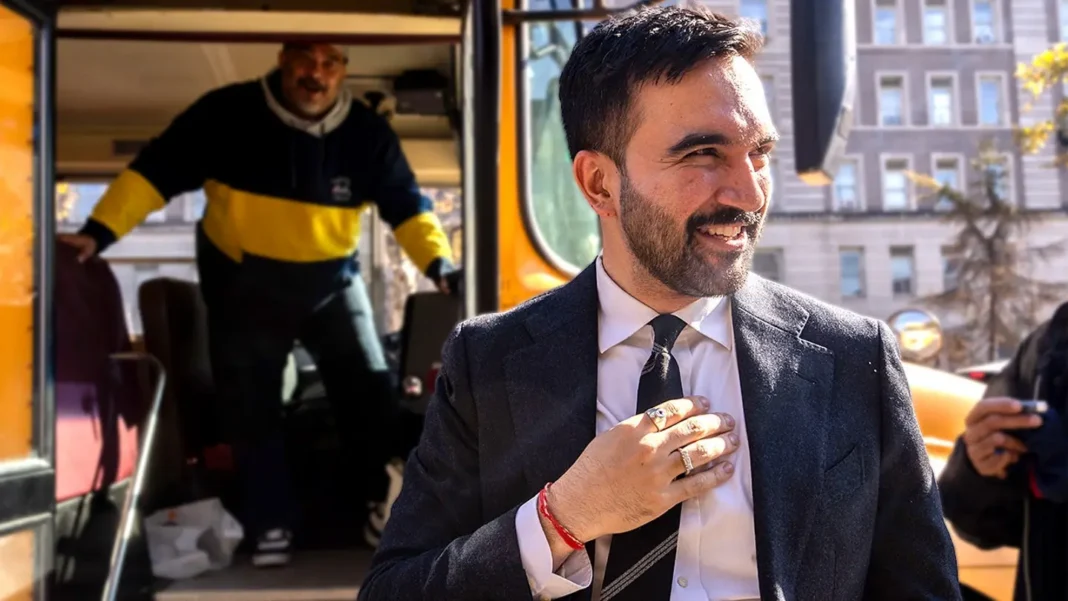
Zohran Mamdani ran for New York City mayor on a platform that included making the city’s buses free, and New Yorkers are taking him at his word. The Metropolitan Transportation Authority reported a significant spike in fare evasion on New York City buses in July, costing the transit system approximately $31 million in revenue, per Fox News’s confirmed reporting published this morning. MTA Chairman Janno Lieber, without naming Mamdani directly, told reporters in July that political rhetoric was fueling the evasion. “There’s a trend that broke out,” Lieber said. John Chiarello, president of the Transit Workers Union Local 100, was less circumspect with Fox News Digital: Mamdani’s free bus promise is creating “a perfect storm” of people not wanting to pay.
The mechanism is straightforward. Mamdani won the New York City mayoral election in part on a promise to make buses free. He is now the mayor. The buses are not yet free. But enough New Yorkers heard his campaign promise and concluded that the mayor’s intention to make buses free was sufficient moral authorization to stop paying for them that fare evasion spiked significantly in the month of July, producing a $31 million revenue shortfall for the transit authority that is already running structural budget deficits and that depends on fare revenue to fund operations that cannot be fully covered by public subsidy.
This is the specific policy consequence of campaign promises that are bold enough to change behavior before implementation. Mamdani is not the first politician to discover that promising something for free creates behavioral changes that precede the actual delivery of the free thing. His situation is distinctive because the free thing he promised is a public service that is currently funded in part by the fees his supporters have stopped paying, which means the promise to make buses free is partially self-undermining in that the revenue loss from the behavioral change makes it harder to sustain the transit system whose funding model he is trying to eliminate.
The fiscal math of free public transit is a contested policy question that cities around the world have approached differently. Several European cities, including Luxembourg, have made their entire transit networks free and funded the cost from general revenue. Several American cities have made specific transit modes free, typically with bus systems rather than rail, funded by a combination of redirected parking revenue, general fund subsidy, and reduced operating costs from eliminating fare collection infrastructure. The policy case for free public transit rests on equity, environmental, and economic arguments. The fiscal case against it rests on the revenue implications for transit systems that are already underfunded relative to their maintenance and capital investment needs.
New York City’s transit system is the largest in the United States, operating the subway, bus, commuter rail, and ferries that move millions of people daily. Its capital program for maintenance and expansion is perpetually underfunded. Its operating budget depends on a fare revenue stream that is already undermined by the highest fare evasion rates in the system’s history, which predate Mamdani and have been climbing since the COVID-era decision to stop enforcing fare payment on buses. The decision to stop enforcing fare payment on buses was a Mamdani precursor implemented under Mayor Eric Adams as a crime reduction measure, on the theory that fare enforcement confrontations were producing more harm than benefit. That decision produced the evasion baseline on which Mamdani’s campaign promises are now operating.
The MTA’s $31 million July revenue shortfall is not the only financial pressure on the system. The authority has been operating under a congestion pricing regime that was partially implemented and then partially reversed by the governor under political pressure, producing neither the full revenue benefit of congestion pricing nor the political goodwill that comes from not implementing it. The fare evasion shortfall from bus riders taking Mamdani’s campaign promise as behavioral permission is an additional pressure on a budget that has many pressures.
Mamdani has not formally implemented free bus service. His administration is presumably working on a funding plan that would make the policy actual rather than aspirational. In the meantime, the behavioral change produced by the campaign promise is real and it is costing the transit system real money.
The buses are not free yet. New Yorkers stopped paying anyway. The MTA lost $31 million in July.
When the mayor promises free buses and fare evasion produces a $31 million monthly shortfall before any policy changes, what exactly is the relationship between campaign promises and government finance?
Sources
Fox News: Mamdani’s free bus push linked to $31M MTA fare revenue loss in NYC