



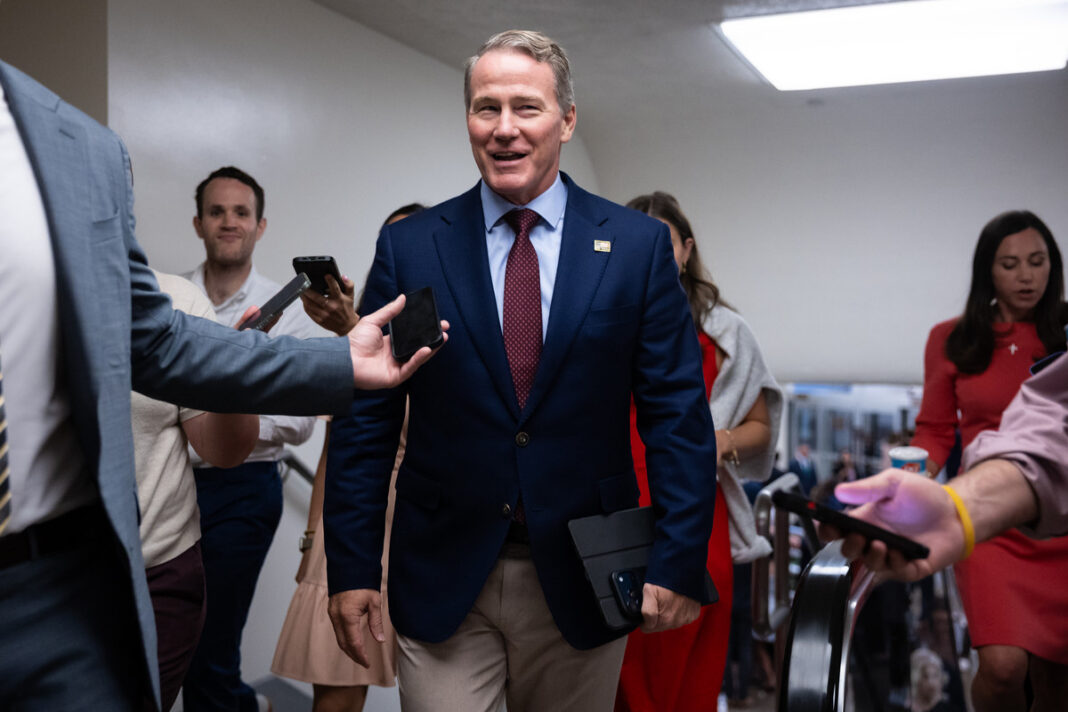
Jon Husted disclosed gifts from JobsOhio while serving as lieutenant governor. Ohio law does not require him to list their value, and neither Husted’s office nor JobsOhio has said exactly what he received.
Republican Sen. Jon Husted disclosed that JobsOhio gave him gifts in 2021, 2022 and 2023 while he was serving as Ohio’s lieutenant governor. The mystery is that almost everything after the word “gifts” remains blank. The public filings do not say what the items were worth, and neither Husted’s office nor JobsOhio would tell the Ohio Capital Journal whether the gifts were meals, travel, event tickets or something significantly more expensive.
That is not necessarily because someone forgot to fill in the form. Ohio law does not require public officials to disclose the dollar value of gifts on the state ethics form. As a result, the same disclosure category can theoretically cover a modest dinner or a trip worth thousands of dollars, leaving voters with a wonderfully precise accounting system best summarized as: something happened.
JobsOhio is not an ordinary private business. It is Ohio’s quasi-private economic-development corporation, created to recruit companies, negotiate incentives and help steer major investment projects. It operates with revenue tied to the state liquor enterprise and has been involved in billions of dollars of economic-development commitments. Husted, while lieutenant governor, was deeply involved in the DeWine administration’s economic agenda.
That relationship is why the gifts are drawing attention. Public officials receive meals, event access and travel connected to their jobs all the time, and state law allows many of those interactions. The concern arises when an organization with enormous influence over public economic policy is giving something of undisclosed value to one of the state’s top elected officials while that official is involved in the same economic-development ecosystem.
The Ohio Capital Journal reports that Husted listed JobsOhio gifts on his financial disclosures for three consecutive years. The publication asked both Husted’s office and JobsOhio to explain what those gifts were and how much they were worth. Neither provided that information. There is no indication in the reporting that Husted violated Ohio disclosure law by failing to list a value, because the law simply does not require one.
That is the part of the story that makes the ethics system itself almost more interesting than the gifts. Financial disclosure rules are supposed to help the public spot potential conflicts. A form that tells voters “yes, there was a gift” but does not require anyone to say whether it was a sandwich or a week in Monaco is offering transparency in a somewhat philosophical sense.
The JobsOhio gifts also arrive amid broader scrutiny of Husted’s financial and political ties while he served in state government. Recent Ohio Capital Journal reporting has examined campaign money from Heartland Bank after Husted joined its board, his family’s financial interests connected to Intel and the extensive public incentives surrounding the company’s Ohio semiconductor project.
None of those stories automatically establish wrongdoing in the JobsOhio matter. Ohio ethics officials have noted that campaign contributions are generally treated differently under state law from gifts or bribes, and the current report does not say Husted improperly influenced JobsOhio in exchange for anything he received.
The issue is visibility. JobsOhio has enormous power in Ohio’s economic-development system but is structured differently from a traditional state agency. Critics have long argued that its quasi-private status makes public accountability more difficult. When that organization gives gifts to a lieutenant governor and the public cannot learn what those gifts were worth, the accountability debate more or less writes itself.
Husted is now a U.S. senator after Gov. Mike DeWine appointed him to fill the seat vacated by JD Vance. That raises the stakes because financial questions from his years in state government now follow him into a federal office where ethics rules and disclosure expectations are different.
Supporters can fairly note that Husted disclosed the gifts rather than hiding their existence. If state law does not require a value, he complied with the form as written. Critics can fairly respond that a disclosure system that hides the size of a gift does not allow the public to meaningfully assess it. Both statements can be true at the same time.
JobsOhio could voluntarily answer the question. Husted’s office could voluntarily answer the question. So far, according to the reporting, neither has. That leaves Ohio voters with three years of gift disclosures and no meaningful way to know whether they are looking at ordinary hospitality or something substantial.
Maybe every item was perfectly mundane. Maybe there is an explanation that would end the controversy in ten seconds. That is what makes the silence strange. When the easiest way to kill an ethics story is to say “it was dinner and here is the receipt,” refusing to provide the details tends to make a boring disclosure considerably more interesting.
So the question is less about whether Husted broke a disclosure rule — the current reporting does not establish that he did — and more about whether a disclosure law that allows elected officials to report mystery gifts without values is actually giving the public enough information to judge potential conflicts.
Sources
- News From The States / Ohio Capital Journal — Husted took gifts from JobsOhio while he was Ohio lieutenant governor, financial disclosures show
- Ohio Capital Journal — Husted political committee got nearly $500K from a bank he worked for while in office
- Ohio Capital Journal — As he worked to advance the Intel project, an Ohio senator’s wife was invested in it