



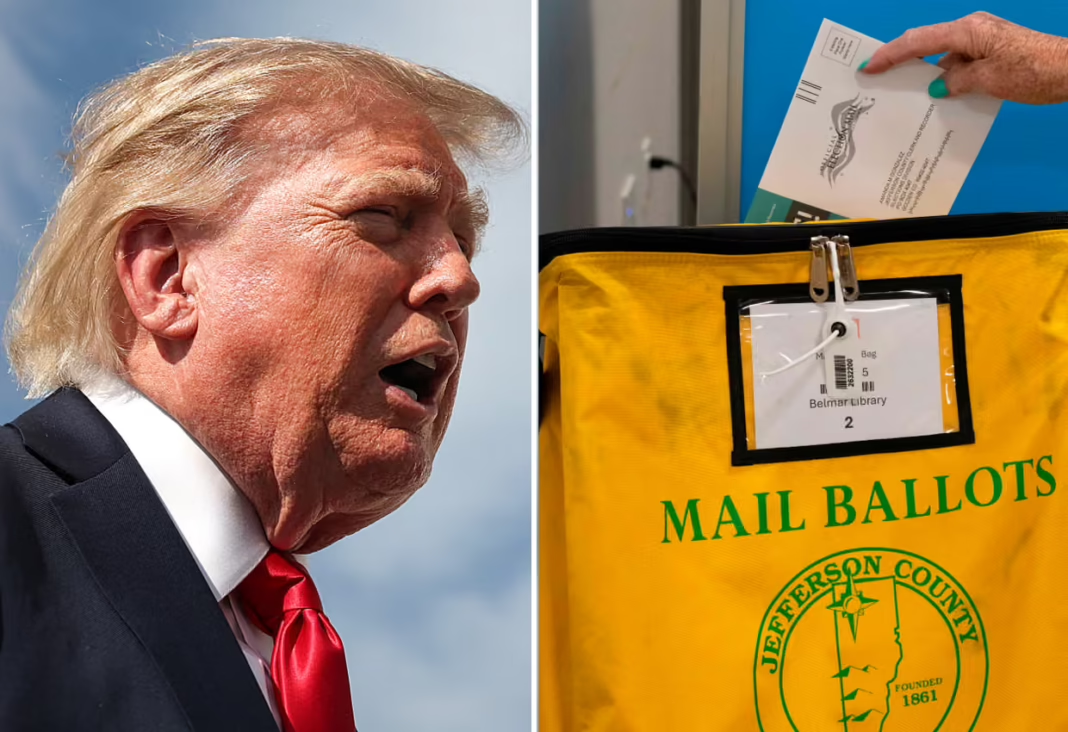
Donald Trump won an important Supreme Court round Monday in his campaign to tighten mail-voting rules, but even the court that helped him made a point of not calling the whole thing legal. The justices voted 6-3 along ideological lines to lift a June injunction issued by a federal judge in Massachusetts. That lets the administration move forward while the case continues. A second nationwide injunction remains in place, and the majority cautioned that its order did not bless whatever the government does next. For a president who prefers victories with trumpets, this one arrived with a receipt attached.
The dispute comes from an executive order Trump signed in March. According to the Guardian, it directed the Department of Homeland Security to compile and send states lists of confirmed U.S. citizens eligible to vote, using citizenship and naturalization records and other federal databases. It also told the U.S. Postal Service to deliver mail ballots only to voters on each state’s approved mail-ballot list. The Justice Department was directed to prioritize investigations and prosecutions of state and local election officials who issue federal ballots to people deemed not eligible to vote. That is not a minor formatting change. It is a federal attempt to reach directly into election administration before the November midterms.
Democratic officials from 23 states and the District of Columbia sued, arguing that the Constitution assigns election administration to the states and gives Congress authority over federal election rules, not the president acting alone. U.S. district judge Indira Talwani agreed with key parts of that argument in June and blocked portions of the order. The First Circuit later refused, in a 2-1 ruling, to lift that injunction while the administration appealed. Talwani then issued another injunction with nationwide effect involving Postal Service enforcement. By Aug. 12, the Justice Department was back at the Supreme Court asking the justices to intervene. Apparently election certainty now requires enough procedural layers to make a tax return look breezy.
Monday’s Supreme Court order changed one part of that landscape. The conservative majority lifted the first injunction, but it did not erase the second one and did not resolve the underlying constitutional fight. The majority wrote, in an unsigned order, that its decision did not mean any implementation measure would “necessarily be lawful.” It added, “On that score, time will tell.” That is a remarkably restrained sentence to attach to a ruling Trump can fairly describe as a win. It is also the sentence most likely to disappear once the victory lap begins.
Justice Ketanji Brown Jackson dissented, joined by the court’s other two liberal justices. She wrote that the decision “needlessly injects chaos and uncertainty into the upcoming midterm elections.” New York attorney general Letitia James called the ruling a “painful setback” while saying her office was exploring its legal options. California governor Gavin Newsom said his state planned another lawsuit. Derrick Johnson, president of the NAACP, condemned the decision as well. The legal fight, in other words, is not ending. It has merely changed floors in the courthouse.
There is also an important scale problem in Trump’s rhetoric about mail voting. The Guardian reports that about 30% of ballots in the 2024 presidential election were cast by mail. A 2025 Brookings Institution study cited by the paper found roughly four fraud cases for every 10 million mail ballots cast. Trump has nevertheless spent years calling for tighter mail-voting rules and repeating the false claim that widespread voter fraud caused his 2020 defeat. He has used mail voting himself. None of that prevents him from treating the method as suspicious enough to justify a federal overhaul. The mailbox keeps being promoted from office supply to political villain.
That is where the Trumpiverse part becomes clearer. The administration says its policies are aimed at election integrity. The states challenging the order say the president lacks the authority to impose them. The Supreme Court has now let one injunction fall while explicitly warning that later implementation could still be unlawful. That is a narrow procedural reality. Trump’s political style is not famous for narrow procedural realities. The risk is that a limited court order becomes a much larger campaign claim, especially when the underlying subject is already one of his favorite sources of suspicion.
The timing makes the distinction matter. The midterms are less than 100 days away, and the Guardian reports that it remains unclear whether the administration can actually take action before November. Election offices are already preparing under existing state rules. Courts are still deciding what the executive branch may require. The Justice Department is still defending the order. States are still challenging it. The Supreme Court has opened one door but left another locked, then posted a note saying the room beyond the first door may contain additional legal problems. That is not a mandate. It is permission to keep litigating with better posture.
Trump can call Monday a victory because it was one. The administration asked the Supreme Court to lift a lower-court injunction and the court did. But the facts around that victory are narrower than the slogan waiting to be made from it. One injunction remains. The lawsuits remain. The court’s own warning remains. And the central constitutional question remains unresolved. For voters trying to understand what actually changed, those boring details are the story. For Trump, the temptation will be to treat the 6-3 vote as the part worth printing in giant type and everything after it as legal fine print.
If the Supreme Court gave Trump one opening while warning that the next steps may still be unlawful, how far will he try to push before another court says stop?
Sources
The Guardian: US Supreme Court rules Trump can proceed with crackdown on mail-in voting
The Guardian: Trump officials again urge US Supreme Court intervention on mail ballots
The Guardian: Appeals court rejects Trump bid to curb mail-in voting in 23 states