



The Trump administration wants to send 1,000 Justice Department election monitors around the country for the November midterms. That sounds enormous until you remember the United States has tens of thousands of polling places, local officials control access to many of them, and the federal monitors who have already shown up this year have mostly behaved like people waiting for a conference room to open. The plan is being pitched as the largest monitoring effort in department history. The first question is whether the department can even assemble it. The second is what exactly 1,000 federal lawyers are supposed to discover that local election workers, observers, poll challengers and existing federal procedures do not already cover.
The Guardian reported Friday that Harmeet Dhillon, who leads the Justice Department’s civil rights division, has said the department hopes to deploy 1,000 monitors in November. Election observation is not some new Trump invention. The department has sent monitors for decades to help enforce federal voting laws and court orders. The scale is what has been advertised as historic. The department sent 289 monitors in the 2022 midterms and 714 people during the 2024 presidential election, according to figures cited by The Guardian. So 1,000 is bigger. It is also being proposed by an administration whose president has repeatedly said the federal government should take a larger role in elections and has continued raising fraud claims about places that vote against him.
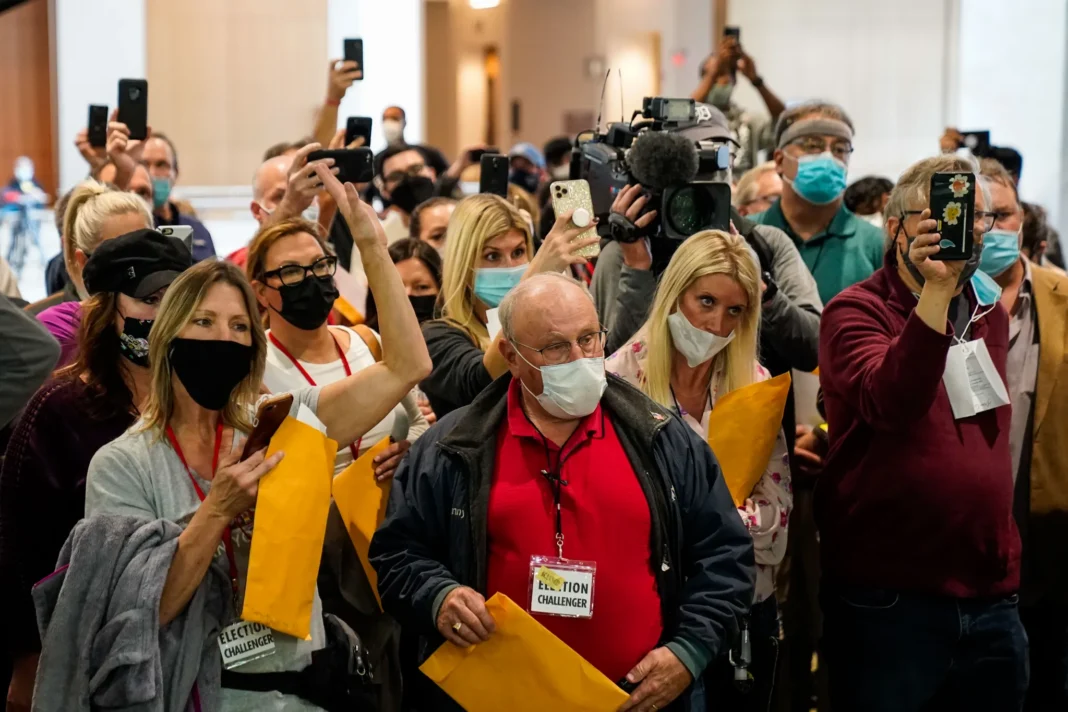
That is the target here. Not election monitoring itself. Monitoring elections is normal. Turning routine oversight into another MAGA show of force is not. The administration keeps presenting ordinary government functions as if they have finally been discovered by people willing to do them with enough capital letters. A thousand monitors sounds like an army. In practice, election officials quoted by The Guardian described a much less cinematic operation. During Minnesota’s primary, federal teams visited precincts, sometimes had to remain outside because local officials would not permit them inside, and caused no major disruptions. One former Justice Department official predicted that even a 1,000-person deployment would mostly produce videos of lawyers standing around with clipboards and following poll-worker instructions. America may survive this elite tactical unit of people asking where the bathroom is.
The administration has given officials reasons to watch the watchers anyway. Talking Points Memo reported in July that Detroit officials disputed the Justice Department’s stated justification for sending monitors to the city. A DOJ letter said federal monitors had identified concerns at Detroit polling sites in 2024. Detroit City Clerk Janice Winfrey responded that the city had no record of Justice Department representatives being present and said any such monitors had not followed local sign-in rules. The department defended its broader monitoring practices but did not explain to TPM which 2024 monitors the letter meant. That is a fairly awkward foundation for a campaign built around verifying everybody else’s paperwork.
Then came Michigan’s August primary. The Justice Department sent monitors to several Democratic-leaning municipalities. According to TPM, the monitoring itself was uneventful. No dramatic fraud plot emerged. No federal team had to dive across a counting table. Local officials reported that the observers did their jobs without incident. Trump responded to the election by reviving claims that Detroit was corrupt, saying Wayne County was one of the most corrupt voting areas in the country and again suggesting that mail ballots could appear improperly. His own administration had just sent federal observers into the system. Their apparent failure to uncover the catastrophe did not slow the catastrophe speech.
That is what makes the 1,000-monitor promise such an efficient piece of election theater. If the monitors find serious violations, Trumpworld can say the giant deployment was necessary. If the monitors find nothing, the broader fraud narrative can continue anyway because absence of evidence has never been a meaningful speed bump for it. The monitoring operation therefore risks becoming less a fact-finding exercise than a prop in a story the president has already been telling for years. The government sends observers because elections are supposedly suspicious. The observers report ordinary election administration. The suspicion survives untouched. Everyone gets a lanyard.
There is a more practical problem. The Justice Department has lost experienced personnel from its civil rights division, and The Guardian reported that experts are skeptical it can coordinate a deployment of this size. Local jurisdictions also retain significant authority over where federal observers may stand and what access they receive. In Minnesota, some counties kept the monitors outside the polling-place boundary. Across the country, election administration remains decentralized by design. A federal announcement can promise 1,000 people. It cannot magically turn 1,000 people into 1,000 independent authorities with unlimited access to local voting operations.
Republicans spent years arguing that elections should be run by states and localities, except when Republican national leaders decide the federal government should arrive in matching windbreakers. That tension is the thread worth watching. The Justice Department has a legitimate role protecting voting rights. It also has an obligation not to use that role as stage dressing for a president’s recurring claims that elections become suspicious whenever he dislikes the result. The boring version of election monitoring is useful precisely because it is boring. Lawyers observe procedures, document violations when they occur and leave. The Trump version keeps trying to turn the clipboard into a cavalry flag.
If 1,000 federal monitors watch the midterms and mostly find ordinary election workers doing ordinary election work, will Trumpworld accept that result or simply demand 2,000 next time?
Sources
The Guardian: Voting rights experts skeptical over Trump pledge of 1,000 election monitors
Talking Points Memo: DOJ Election Monitoring In Michigan Was Uneventful — But That Doesn’t Fit Trump’s Narrative
Talking Points Memo: READ: Detroit Responds to DOJ Sending Election Monitors to Three Blue Michigan Cities