



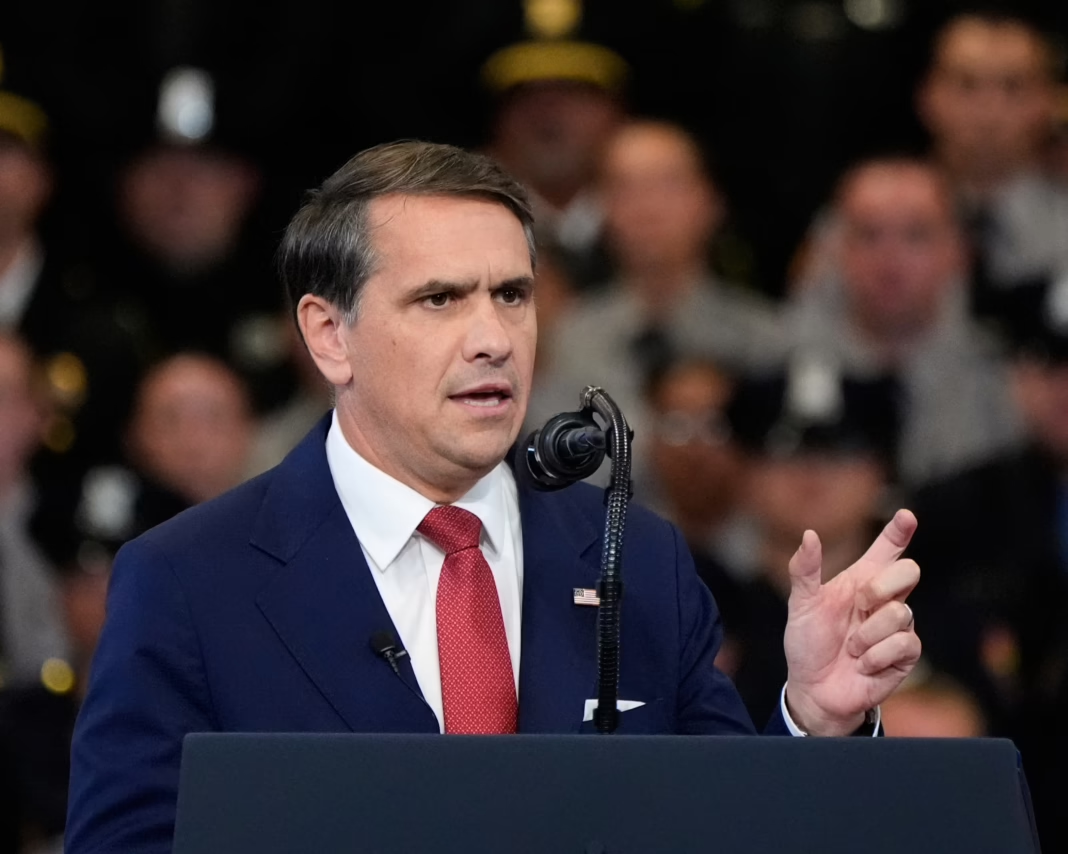
Donald Trump has spent years insisting that Washington is full of people who got important jobs for the wrong reasons. Then he put Todd Blanche in charge of the Justice Department. Blanche is not merely a political ally. He was Trump’s personal criminal-defense lawyer. That arrangement might have been awkward enough as a trivia answer. Instead, after becoming attorney general, Blanche went on television and described his job in terms that made the old conflict-of-interest rules look almost quaint. According to Salon, Blanche said on Meet the Press that he would not tolerate Justice Department employees who opposed the president’s agenda and repeatedly framed his role around carrying out Trump’s priorities. The administration has found a remarkably efficient answer to the old question of how to keep politics out of federal law enforcement. It stopped pretending that was the assignment.
There is nothing inherently disqualifying about a president appointing a lawyer he knows. Presidents choose people they trust. Attorneys general are political appointees. The problem is the particular kind of trust being advertised here. Blanche represented Trump when Trump was a criminal defendant. He later joined the administration and, after confirmation, became the nation’s top law-enforcement officer. Salon’s reporting notes that he had been Trump’s longtime personal lawyer and describes his television comments as a pledge to align the department with Trump’s wishes. Even by Washington standards, this is a short commute from private defense counsel to public prosecutor in chief.
The target is not Blanche’s résumé. It is Trumpworld’s increasingly elastic definition of merit. The movement spent years attacking institutions that considered race, gender, ideology or institutional fit when making appointments. Fine. A serious meritocracy is a defensible goal. But meritocracy becomes harder to sell when the most useful credential for a major federal job appears to be having already demonstrated personal loyalty to the president. If the standard is competence, explain why the president’s former criminal lawyer is uniquely suited to oversee prosecutions involving people the president likes, dislikes, remembers, resents or discovers during cable news. If the standard is independence, the sales pitch needs considerably more work.
Blanche’s defenders can make a fair argument that he is an experienced lawyer and that attorneys general have always reflected the priorities of the administrations that appointed them. True. Nobody expects the Justice Department to float above politics like a monastery with subpoenas. But there is a difference between sharing a president’s legal philosophy and publicly describing departmental loyalty in personal terms. The whole point of an institution is that its rules matter even when the boss has strong feelings. Otherwise the department is just a very large law firm with one unusually famous client.
That distinction matters because Trump does not hide his interest in who gets investigated and who does not. The current White House has repeatedly turned staffing into a test of allegiance, while allies portray resistance inside government as sabotage by unelected bureaucrats. In that worldview, independence is suspicious by definition. A prosecutor who says no is not doing a job. He is defying the president. A lawyer who says yes is not merely aligned. He is loyal. Once those are the categories, the Justice Department’s institutional mission starts to look less like neutral enforcement and more like customer service with badges.
There is also a useful irony in who has to defend this system. Conservatives spent years warning that federal agencies had become politicized, that prosecutors could not be trusted to separate law from partisan preference and that bureaucratic power needed to be restrained. Those concerns do not become silly just because the president is Republican. If anything, appointing a former personal defense lawyer as attorney general should make the concern easier to understand. The principle either survives a change of jersey or it was never much of a principle.
Trump’s genius for politics has always included turning accusations into job descriptions. Critics said he demanded loyalty. His allies began praising loyalty. Critics said he wanted personal control of institutions. His supporters argued that elections should give presidents more control of institutions. Critics worried that prosecutors could become political weapons. Trump’s answer has often been that the real problem was that the weapons were pointed at him. This is not hypocrisy in the usual sense. It is a competing theory of government in which legitimacy flows downward from the president, and every independent actor has to explain why it is not taking orders.
Blanche may ultimately run the department with more restraint than his television comments suggest. That possibility matters, because a sharp article still has to leave room for what has not happened. But the appointment and rhetoric reveal the standard Trumpworld wants the public to accept. The attorney general can be the president’s former defense lawyer, can speak in explicitly loyal terms and can still be presented as the cure for politicized justice. The contradiction is now part of the product.
If the way to depoliticize the Justice Department is to put the president’s own lawyer in charge of it, what would politicization look like?
Sources
Salon: Todd Blanche’s dangerous lie sets the stage for more DOJ abuses
The Guardian: Todd Blanche declines to pledge independence from White House
Washington Examiner: Blanche says ‘of course’ he’ll consider Trump’s opinion on reviving prosecutions