




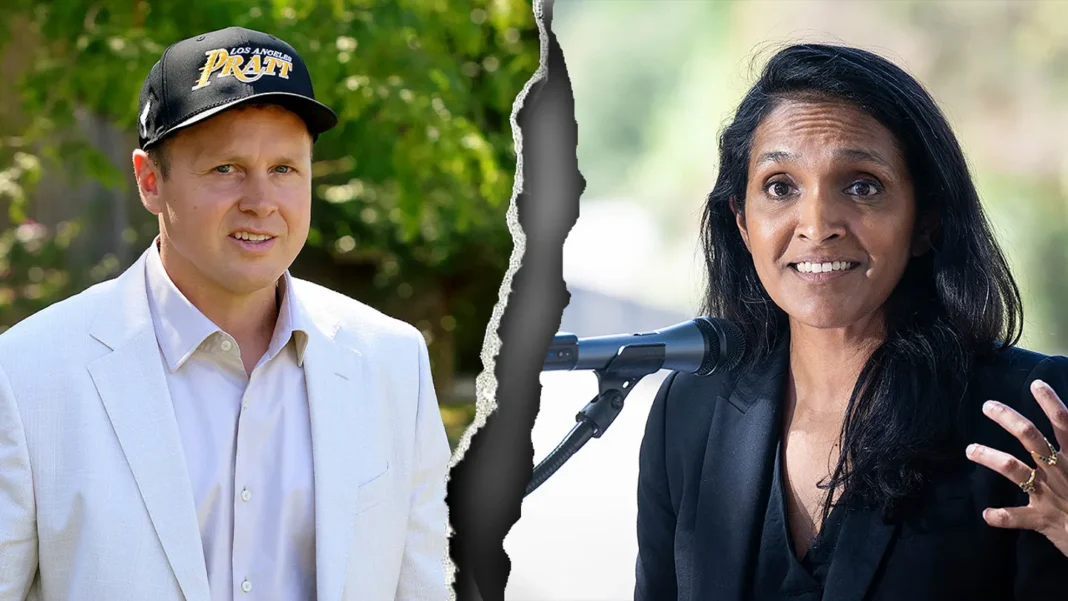
Los Angeles Councilmember Nithya Raman celebrated a newly painted neighborhood crosswalk this week, thanking her field team for continuing to problem-solve and make streets safer. Fox News reported that the project had first been raised by the Los Feliz Neighborhood Council late last year and that the celebratory post drew online mockery over the months-long timeline for a basic piece of street infrastructure. Raman is also a Democratic Socialists of America member and a mayoral candidate. Nothing says municipal revolution quite like fresh white paint.
Raman’s defenders can fairly say that local officials get blamed when basic services fail and mocked when they celebrate fixing them. That is true. The answer is not to stop fixing things. It is to develop a sense of scale. Competence becomes more persuasive when it does not demand applause every time the municipal government completes a task that residents already assumed was included in the taxes.
The underlying service is worthwhile. Crosswalks matter. Street design can reduce danger, and residents are entitled to ask government to fix small things before they become large ones. The comedy comes from the presentation. A city council office turned routine maintenance into a victory montage, complete with before-and-after images and a thank-you note to the governing process. Los Angeles did not land on Mars. It repainted where people walk.
The target is progressive municipal politics when it confuses the language of transformation with the delivery of ordinary services. Activists and candidates often describe city government as the place where structural change becomes tangible. Fine. Then tangible should be the easy part. A crosswalk should not require a heroic narrative arc. It should require paint, scheduling and somebody who knows where the intersection is.
The episode also exposes a problem for ideological candidates. The bigger the promises, the smaller ordinary wins can look. A socialist mayoral campaign naturally invites questions about housing, transit, public safety, homelessness, budgets and the machinery of a sprawling city. Against that backdrop, a crosswalk announcement can feel less like evidence of capacity and more like the trailer arriving before the movie has been financed.
Local government desperately needs people who care about unglamorous details. That is not the joke. The joke is pretending the detail is glamorous. If Raman wants voters to see the crosswalk as proof that her office can move a bureaucracy, she now has to demonstrate that the same persistence works when the problem involves more than a bucket of paint.
The reason los angeles took months to discover the crosswalk works as more than a one-day headline is that the underlying incentive does not disappear when the news cycle moves on. The people and institutions involved are being rewarded for a particular kind of behavior, whether that reward is attention, political loyalty, money, status or the comfort of avoiding a harder decision. That is the thread worth watching after the immediate controversy cools. A single episode can be dismissed as bad luck or bad optics. A repeated incentive becomes a governing or cultural habit. The useful test is not whether everyone involved can produce a defensible explanation. Most public controversies come with one. The useful test is whether the explanation would still sound reasonable if the names and teams were reversed. That is where satire earns its keep. It strips away the jersey and leaves the behavior sitting there by itself. The next development will matter because it will show whether this was an exception that embarrassed the people involved or a model they intend to keep using. If the same logic appears again, the story stops being an oddity and becomes a pattern. If the people involved change course, that is evidence too. That is why the closing question matters here: If a mayoral campaign treats a repainted crosswalk as proof of governing muscle, what happens when the city asks for something harder? Public life is full of arguments about motives that cannot be proved. Behavior is easier to judge. Watch what gets repeated, what gets rewarded, what gets quietly abandoned, and who is asked to absorb the cost. Those details usually tell the story more clearly than the slogans do.
Raman’s crosswalk post is a tiny story, but tiny stories can reveal a governing style. Progressive city politics often speaks in the language of systems, structures and transformation. Residents experience government at a much smaller scale. The pothole is either filled. The trash is either collected. The crosswalk is either visible. Ideology becomes credible when those mundane things happen without drama. When routine delivery requires a victory speech, the rhetoric starts competing with the result.
There is also a social-media incentive that pushes officials toward this kind of overstatement. Constituents rarely see the dozens of calls, permits, staff emails and scheduling problems behind a small project. Posting the finished result is a way to show work. The temptation is to narrate every completed task as proof of exceptional leadership because plain competence does not travel as far online. The algorithm wants a triumph. Municipal government usually offers a work order.
The better political move would be to make ordinary competence feel ordinary again. Fix the crosswalk, tell residents it is done, thank the people who requested it and move on to the next thing. Save the cinematic language for a project that changes how the city functions. Voters might even find the restraint refreshing. Los Angeles has enough drama without adding a third act to lane markings.
If a mayoral campaign treats a repainted crosswalk as proof of governing muscle, what happens when the city asks for something harder?
Sources
Fox News: Socialist mayoral candidate ignites online mockery for touting basic city service