




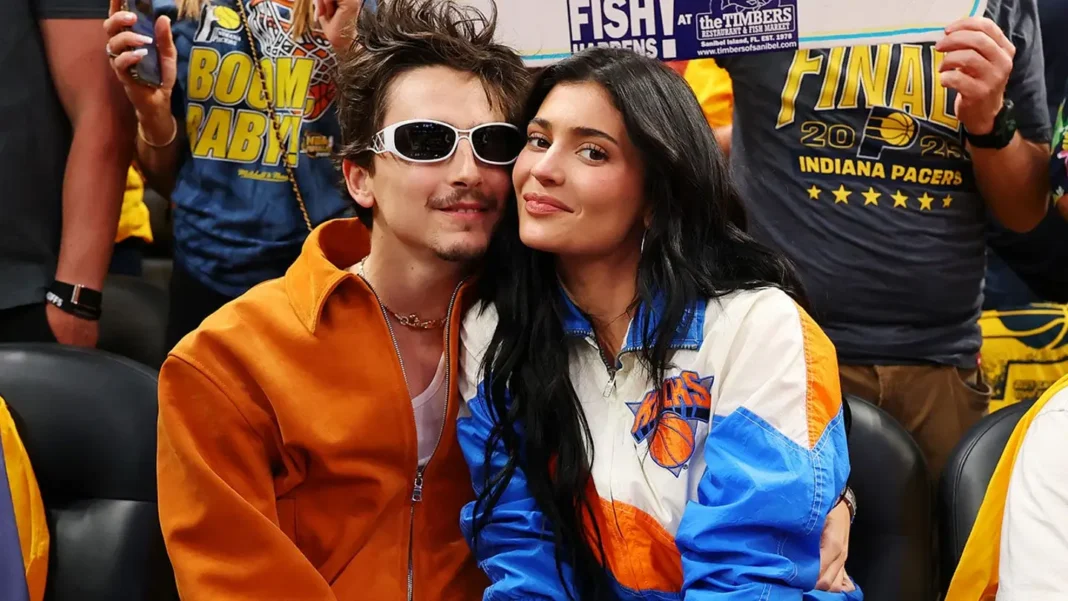
Kylie Jenner has become a New York Knicks fan through boyfriend Timothée Chalamet, and her basketball conversion has already acquired the only thing modern celebrity fandom truly requires. A wardrobe logistics problem. In an OutKick story published Thursday night and circulating Friday, Jenner discussed on the “Better Half” podcast how she fell for the Knicks after attending games with Chalamet and how courtside outfits require planning so she can actually sit down without worrying about what the cameras see.
There is nothing wrong with Jenner becoming a fan because her boyfriend took her to games. That is how millions of people acquire teams. Family, partners, geography and one unexpectedly fun night have created more sports loyalties than careful philosophical inquiry ever did. The funny part is how quickly a normal pathway into fandom becomes a public brand extension when the person entering the arena is already a brand.
Jenner said she had not followed basketball closely before attending her first Knicks game and then became invested in the team. She also described herself as lucky to have become a fan in time to watch the Knicks win a championship. Her comments about clothing were characteristically candid, including explicit language that does not need repeating here. The clean version is that courtside fashion and courtside sitting are not always natural allies.
The target is celebrity sports culture, where fandom can no longer remain a private emotional defect like it is for normal people. It has to become content. The ordinary fan wears the same unwashed jersey during a winning streak. The celebrity fan has stylists, photographers, relationship speculation and an entire secondary conversation about whether the outfit successfully communicated allegiance while preserving the architecture of the look.
The Knicks benefit from this arrangement because celebrity courtside culture is part of Madison Square Garden’s product. Cameras find famous people. Social media circulates the outfits. Fans argue about whether somebody is a real fan. The basketball game remains in the middle of the building, occasionally interrupting the content ecosystem with a score.
Jenner’s conversion is therefore almost perfectly contemporary. She discovered a team through a relationship, enjoyed winning, developed rituals and immediately had to explain her legitimacy to strangers. That is fandom. The only unusual part is that her version comes with designer clothes and enough cameras to make sitting down a strategic decision.
Celebrity courtside culture has always blurred sports and entertainment, but social media has turned every seat into a small production studio. The celebrity is watching the game while millions of other people watch the celebrity watch the game. Outfit choices become stories. Facial expressions become memes. A conversation during a timeout can become relationship analysis before the next possession ends.
That ecosystem creates a funny authenticity test. Longtime fans resent newcomers, especially famous newcomers, for arriving late to the emotional suffering. But sports teams actively court celebrity attention because it expands the audience and makes the arena look culturally important. The Knicks cannot simultaneously enjoy the cameras pointed at Jenner and complain that people are discussing Jenner. Madison Square Garden knows what business it is in.
Jenner may eventually become the sort of fan who can recite rotations and complain about defensive coverages. Or she may simply enjoy games with Chalamet. Both are allowed. The internet’s insistence on certifying fandom is the stranger behavior. Sports are supposed to recruit people. The only initiation requirement should be discovering that your mood is now controlled by adults you have never met throwing a ball.
The reason kylie jenner became a knicks fan and immediately found a wardrobe problem works as more than a one-day headline is that the underlying incentive does not disappear when the news cycle moves on. The people and institutions involved are being rewarded for a particular kind of behavior, whether that reward is attention, political loyalty, money, status or the comfort of avoiding a harder decision. That is the thread worth watching after the immediate controversy cools. A single episode can be dismissed as bad luck or bad optics. A repeated incentive becomes a governing or cultural habit. The useful test is not whether everyone involved can produce a defensible explanation. Most public controversies come with one. The useful test is whether the explanation would still sound reasonable if the names and teams were reversed. That is where satire earns its keep. It strips away the jersey and leaves the behavior sitting there by itself. The next development will matter because it will show whether this was an exception that embarrassed the people involved or a model they intend to keep using. If the same logic appears again, the story stops being an oddity and becomes a pattern. If the people involved change course, that is evidence too. That is why the closing question matters here: If celebrity fandom now requires courtside fashion strategy before the opening tip, is anyone still allowed to just watch the game? Public life is full of arguments about motives that cannot be proved. Behavior is easier to judge. Watch what gets repeated, what gets rewarded, what gets quietly abandoned, and who is asked to absorb the cost. Those details usually tell the story more clearly than the slogans do.
If celebrity fandom now requires courtside fashion strategy before the opening tip, is anyone still allowed to just watch the game?
Sources