




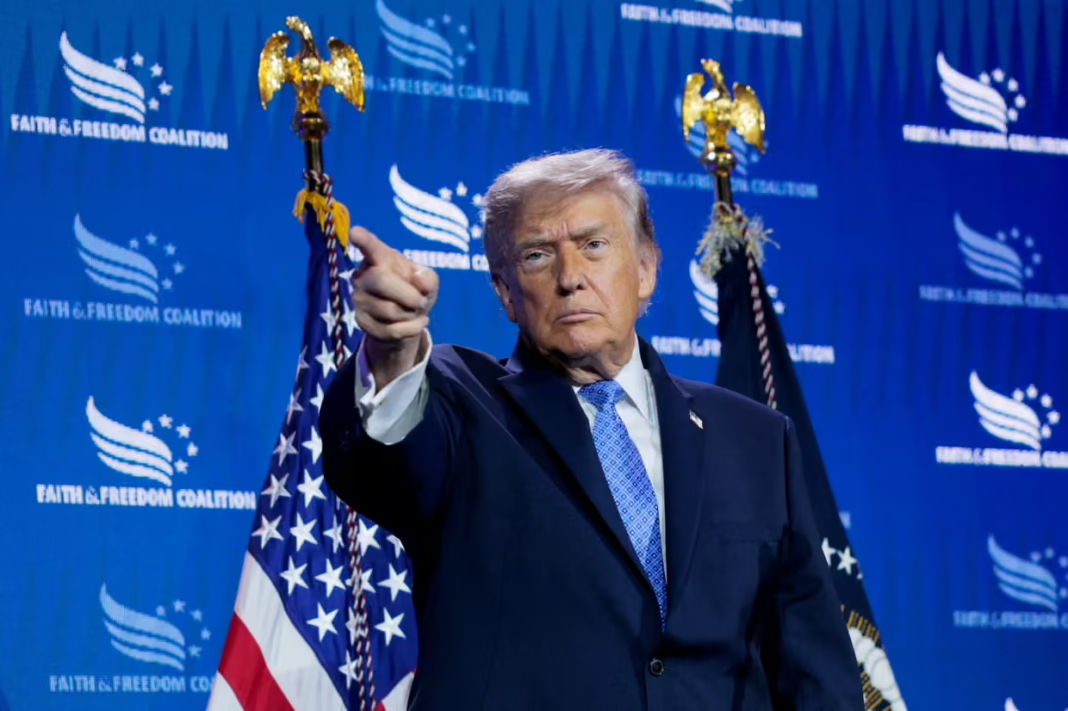
The Guardian’s Friday politics podcast asked a straightforward question with an awkward backdrop. How did Donald Trump get so rich? The episode notes that Trump has personally made billions of dollars since returning to office while his administration has pursued trade wars, fought military conflicts and governed as the national debt passed $40 trillion. The president has spent years presenting wealth as proof that he understands money. The country is now getting the master class while he keeps the tuition.
This does not mean Trump personally profits from every tariff or policy. That would be an unsupported leap. It means his presidency is unusually difficult to separate from his commercial identity. Trump-branded ventures, investments and licensing have always been part of the public story. Returning to the White House did not make the brand disappear. It made every increase in personal wealth politically legible.
The podcast features Forbes journalist Dan Alexander discussing the growth of Trump’s fortune and the relationship between his business interests and presidency. The important point for BuzzyTimes is not to turn every dollar into an allegation. Wealth itself is not wrongdoing. The absurdity is the political contrast. Trump’s economic message asks voters to accept disruption, tariffs and uncertainty as the price of a stronger country while his own financial story is moving in the opposite direction from the sacrifice narrative.
The Trumpiverse target is the merger of personal brand and public office. Most presidents try to persuade voters that policy success will eventually show up in household finances. Trump has an additional metric sitting in plain sight. His own balance sheet. When the president becomes richer during a period in which he is asking citizens to tolerate higher costs for strategic reasons, the optics do not require an opposition researcher. They arrive preassembled.
That matters because Trump’s economic politics are intensely personal. He describes deals as wins and losses, countries as taking advantage of America, and policy disputes as contests of strength. Voters are asked to judge whether he is winning on their behalf. If his own wealth is visibly rising while households complain about prices, opponents have an obvious reply. Somebody is certainly winning.
The deeper problem is trust. Economic policy often requires patience. Tariffs can impose near-term costs in pursuit of longer-term goals. Voters may accept that if they believe the burden is shared and the strategy is coherent. A president whose personal fortune is expanding has to work harder to persuade people that national sacrifice is not another transaction in which he somehow found the premium seat.
The wealth question is particularly potent because Trump has always made money part of his political character. He did not enter politics pretending to be detached from business success. He sold business success as evidence that he could run the country. That makes scrutiny of his fortune unavoidable. The metric was his before it was anybody else’s.
Presidents normally face conflict-of-interest questions because public decisions can affect private assets. Trump’s sprawling brand makes the boundary unusually visible and unusually difficult for voters to follow. The answer is not to assume corruption every time an investment rises. It is to insist on enough disclosure and separation that the public does not have to guess. Suspicion grows fastest where complexity and secrecy overlap.
The midterms will give the contrast political force. Republicans will ask voters to judge Trump’s economy. Democrats will ask whether households feel better off. Trump will keep pointing to national indicators and deals he calls victories. His critics will keep pointing to prices and his own wealth. In a presidency built around winning, the most uncomfortable question may be who the scorecard says is winning.
The reason trump got richer while america got the economic lecture works as more than a one-day headline is that the underlying incentive does not disappear when the news cycle moves on. The people and institutions involved are being rewarded for a particular kind of behavior, whether that reward is attention, political loyalty, money, status or the comfort of avoiding a harder decision. That is the thread worth watching after the immediate controversy cools. A single episode can be dismissed as bad luck or bad optics. A repeated incentive becomes a governing or cultural habit. The useful test is not whether everyone involved can produce a defensible explanation. Most public controversies come with one. The useful test is whether the explanation would still sound reasonable if the names and teams were reversed. That is where satire earns its keep. It strips away the jersey and leaves the behavior sitting there by itself. The next development will matter because it will show whether this was an exception that embarrassed the people involved or a model they intend to keep using. If the same logic appears again, the story stops being an oddity and becomes a pattern. If the people involved change course, that is evidence too. That is why the closing question matters here: If Trump’s personal fortune keeps rising while voters absorb the costs of his economic agenda, how long can he keep selling sacrifice as shared? Public life is full of arguments about motives that cannot be proved. Behavior is easier to judge. Watch what gets repeated, what gets rewarded, what gets quietly abandoned, and who is asked to absorb the cost. Those details usually tell the story more clearly than the slogans do.
If Trump’s personal fortune keeps rising while voters absorb the costs of his economic agenda, how long can he keep selling sacrifice as shared?
Sources
The Guardian: How did Trump get so rich? – Podcast
The Guardian: How did Trump get so rich? | Politics Weekly America
The Guardian: Alarm bells over conflict of interest as filing shows Trump raked in $2bn in 2025