



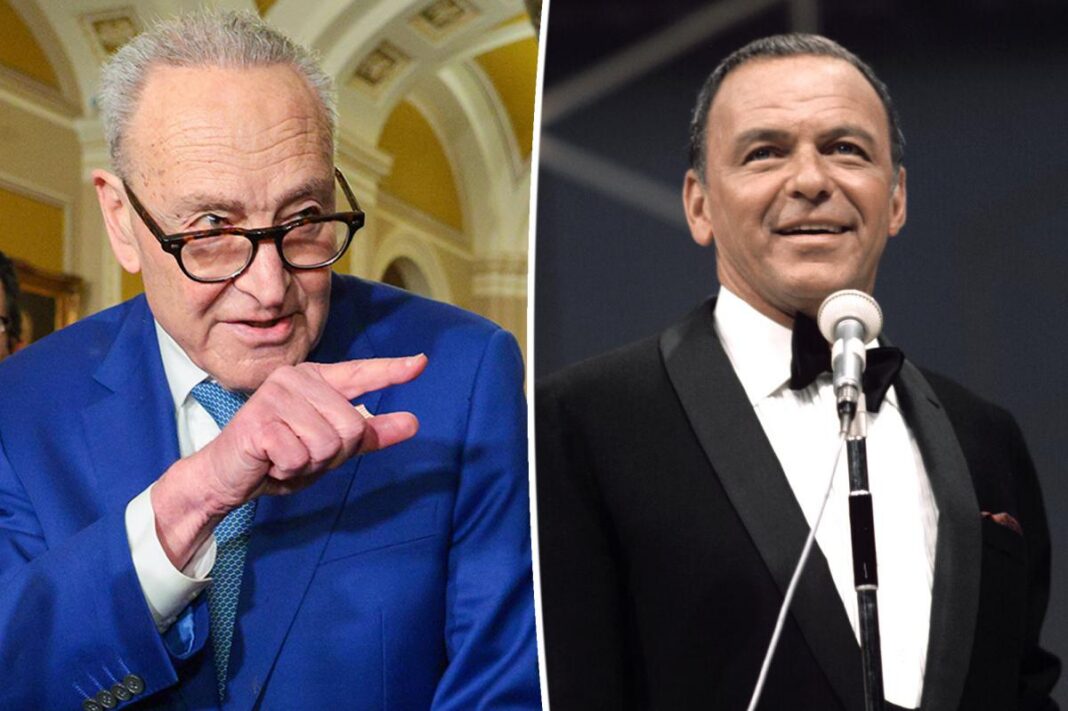
The Democratic fight over Senate leadership has acquired a celebrity endorsement so exclusive that the celebrity has been dead since 1998. Frank Sinatra appeared on a list of prominent people opposing Chuck Schumer's return to the top Senate job. The explanation was not a séance, an unearthed political statement or an unusually ambitious exercise in artificial intelligence. It was a prank by someone working for Schumer.
Old Blue Eyes enters the leadership race
The New York Post reported that Schumer campaign spokesman Angelo Roefaro put Sinatra's name into a shared document associated with support for Maryland Sen. Chris Van Hollen's leadership challenge. The effort comes as Democrats prepare to take congressional power in January. A letter from celebrity supporters and donors was intended to make the case for a different direction.
Sinatra, who died before Schumer entered the Senate, was obviously in no position to weigh the candidates' relative merits. That is the entire premise of the joke. It is also why the singer's appearance on the list was such a conspicuous sign that something was wrong with the document.
The actual leadership contest is not decided by entertainers. Senate Democrats choose their leader, and a public appeal from famous supporters is an attempt to influence that decision rather than a formal vote. Sinatra's contribution, had it been possible, would therefore have been principally decorative.
A Google document becomes a political weapon
Roefaro acknowledged to the Post that he was responsible for adding the name, arguing that the incident illustrated problems with the way the list was handled. He maintained that Schumer himself knew nothing about the prank. The altered document was briefly posted on X by a New York Times reporter before the post was removed.
Political consultant Alyssa Cass said she had passed the list to the newspaper and arranged for the error to be corrected promptly. She also told the Post that her firm was not participating in the campaign against Schumer. Her account places the incident squarely in the world of shared documents, political intermediaries and hurried media distribution.
There are important limits to what the prank establishes. Someone inserting a false name into a document does not prove that every other name was false or that the campaign's organizers deliberately invented endorsements. Nor does the episode establish that the reporter knowingly circulated inaccurate information. It shows how easily a manipulated version can travel beyond its intended audience.
Hollywood meets Senate procedure
Celebrity support has long been part of American political publicity. A recognizable actor can draw attention to an issue that might otherwise attract little interest outside Washington. A list of prominent names can also project momentum, especially when activists are trying to convince elected officials that their constituents want change.
But there is a considerable difference between selling tickets to a concert and assembling votes in a Senate caucus. Senators have institutional interests, electoral concerns and working relationships that are not necessarily affected by the entertainment industry's preferences. Whatever the genuine signatories think, their letter cannot substitute for those votes.
Schumer's camp has argued that he has the support needed to retain his leadership position. That remains the camp's assessment, not proof that the contest has been settled. Van Hollen's challenge reflects a dispute over how Democrats should use their renewed power, a question that deserves more attention than a prank in a spreadsheet-adjacent environment.
The real lesson is painfully ordinary
The incident is an unusually entertaining reminder of a very ordinary administrative problem: documents that circulate among multiple people can be changed, and the version a recipient sees may not be the intended final version. Political communication raises the stakes because a screenshot can reach thousands of people before anyone checks the original.
In any serious endorsement effort, the important evidence is whether the named people actually agreed to support it. The same principle applies whether the names belong to donors, actors or obscure local officials. An authentic list is worth more than a glamorous one with uncertain provenance.
For Schumer's spokesman, the prank produced an attention-grabbing story that shifted discussion away from the challenger and onto the challenger’s publicity operation. Whether that helps his boss in the actual caucus contest is another matter entirely. A funny stunt is not a substitute for a convincing argument about leadership.
As Democrats debate their political future, they have inadvertently provided a lesson in document management and an excellent excuse to revisit the Sinatra catalog. The singer himself remains unavailable for comment. At least one participant in this particular Washington scandal has an absolutely airtight alibi.