



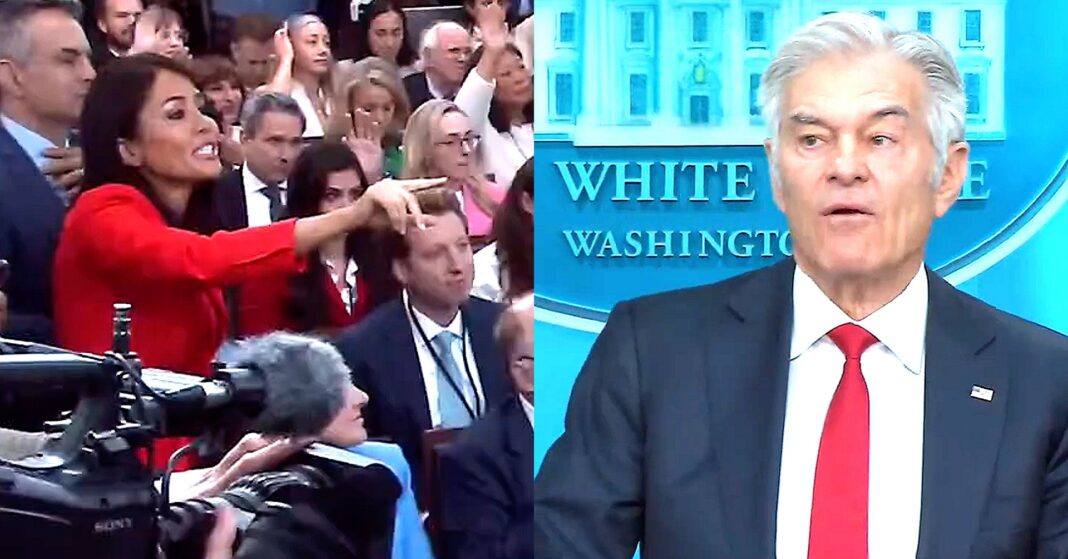
A White House press briefing closed Tuesday with a question that managed to be both entirely predictable and somehow still remarkable: a reporter from MyPillow CEO Mike Lindell’s LindellTV asked Dr. Mehmet Oz, the celebrity physician now running the Centers for Medicare & Medicaid Services, if he had any medical advice for Americans suffering from Trump Derangement Syndrome.
Cara Castronuova posed the question as Oz wrapped up his briefing appearance filling in for Press Secretary Karoline Leavitt. Oz had just announced he was taking one last question when Castronuova jumped in.
“Do you have any medical advice for the Americans out there that are suffering from a very serious ailment called Trump Derangement Syndrome?” she asked.
Oz responded as though the question merited a clinical answer. He said he was “concerned about folks who have focused their entire life energy on dislike of the president.” When Castronuova pressed again for medical advice, Oz replied, “Treating stupid is really hard.”
The briefing room as performance space
The exchange is notable less for what it reveals about Oz than for what it demonstrates about the White House briefing room under this administration. The briefing is no longer a venue where reporters ask questions designed to inform the public. It is increasingly a stage where friendly outlets perform loyalty and Cabinet officials reward them with soundbites designed to go viral in spaces where the presidency’s critics are referred to as diseased.
Castronuova works for LindellTV, an outlet run by a man who has spent years promoting conspiracy theories about the 2020 election and who remains one of Trump’s most visible supporters. Her question was not journalism. It was brand alignment.
Oz didn’t deflect. He didn’t laugh it off. He diagnosed Trump’s opponents as “stupid” and suggested their condition was untreatable. That’s not a doctor talking. That’s a surrogate.
The GLP-1 pivot nobody asked for
After the Trump Derangement Syndrome exchange, another reporter bulldozed in with a question about whether Americans would receive brand-name medications like Wegovy and Ozempic under Trump’s $50 monthly prescription plan, which Oz has been promoting as “Trump Rx.” Oz confirmed the program would include “the real deal” medications from Novo Nordisk and Eli Lilly.
The whiplash from diagnosing political opponents as incurably stupid to hawking weight-loss drugs under a presidential brand name was swift. It also raised a question the briefing room did not pursue: whether a public health official should be using his position to promote a program that carries the sitting president’s name as though it were a product line rather than a government initiative.
What we’re watching
This is not the first time a Trump Cabinet official has treated the briefing room as friendly territory rather than contested ground. It will not be the last. The question is whether the press corps that remains in that room continues to treat these sessions as opportunities for accountability or whether they accept the room’s redefinition as a venue where only certain questions are welcome and certain reporters get called on.
The briefing room has always been theater. The difference now is that some of the performers are openly auditioning for the same side. And the official at the podium is calling the opposition stupid on the record, in front of cameras, without apparent concern that doing so might undermine the credibility of the office he holds.
That used to be the kind of thing that ended badly for the person saying it. Now it’s the kind of thing that gets you invited back.
The question worth sitting with: at what point does a White House briefing stop being a briefing and become an infomercial with a presidential seal, and does anyone with the access to ask that question out loud still have the interest in doing so?
Sources: