



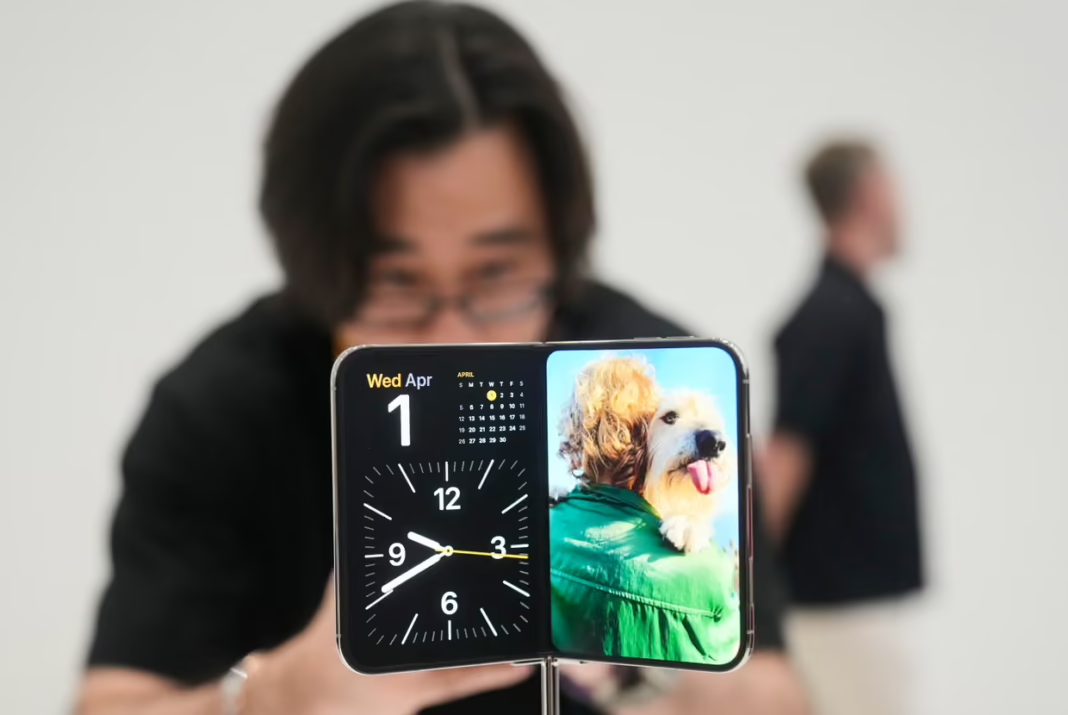
Apple has finally made a foldable iPhone, which means the company has reached the stage of innovation where the phone can now imitate a wallet while costing more than many wallets contain. The new iPhone Duo opens like a small book, carries a 7.6-inch inner display and starts at $1,999. Apple calls it a major new chapter. Customers may call it the first phone purchase that should probably come with escrow.
The device was unveiled at Apple’s ‘Surprise and Shine’ event, the first major product showcase under new chief executive John Ternus. The Guardian described the Duo as Apple’s first foldable phone and a major test for Ternus after he succeeded Tim Cook. The Sun likewise reported the $1,999 price, passport-style fold, A20 Pro chip, dual screens and return of Touch ID through a side-mounted sensor. Apple has entered the foldable market several years after rivals and, in classic Apple fashion, arrived late enough to charge admission.
There is nothing inherently silly about a foldable phone. A larger screen that still fits in a pocket is useful. Samsung, Google and other manufacturers have already demonstrated that some people enjoy the format. The engineering is difficult, hinges matter, display durability matters and software has to adapt. Apple’s version may be excellent. The comedy is the company presenting the form factor with the solemnity of a constitutional amendment after spending years watching everyone else beta-test the crease.
The price does most of the satirical labor by itself. Two thousand dollars is no longer a phone price. It is a financial relationship. At that level the device should remember your anniversary, dispute suspicious charges and explain itself to your spouse. Apple is betting that enough customers will view a folding screen as a premium leap rather than an invitation to compare the purchase with a laptop, a vacation or several months of electricity.
The Duo also arrives as Apple tries to reset its public story around artificial intelligence. The company has spent years being portrayed as behind rivals in generative AI, then used the new hardware launch to promote a more capable Siri and new AI features. That creates a familiar tech-industry maneuver. When software leadership is uncertain, make the rectangle physically more complicated. Nothing says strategic momentum like adding a hinge while the chatbot catches up.
Apple’s defenders will point out that first-generation premium products are often expensive. Fair. The original iPhone was expensive for its time. Early foldables from competitors also carried eye-watering prices. But Apple has built its modern empire by turning luxury into normality one upgrade cycle at a time. A $1,999 Duo is therefore less interesting as a niche gadget than as a test of how far consumers will follow the annual ritual of being told that last year’s perfectly functional slab has become emotionally incomplete.
There is also something wonderfully Apple about the return of Touch ID on a device marketed as the future. Face ID has been the company’s preferred authentication story for years, but the Duo brings fingerprint scanning back through the side button. Innovation occasionally means rediscovering the feature you removed, relocating it and placing it next to a processor with a newer number. Technology moves in circles. Apple simply polishes the circle before launch.
The company is not wrong that foldables can change how people use phones. A wider internal display can improve multitasking, reading, video and creative work. The question is whether the benefit is large enough to justify the cost and the compromises that come with hinges, unusual dimensions and more fragile display technology. For enthusiasts, maybe. For everyone else, the most revolutionary feature may be discovering that the old iPhone still turns on.
Ternus also inherits a uniquely difficult job because Apple is no longer judged like an ordinary hardware company. Every launch must prove that a $4.5 trillion business has discovered another future large enough to keep growing. A competent phone update is not enough. A foldable phone therefore arrives carrying corporate symbolism far heavier than the device itself. It has to be a product, a leadership debut, an innovation narrative and a rebuttal to years of criticism, all while fitting in a trouser pocket. The launch also shows how mature smartphones have become. Cameras improve, chips get faster and batteries last longer, but the category is so refined that manufacturers increasingly need physical spectacle to make an upgrade feel dramatic. Folding the screen creates that spectacle instantly. Whether it creates two thousand dollars of practical value is the less cinematic question Apple leaves to checkout. The broader test is whether the people making the claim can defend it once the applause stops. Campaign rhetoric can survive on labels, symbols and timing. Governing, budgeting and consumer behavior usually demand numbers, trade-offs and consequences. That is where this story becomes more than a clip, because the contradiction has to survive ordinary reality. The launch is therefore a useful test of Apple’s pricing power under new leadership. Ternus does not need every customer to buy the Duo. He needs enough people to want it that the rest of the lineup looks reasonably priced by comparison. At two thousand dollars, the halo has become a financing plan.
Apple has earned the right to charge premium prices because millions of customers trust its hardware, software and ecosystem. But premium eventually becomes theater if every incremental novelty is framed as destiny. The Duo may be brilliant. It may also become the most elegant way yet to fold two thousand dollars in half.
If the iPhone Duo is the future, how much of that future is the hinge and how much is the $1,999 price tag?
Sources
The Guardian: Apple unveils folding iPhone Duo as new CEO takes center stage
The Guardian: Apple’s new CEO introduces himself at annual showcase: ‘I continue to be inspired every single day’
The Sun: Apple unveils first foldable £1,999 iPhone Duo that opens like a BOOK & iPhone 18 Pro with 45-HOUR battery life