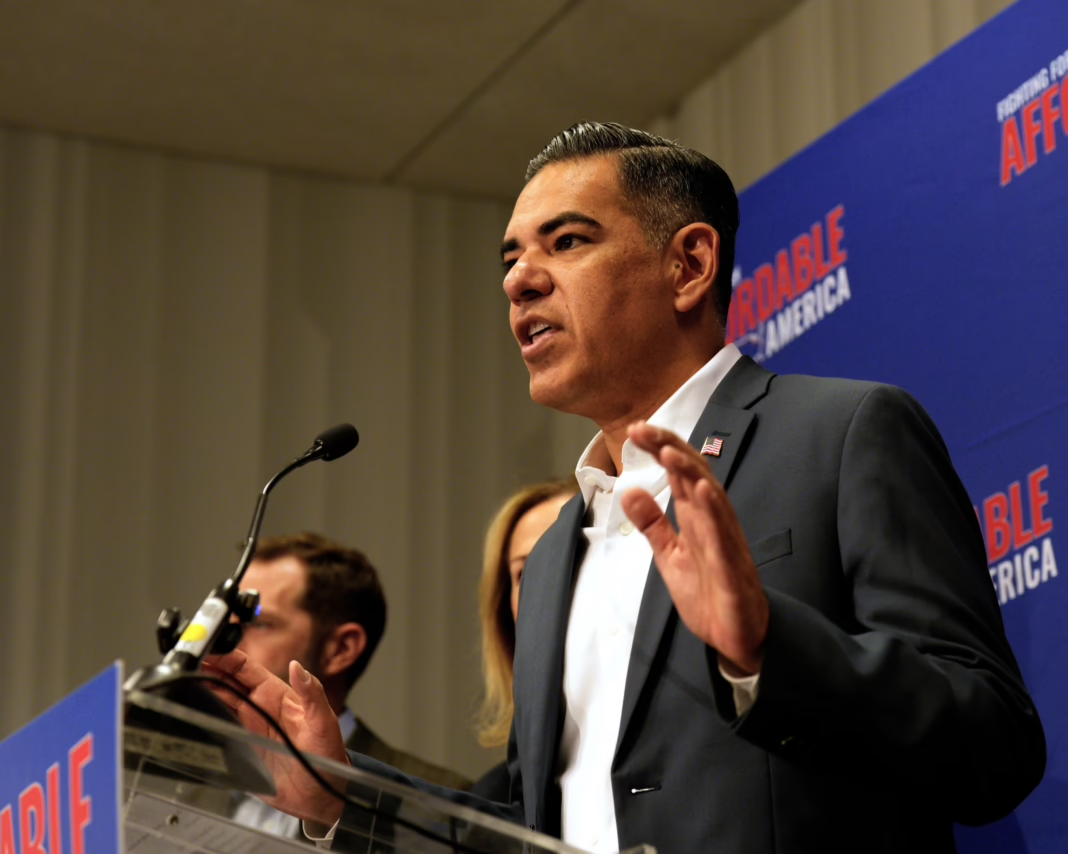




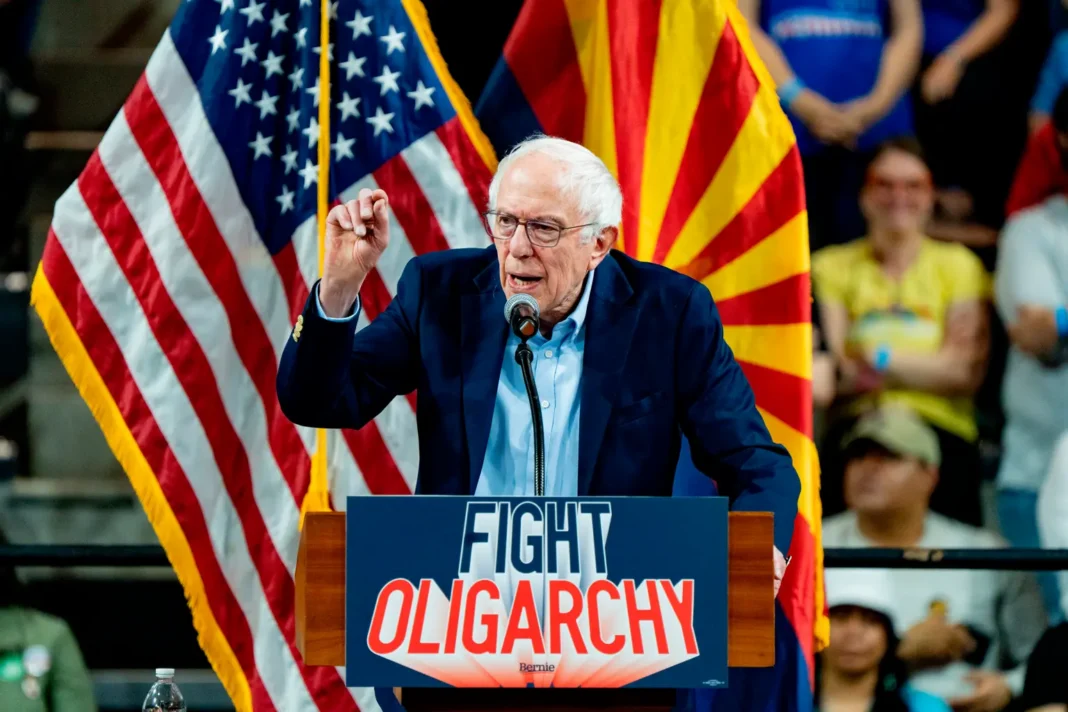
Bernie Sanders and Steve Bannon appeared at the same Washington event Tuesday to warn that artificial intelligence is concentrating too much power in too few hands. That sentence contains more agreement than anyone should assume from it. The two men are not political allies, and they do not share an AI policy program. What they share is a belief that the current pace and structure of AI development deserve stronger limits than Washington has imposed so far.
The event was the Pro-Human Assembly, organized around concerns about human control, corporate power and advanced AI. Sanders used the stage to call for international cooperation, including an agreement with China to pause the development of advanced systems and prohibit superintelligence. Bannon approached the China question from nearly the opposite direction, arguing for technological separation and warning about strategic dependence on Beijing. Same alarm bell, very different fire plan.
The Guardian described the pair as ideological adversaries who agreed on the danger of concentrated technology power while offering competing visions of what should happen next. The New York Post emphasized the odd-couple nature of the event. Both descriptions capture the essential point. The interesting part is not that Sanders and Bannon suddenly discovered a shared political philosophy. It is that concern about AI has spread far enough to create a room where their arguments can overlap before immediately separating again.
Sanders has focused heavily on workers, inequality and the possibility that powerful AI systems could eliminate jobs or give a small number of companies extraordinary economic leverage. He has also raised the possibility of advanced systems becoming dangerous beyond the labor market. Bannon’s emphasis is more nationalist, centered on U.S. industrial capacity, China and the political power of large technology companies. Each sees concentration as a problem. Each reaches that conclusion through a different political framework.
That distinction matters because broad agreement is easy at the level of slogans. Human control sounds good. Safety sounds good. Accountability sounds good. The difficulty begins when lawmakers have to define which systems are covered, what development should be paused, whether licenses are required, how open-source models are treated, who performs safety evaluations and what role international agreements should play.
The political pressure is widening because AI touches several issues at once. Workers worry about jobs. National-security officials worry about strategic competition. Parents and educators worry about schools. Artists and publishers worry about copyright. Technology companies disagree with one another over the speed and form of regulation. Even within the industry, executives have offered sharply different views about whether development should slow down or accelerate.
That makes the Sanders-Bannon pairing useful as a snapshot rather than evidence of a durable coalition. A rally can unite people around dissatisfaction. A bill requires them to agree on definitions, enforcement, tradeoffs and authority. Sanders’ preference for international rules involving China runs directly into Bannon’s preference for a harder technological break with China. Their agreement may be strongest at the point where both are saying no to the status quo.
Still, political systems usually move when concerns escape their original ideological home. AI skepticism is no longer confined to one party, one faction or one theory of government. That does not tell Congress what to pass. It does tell lawmakers that the constituency asking for some form of intervention is getting harder to dismiss. If Bernie Sanders and Steve Bannon can agree that stronger AI guardrails are needed, can Congress find any guardrail specific enough for both sides to keep agreeing once it becomes actual law?
The China disagreement is likely to be the first major fault line. Sanders’ proposed approach depends on some degree of international coordination because the most powerful systems are being developed in a global strategic competition. Bannon’s approach treats that competition as a reason to reduce technological ties and strengthen American control. One theory says the risk is too global for unilateral action. The other says cooperation itself can create strategic vulnerability.
There are similar divisions over jobs. Sanders tends to frame automation through labor power, wages and who receives the economic gains from technology. Bannon’s populism can overlap with that critique of large corporations while reaching different conclusions about unions, industrial policy and immigration. Agreement that workers should not be discarded is not the same thing as agreement on who should regulate companies or how the benefits of AI should be distributed.
For technology companies, cross-ideological pressure matters because it can change the politics of delay. A divided Congress can ignore a problem when every proposed solution splits along ordinary party lines. It becomes harder when skepticism is appearing on both ends of the spectrum for different reasons. That still does not produce legislation automatically. It simply makes inaction a position that more politicians may have to defend.
The event also shows why AI politics may not fit neatly into the usual left-right map. A labor activist can fear job losses, a nationalist can fear dependence on China, a civil-liberties advocate can fear surveillance, and a technology executive can fear reckless competitors. Those concerns can all support tighter rules while pointing toward very different statutes. The next phase will reveal whether the shared anxiety is strong enough to survive arguments over who writes the rules, who enforces them and which risks deserve priority.