




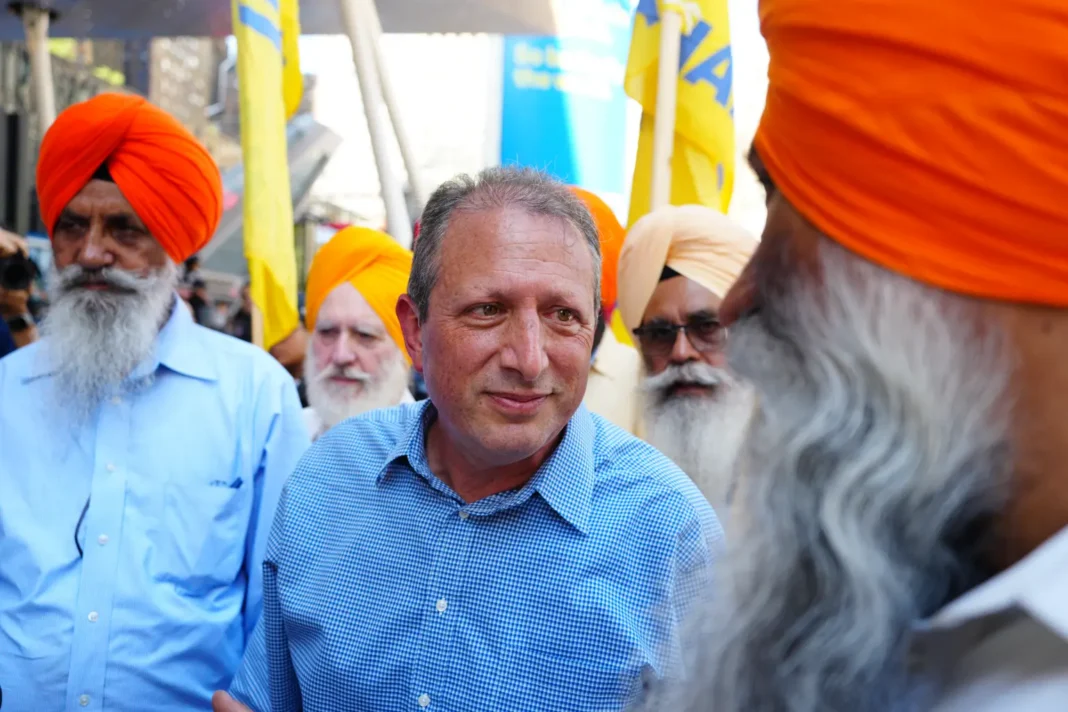
Brad Lander went to a protest in Manhattan on Saturday and discovered that being a progressive Democrat does not guarantee admission to the progressive Democrat portion of the sidewalk. The New York Post reported that Lander, the Democratic congressional nominee and former city comptroller, joined demonstrators outside Madison Square Garden protesting an appearance by Mohan Bhagwat, leader of India’s Hindu nationalist Rashtriya Swayamsevak Sangh. Instead of welcoming him, some protesters denounced Lander as a Zionist and directed antisemitic abuse at him. Politics has now perfected the self-checkout lane: scan your beliefs, place them in the bagging area, and wait for the machine to announce that an unexpected ideology has been detected.
The underlying protest had a real subject. Critics of the RSS have accused the organization of promoting an exclusionary Hindu nationalist ideology and hostility toward religious minorities. The RSS disputes allegations against it. New York Mayor Zohran Mamdani had criticized the organization ahead of Bhagwat’s event while acknowledging that the city could not cancel a private gathering. Lander, who is Jewish, has also been a critic of Israeli government policy. None of that was apparently sufficient for the protesters who decided his Zionism disqualified him from standing beside them.
According to the Post, the confrontation became ugly enough that Lander left the demonstration for his safety. The paper quoted protesters using an antisemitic slur and demanding that he leave. That distinction is important because this is not satire about activists merely disagreeing with a politician. Disagreement is the whole point of a protest. The target is a political culture in which coalition membership can be revoked on contact, even when two people showed up to oppose the same thing. The left has spent years teaching seminars on intersectionality and somehow still struggles with the advanced course called standing next to somebody you do not completely agree with.
Lander is an especially revealing person for this to happen to. He is not a Republican wandering into a rally wearing a campaign hat and asking for a group photo. He has long operated on New York’s progressive flank and has criticized Israel’s conduct while identifying as a liberal Zionist. That should make him useful in a coalition trying to distinguish opposition to Hindu nationalism, Israeli policy or any other government from hostility toward an ethnic or religious group. Instead, his presence became an opportunity for a smaller faction to demonstrate ideological dominance. Nothing says broad-based movement like physically shrinking the group.
This is where too-woke politics repeatedly turns its own moral vocabulary into a bouncer. A movement begins with a claim about justice, rights or state power. Then the internal argument shifts from what should be changed to who is pure enough to demand the change. Eventually the most energetic people are not persuading outsiders. They are auditing allies. Every cause acquires a password. Every coalition gets a velvet rope. The reward for passing today’s test is learning that tomorrow’s test has been updated.
There is also a practical political cost. Lander is running for Congress. Mamdani is mayor. New York Democrats need Jewish voters, Muslim voters, Indian American voters, progressives, moderates and people who have never once used the phrase “settler colonialism” before breakfast. A party that wants to govern a city this complicated cannot organize itself like a private group chat where one disputed belief earns removal. The point of a coalition is that its members disagree on things. Otherwise it is not a coalition. It is a dinner reservation.
The Post is a conservative outlet and framed the episode aggressively, so its characterization of the broader protest should be treated accordingly. But the reported abuse aimed at Lander is the part that matters. Antisemitic language does not become enlightened because the speaker has progressive politics, and a Jewish politician does not become responsible for every action of the Israeli state because someone at a rally says so. The left is usually quick to explain why collective blame is intellectually lazy. It should remain lazy when the target is Jewish.
The irony is that movements obsessed with language often underestimate what their own language communicates. If a protest against exclusionary nationalism cannot tolerate a liberal Jewish ally because he uses the wrong label for his relationship to Israel, the demonstration starts making an argument about itself. The loudest activists may feel they protected the cause from contamination. Everyone watching from outside sees a movement that found an ally, checked his paperwork and sent him home.
There is a difference between drawing moral boundaries and making boundary-drawing the movement’s main activity. Coalitions need limits. Nobody is obligated to march beside someone advocating the opposite cause. But Lander was reportedly at the event to protest the same speaker. The dispute was over whether his other political commitments made his presence unacceptable. That is the sort of test that can multiply forever because every participant has another position, association or imperfect phrase waiting to be audited. The result is not greater ideological clarity. It is a movement that spends scarce attention sorting allies into increasingly precise categories while the people it hopes to defeat watch from across the street. Purity can feel powerful inside a crowd. Elections have the annoying habit of counting everybody outside it too.
That is also why the episode should not be reduced to a left-versus-Israel argument. The immediate absurdity is procedural. A public protest is supposed to make a case to people beyond the people already holding signs. Sending away a recognizable elected ally because his ideological biography contains a disfavored word does the opposite. It turns persuasion inward and makes membership the product. Movements can survive internal arguments. They usually need them. What they cannot do indefinitely is confuse the intensity of an internal consensus with the size of an external majority.
If a progressive coalition cannot make room for Brad Lander at a protest he supports, exactly how many voters is it planning to make room for in November?
Sources
New York Post: Dem pol Brad Lander ripped as Zionist by lefty protesters outside Hindu-nationalist speech at MSG
The Guardian: Abdul El-Sayed apologizes for comment about Michigan synagogue attack
Fox News: One question about the Constitution puts liberals appetite for sweeping change to the test