



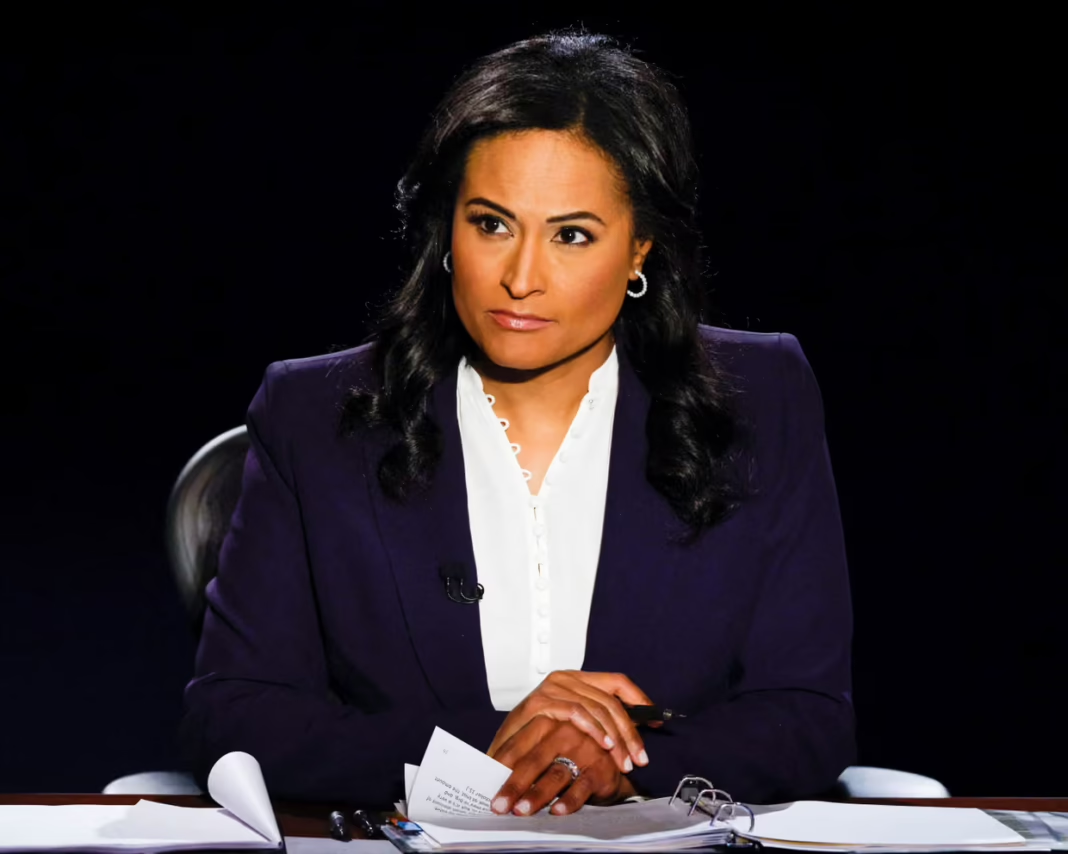
Donald Trump has identified another urgent federal regulatory matter: Kristen Welker said his endorsement record had “mixed results.” On Sunday, the president wrote that the NBC “Meet the Press” moderator should be reported to the Federal Communications Commission for “rebuke or punishment” over that characterization. Fox News and the Guardian both reported the threat. The FCC regulates broadcasters. It does not traditionally function as a presidential Yelp desk for sentences the president finds insufficiently complimentary, but Trump has never been overly constrained by a job description when a grievance is available.
Welker’s offending phrase came during a live NBC4 Washington appearance before Sunday’s “Meet the Press.” Trump responded by pointing to his strong primary record. Fox News reported that candidates he endorsed had won all 24 Republican Senate primaries in which he backed someone and 214 of 218 House primaries, roughly 98 percent. Those are plainly impressive numbers. They also do not make the phrase “mixed results” a federal offense. A political argument about how much credit an endorsement deserves can usually be settled with more statistics, a campaign memo or several hours of cable television. Trump would prefer a regulator.
NBC defended Welker, calling her one of the best in the business. The Guardian noted that legal experts say the FCC does not have authority to punish an individual journalist for commentary of this kind. That should be the end of the institutional question. The president can complain about coverage. He can call it wrong. He can post charts until Truth Social runs out of pixels. The strange part is the reflex to attach government power to the complaint, as though every unfavorable adjective should arrive with a federal case number.
This is pure Trumpiverse because the substantive dispute is almost comically small compared with the proposed response. Trump is not alleging that NBC jammed emergency frequencies or sold spectrum under the table. A journalist summarized his electoral influence in a way he disliked. The president then invoked the agency that licenses broadcast stations. It is the governing equivalent of calling the building inspector because the waiter said your golf score was “pretty good.
The episode also fits a broader pattern. Trump has repeatedly attacked major broadcasters and journalists, while his administration has pushed regulatory and legal pressure against media organizations he considers hostile. The Guardian placed the Welker threat in that context. Supporters argue that powerful media companies should not be immune from scrutiny and that broadcasters using public airwaves have obligations. Fair enough. But scrutiny of a broadcaster’s legal obligations is different from threatening punishment because its moderator used a debatable description of election results. One is regulation. The other is customer service with a seal.
Trump’s own numbers make the overreaction more unnecessary. If his endorsement record is as dominant as he says, the easiest answer is to publish the record and enjoy it. A politician with a 100 percent Senate-primary batting average should not need Brendan Carr to explain the box score. Yet Trump’s political style rarely permits a slight to remain a slight. Criticism becomes corruption. Disagreement becomes dishonesty. A television host’s wording becomes a question for federal authority. Every pebble gets promoted to a constitutional crisis before lunch.
There is a practical problem for Republicans too. Trump wants voters to treat the midterms as a referendum on him, and his endorsement power is part of that argument. If the White House spends its time demanding official consequences for journalists who describe that power imperfectly, the conversation shifts away from the wins and toward the threat. The president takes a statistic that helps him and wraps it in a story about punishing the press. It is difficult to design a more efficient way to turn 98 percent into the second-most-interesting number in the article.
The FCC may do nothing. Welker will keep hosting. Trump will keep posting. But the casualness of the demand is the point. Federal agencies are supposed to exercise powers defined by law, not serve as extensions of presidential mood. Trump can insist his endorsement record is spectacular. Welker can call it mixed. Viewers can decide which description fits. That messy exchange is normally called politics. Once the president asks a regulator to punish the person holding the microphone, it becomes something else.
The legal distinction matters because presidents are allowed to be thin-skinned. The Constitution does not require emotional detachment, and no statute can make a politician enjoy a Sunday show. The constraint is supposed to appear when private irritation meets public power. An ordinary candidate can threaten to stop appearing on a network. A president can influence agencies, appointments and enforcement priorities. That makes casual demands for punishment different when they come from the Oval Office. The joke is that Trump treats the FCC like the complaints desk. The thread is that the complaints desk has actual regulatory authority over broadcasters. Democracies survive plenty of angry posts. They become less comfortable when officials start describing lawful criticism as something the state should correct.
Trump’s defenders can fairly argue that Welker’s wording compressed a complicated record. Endorsements can win primaries and still create problems in general elections, while candidates can lose despite presidential support. That is exactly why “mixed” is an argument rather than a measurable offense. The proper response is counterargument. Trump had the data ready. Fox News had its tracker. The political system was fully equipped to host a fight over what the numbers meant without adding the FCC to the guest list. Invoking punishment does not make his statistical case stronger. It merely demonstrates that, in Trumpiverse, even a disagreement over percentages can acquire a badge.
If every disputed description of Trump eventually becomes a matter for federal regulators, who will be left to regulate the regulators?
Sources
The Guardian: Trump says NBC’s Kristen Welker should face punishment from FCC
Fox News: Trump vows to report NBC anchor Kristen Welker to FCC over purposeful inaccuracy on endorsements
New York Post: Trump calls for NBC’s Kristen Welker to face FCC rebuke or punishment