




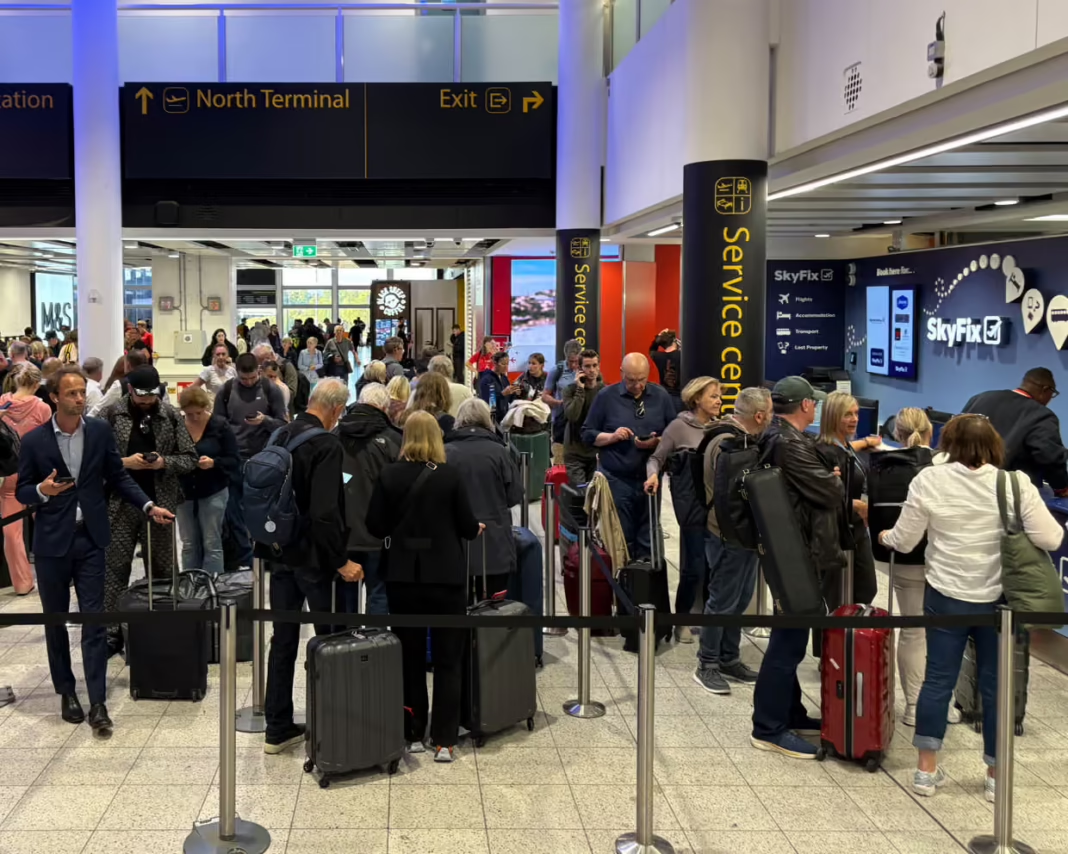
Britain’s air traffic control system failed on Tuesday, more than 2,000 flights were ultimately cancelled or disrupted across two days, and by Wednesday the government had reached the reassuring next stage of modern infrastructure management: asking the man in charge to investigate the system he runs. Nats chief executive Martin Rolfe was summoned by Transport Secretary Heidi Alexander and given a week to report back. The government says it still has confidence in him. Passengers who slept near a charging socket at Heathrow may wish to take a slightly longer review period.
The failure began in Nats’ flight-processing system and forced limits on traffic across major UK airports. Heathrow, Gatwick, Manchester, Stansted and others suffered widespread cancellations and delays even after the immediate fault was resolved because aircraft and crews were stranded in the wrong places. Nats ruled out a cyberattack. That should be comforting. The country did not need a hostile foreign actor to interrupt the skies. It managed the task domestically.
The Guardian reported that this was the third major air-traffic disruption in just over three years. Nats says Tuesday’s fault was different from the incidents in 2023 and 2025. That distinction matters technically. To passengers, it may feel like being told the kitchen flooded for three completely unrelated reasons. The carpet remains wet. At some point resilience is not a question about whether the same component broke twice. It is a question about why the service keeps reaching the same destination.
Ryanair and Wizz Air have called for Rolfe to resign or be sacked. Ryanair chief Michael O’Leary argued that the UK pays for one of Europe’s most expensive air-traffic-control systems and still suffers repeated failures. Wizz Air’s UK managing director invoked the traditional management principle of three strikes and you are out. Rolfe has apologized and promised a full investigation. If the aviation system had a frequent-flyer program for investigations, Britain would already have lounge access. Nats is not a scrappy startup beta-testing a route planner. It is national infrastructure responsible for keeping aircraft separated and traffic flowing through some of the busiest airspace in the world. That makes repeated technical failures different from the ordinary annoyance of an app crashing. You can reopen an app. You cannot refresh Heathrow.
Air traffic control is one of those invisible systems that earns almost no public attention when it works and immediate national fury when it does not. That is unfair in one sense. Thousands of flights move safely through constrained airspace every day because teams of specialists and complex technology function correctly. Reliability is difficult. But reliability is also the product. Nobody buys an airline ticket because the control system has a promising roadmap. The planes are supposed to move.
The most revealing detail is the backup-system argument. Ryanair says Britain’s backup systems failed to absorb the fault properly, while Nats defends the resilience of its network and says the incident requires technical investigation. The public does not need to decide which engineer is right before noticing the larger problem. A backup plan that becomes a national news story whenever the primary system has trouble is not functioning as the reassuring second layer its name suggests. It is functioning as a sequel.
Government oversight now follows the standard ritual. Summon the chief executive. Express significant concerns. Demand a report. Promise lessons will be learned. This sequence exists because sometimes it works. Investigations can identify failures and produce real fixes. But repeated incidents make the phrase ‘lessons learned’ increasingly difficult to deploy without accidentally creating satire. If the lesson keeps returning, it may not have completed the course. The public has also heard this language before. After earlier outages, reviews were commissioned, resilience was discussed and assurances followed. Each new failure therefore arrives with institutional memory attached. The question is no longer whether engineers can diagnose a fault. They clearly can. It is whether the fixes built after the last diagnosis are reducing the system’s ability to surprise the entire country.
The airlines are not neutral victims either. Carriers routinely create their own misery through staffing, scheduling and customer-service decisions, and Michael O’Leary has never encountered a public dispute he could not improve by adding Michael O’Leary. Still, on this issue the airlines have a straightforward point. They cannot run networks if national air traffic systems cannot reliably process flights. Passengers do not care which corporate logo should receive the blame. They care that an itinerary bought months ago has turned into a floor-space negotiation.
The broader Zeitgeist story is familiar far beyond aviation. Modern life is increasingly built on systems so optimized that a small technical problem can disable enormous chains of activity. Airlines, payments, hospitals, cloud services and government portals all promise efficiency through concentration. Then one component goes down and everyone discovers that redundancy was apparently in the premium subscription tier. We have created extraordinary infrastructure that works beautifully until it requires the feature called ‘still working.’ The result is a peculiar modern bargain. We are told centralized systems make life seamless, then asked for patience when the seamless system develops a seam large enough to cancel a holiday.
Nats may produce a convincing report next week and identify a specific fix. Rolfe may remain in his job or decide the pressure is enough. Flights will return to normal because aviation systems are built to recover, even when passengers do not. The unresolved issue is whether Britain is treating repeated failures as isolated technical events or as evidence that resilience itself needs redesign. Another investigation can explain why Tuesday happened. It cannot by itself make a fourth major outage funny.
After three major disruptions in three years, how many investigations does it take before resilience becomes the thing being investigated?
Sources
The Guardian: Nats boss given one week to deliver report into UK flight chaos
The Guardian: UK air traffic control chaos disrupts flights for hundreds of thousands of passengers
The Sun: Ryanair and Wizz Air demand Transport Secretary SACK air traffic chief after 1,750 flights axed and more misery to come