



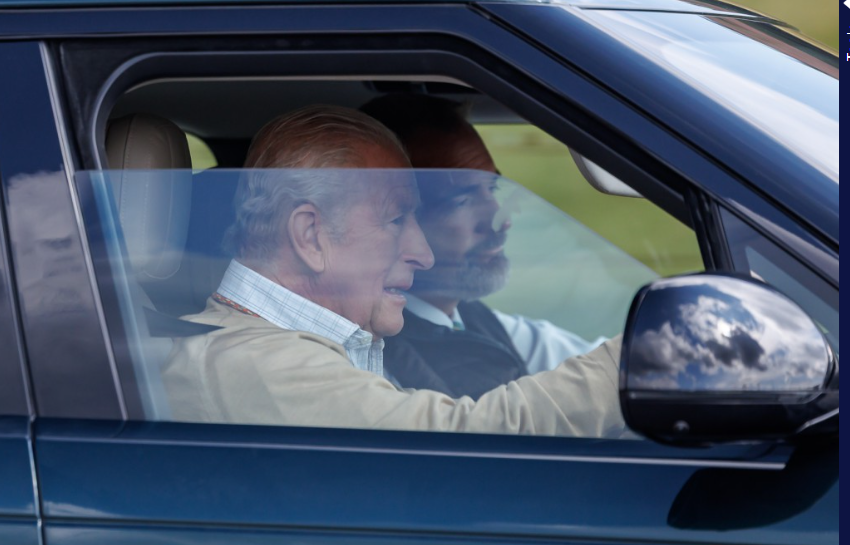
King Charles was photographed driving through Braemar on Thursday, his first public appearance since Prince Harry and Meghan Markle arrived back in Britain with Archie and Lilibet. The Sun reported that the Sussexes landed in Birmingham on Wednesday after flying from California and are expected to spend an extended stretch in the UK. The King, meanwhile, did what kings have done for centuries when family business becomes public business. He got in a car and was seen going somewhere. In the royal communication system, that can count as a full press conference.
The timing is why the photograph became news. Harry and Meghan’s return is not a restoration of their old jobs. The Sun reports that they are moving into a non-royal residence and that their children are due to start school in Britain. The couple stepped back as working royals in 2020 and, under the Sandringham arrangement, did not get the hybrid model they initially wanted, with official duties on one side and private commercial work on the other. Their return now puts them physically closer to the institution they left while leaving the constitutional and commercial boundaries essentially where they were.
That makes Charles the obvious person everyone watches for clues. The Sun reported last week that the royal family gathered at Balmoral as news of the Sussex move broke, and earlier coverage showed Wills and Kate leading the family to church with Charles and Camilla also present. Those are ordinary royal movements during the summer. They also become raw material for a public trying to determine whether a family reunion, a working arrangement or another round of carefully choreographed distance is coming next. A drive through Braemar suddenly carries the analytical burden usually assigned to a policy paper.
The target here is not Charles for driving a car. It is the machinery around the monarchy that turns ordinary motion into coded communication because so little is said directly. The King did not announce a new role for Harry. He did not unveil a reconciliation plan. He did not tell reporters that every grievance had been settled over tea. He was simply visible after a major family development. Yet visibility itself becomes the story because the palace has trained the public to read positioning, attendance and proximity as evidence.
There are real reasons for the restraint. Harry has spent years criticizing the royal household and the British press. Security remains a practical issue after his legal battle over protection in the UK. The Sussexes also have private businesses that separate them from the taxpayer-funded working monarchy. Nobody can simply declare the old arrangement restored because the family happens to live in the same country again. The constitutional questions are more boring than the family questions, but they are the ones that determine what Harry can actually do.
The comedy is that the monarchy has reached a point where silence does not reduce speculation. It industrializes it. A palace spokesperson can decline to comment, and ten stories will appear explaining the significance of the decline. Charles can drive through a Scottish village, and the journey becomes a temperature check on the House of Windsor. Wills can attend church, and the seating plan becomes an argument about the future. The institution has perfected discretion so thoroughly that discretion itself has become content.
Harry and Meghan’s return will test whether that model still works when the family is no longer separated by an ocean. In California, distance made the lack of routine contact easy to understand. In Britain, every missed gathering will invite a question, and every shared appearance will invite several more. The King may want more private time with his son and grandchildren, as the Sun has reported. Private time is the one commodity this family has historically struggled to keep private once the cameras know where everybody lives.
There is also a media incentive that makes restraint almost impossible. Royal coverage rewards the smallest visible change because access to the biggest private conversations is limited. A direct statement from Charles about Harry would be enormous news. In its absence, a drive, a church service or an invitation has to carry more meaning than it naturally contains. The family protects privacy by saying less. The press fills the silence by reading more into what can be seen. Both sides then complain about the other, and the cycle continues with impressive efficiency.
The return also exposes how much the monarchy depends on geography as a substitute for policy. When Harry and Meghan were in California, the distance itself answered many questions. They were not at most family events because they lived thousands of miles away. Their children were not routinely photographed near royal cousins because they lived on another continent. Britain removes that easy explanation. If the Sussexes are a train ride away, absence begins to look chosen even when it may simply be scheduling. Presence begins to look strategic even when it may simply be lunch. The same move that brings the family closer physically makes every ordinary choice easier to overread.
For now, the verified facts are modest. The Sussexes are back in Britain. They are not returning as working royals. Charles has been seen in public since their arrival. Everything beyond that still requires actual decisions by actual people. That may be less dramatic than the palace rumor economy prefers, but it is the useful line. A photograph can tell us the King was in Braemar. It cannot tell us whether the family has figured out what comes next.
If every ordinary royal sighting now gets treated like a message about Harry and Meghan, how will anyone recognize a real message when the palace finally sends one?
Sources
The Sun: King Charles seen for first time since Harry & Meghan landed back in the UK
The Sun: Prince Harry, Meghan Markle and their two children Archie and Lilibet land back in UK
The Sun: Kate and Wills lead royals arriving at church amid Sussexes bombshell return