



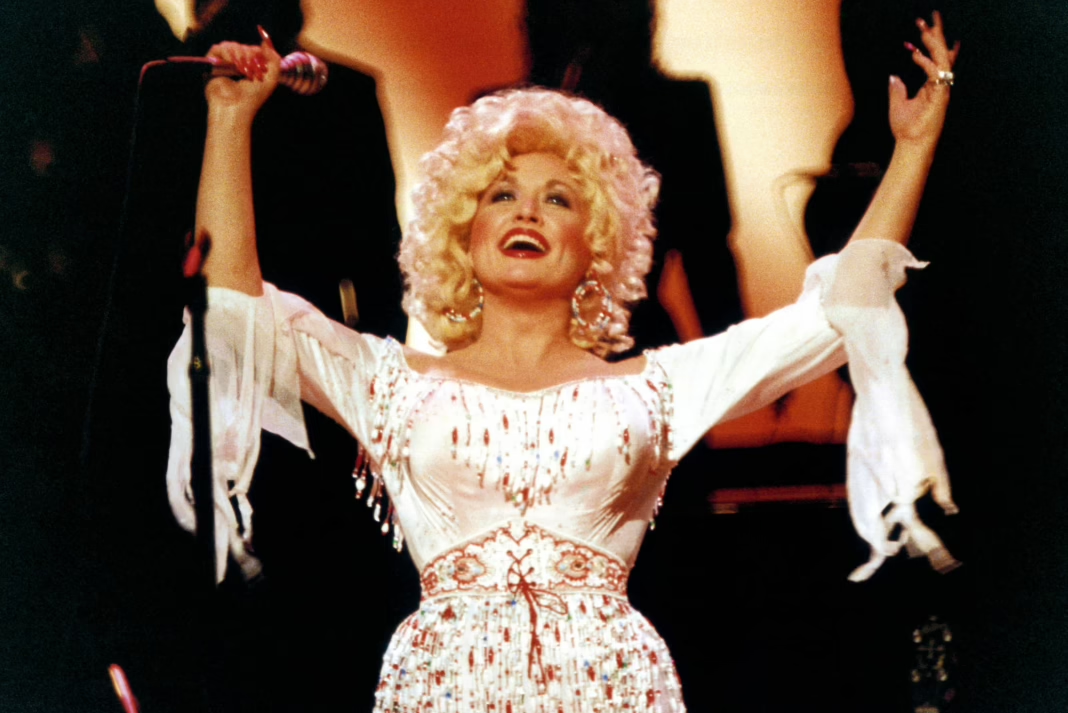
Dolly Parton died Tuesday at 80, and by Wednesday America had done something increasingly exotic. It agreed. The Empire State Building turned pink. The Grand Ole Opry announced a tribute show. Donald Trump ordered flags lowered. Beyoncé, Taylor Swift, Paul McCartney, Eminem, Jane Fonda and politicians from opposite ends of the spectrum offered tributes. The Guardian noted that Parton had the unusual ability to cross age, class and political lines. In 2026, that may be the rarest achievement on her résumé.
This is not a story about finding something funny in Parton’s death. The target is the culture around her, because the reaction exposed how strange our normal cultural life has become. A country that can turn a sneaker, a beer can, a casting choice or a halftime show into a partisan identity test suddenly encountered a celebrity whose death produced grief without an immediate instruction to choose a side. Nobody needed a chart explaining whether “Jolene” belonged to red America or blue America. It belonged to anyone who had ears.
Parton’s career helps explain why. She wrote thousands of songs and built a catalog that moved easily between country and pop. “Jolene,” “I Will Always Love You” and “9 to 5” became part of American cultural furniture. She acted in films, built Dollywood and turned the Imagination Library into a massive literacy project. The Guardian’s coverage of her philanthropy emphasized her focus on children, including sending free books to families. Her public persona was glittery enough to be instantly recognizable and disciplined enough to avoid becoming permanently owned by a political faction.
That last part now looks almost radical. Parton spent decades being famous without converting every interview into a position paper. She could talk about working women, poverty, literacy and LGBTQ+ fans without presenting herself as the nation’s deputy secretary of moral instruction. She was not apolitical because she lacked values. She was careful about making herself a partisan instrument. The result was that people with wildly different politics could project different things onto her and still meet at the same chorus.
The tributes Wednesday made the breadth visible. The Guardian reported praise from musicians across genres and generations. The White House lowered flags. Fans left flowers and candles. The Empire State Building lit up in pink. The Grand Ole Opry planned performances of songs including “Coat of Many Colors,” “Jolene,” “9 to 5” and “I Will Always Love You.” Even the machinery of celebrity mourning seemed briefly less cynical because the affection was not being manufactured from scratch. Parton had spent decades depositing goodwill before the culture came to collect it.
Of course, America being America, there is still an industry around grief. Commemorative covers appear. Buildings change colors. Brands post graphics. Every celebrity with a social account produces a memory. The tribute economy moves quickly because attention does. Usually that speed can feel like a race to insert yourself into somebody else’s death. With Parton, the volume revealed something else. An enormous number of people actually had a Dolly story, a favorite song, a charitable connection or a memory of being made to feel welcome by her work.
That is the Zeitgeist thread. We spend so much time asking which entertainers can still create monoculture that we often look for the answer in opening weekends, streaming records and stadium tours. Parton represented an older and harder version. Not everyone consumed the same new release on Friday. Instead, different generations accumulated the same person over decades. A grandmother knew the Porter Wagoner years. A parent knew “9 to 5.” A child got an Imagination Library book. A pop fan heard Whitney Houston sing a song Dolly wrote. Cultural reach arrived by layering, not by algorithm.
Her death also makes the modern celebrity model look exhausting. Today’s stars are expected to be musicians, brands, activists, content engines, founders and constant narrators of their own relevance. Parton did many of those things before the vocabulary existed, but she made the machinery feel secondary to the work. Dollywood was unmistakably Dolly. So were the rhinestones. Yet the joke was often on herself, and the philanthropy rarely required the audience to admire her politics first.
The country will return to fighting about celebrities soon enough. Probably before lunch. But the reaction to Parton is useful evidence that broad cultural affection has not disappeared. It has simply become difficult to earn and nearly impossible to manufacture on command. You cannot announce yourself as universally beloved. You have to spend decades giving people reasons to arrive there on their own.
In a culture built to sort every famous person into a political tribe, who else could still produce a moment of national affection this broad?
Sources
The Guardian: Tributes pour in after country music legend Dolly Parton dies
The Guardian: Backwoods Barbie and the “God almighty” PMS Blues: Dolly Parton’s 10 best deep cuts
Fox News: Dolly Parton’s cause of death revealed and more top headlines