




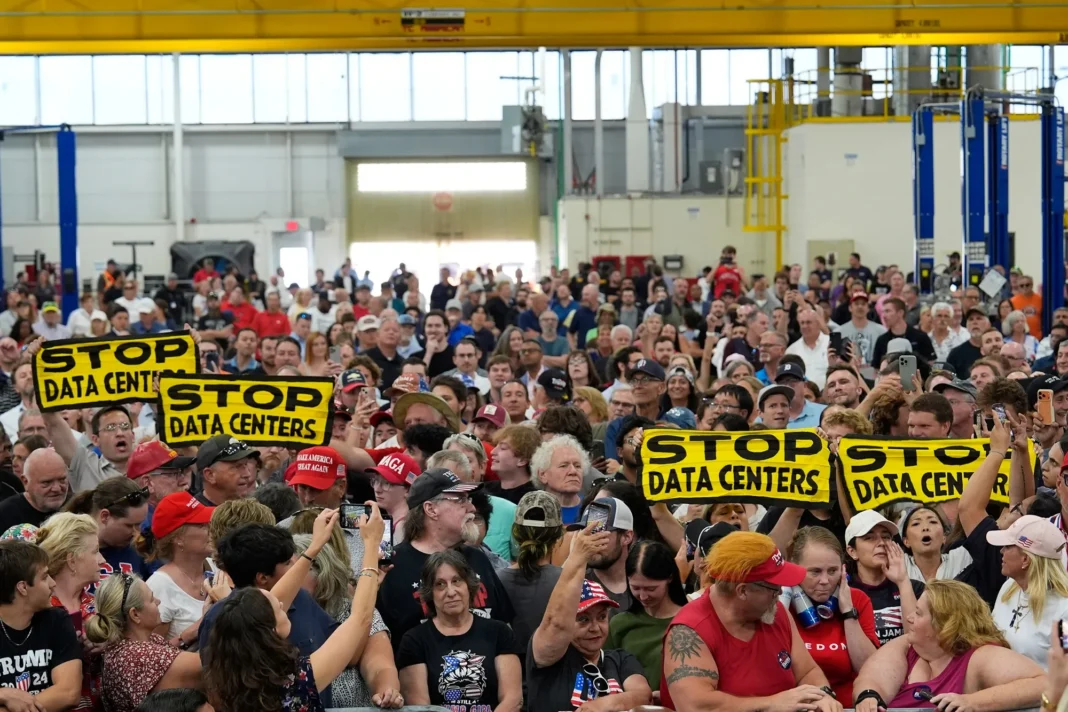
America has finally discovered a cause capable of uniting Republicans, Democrats, environmentalists, homeowners and people who simply enjoy paying less for electricity. They do not want the giant data center proposed down the road. The American Prospect reported Monday that opposition has surged across political lines, citing a Heatmap poll in which 75 percent of Americans opposed data centers near them and 61 percent strongly opposed them. The Guardian reported Monday and Tuesday that the backlash is splitting conservatives from Silicon Valley allies and forcing the Trump administration to respond. After years of being told artificial intelligence is inevitable, voters have located the part of inevitability that requires a zoning permit.
The politics have moved fast because the physical buildout has moved fast. Data centers require enormous amounts of power, significant land and, in some designs, substantial water. Communities are raising concerns about utility prices, noise, farmland, water use and who pays for new generation and transmission. The Guardian reported that grassroots opposition has already delayed or blocked dozens of projects. The American Prospect noted that a year ago House Republicans overwhelmingly backed a version of Trump’s major tax-and-spending bill containing a ten-year moratorium on state or local AI regulation. The Senate later killed that provision 99 to 1. Nothing restores a politician’s appreciation for local control like a substation near a swing district.
The target is Big Tech’s long-standing belief that inevitability is a substitute for persuasion. The industry’s argument has been simple. AI needs computing power. Computing power needs data centers. America must beat China. Therefore, the buildings must be built quickly and everyone should stop asking fussy questions about transmission lines. That logic works inside a keynote presentation. Local democracy has different slide templates. County commissioners want to know about water. Ratepayers want to know about bills. Neighbors want to know about noise. Nobody is especially moved by a CEO explaining that the future has quarterly targets.
Trump chose the subtle approach. The Guardian reported Monday that he said communities rejecting data centers risk becoming ‘backwards and poor.’ This is an unusual way to win over people who already suspect the industry considers them obstacles. Most developers arrive with renderings, tax projections and assurances about community benefits. Trump arrived with an insult. Vice President JD Vance has taken a more recognizably political line, acknowledging the backlash and talking about ways data centers could contribute electricity back to the grid. One approach treats voters as a problem. The other notices they vote.
The backlash is especially revealing on the right. Silicon Valley executives moved closer to Trump and Republicans while pushing for lighter AI regulation and a rapid infrastructure buildout. The political assumption seemed obvious. Conservatives like investment, energy projects and beating China. Then actual conservative communities were asked to host giant facilities with uncertain effects on power bills and land use. The ideology survived until the planning notice arrived. Now Republican candidates are discovering that local control has a remarkably literal meaning when the locality is yours.
The left has its own version of the contradiction. Democrats often support stronger technology regulation and environmental review, but they also represent states and cities that want investment, construction jobs and tech-sector growth. Data centers force every faction to price its principles. Climate goals collide with electricity demand. Housing-style arguments about building more run into residents who do not want industrial scale projects nearby. Labor wants jobs. Environmental groups want limits. Tech-friendly officials want AI leadership. The cloud has become inconveniently physical.
That does not make every objection correct. The American Prospect itself notes that local impacts vary and that data centers can be less disruptive than some heavy industrial uses. A project with dedicated power, enforceable water limits and transparent community agreements is not the same as a badly planned one. The industry’s problem is that it spent years talking about AI as if public consent were a delay imposed by people who did not understand progress. When trust is low, distinctions that might matter technically become harder to sell politically. ‘This facility is different’ is a weak opening after years of ‘you cannot stop this.’
The larger thread is that Big Tech built much of its cultural power by making technology feel weightless. The cloud has no visible smokestack. Search appears instantly. AI arrives in a browser tab. Consumers rarely see the warehouses, substations and transmission systems underneath. Data centers break the illusion. Suddenly AI is measurable in acres, megawatts and water. The technology has a street address. Once that happens, people who never read an AI policy paper can still understand a utility bill.
The industry will keep building because demand for computing is real and the infrastructure is strategically important. The political terms have changed. Companies will need to show who pays for new power, what happens to water use, how many permanent jobs remain after construction and what local communities receive in return. That is slower than declaring the future inevitable. It is also the normal price of building something enormous in a democracy. Big Tech spent a decade asking to move fast. America has finally replied with the minutes from the zoning board. That may be healthy for the technology as well as the politics. Infrastructure that survives public scrutiny is easier to defend than infrastructure imposed through panic about falling behind. The future can still arrive. It may just have to answer questions first.
If AI infrastructure is important enough to reshape the economy, why did its builders assume communities would accept being reshaped without negotiating the terms?
Sources
The American Prospect: Big Tech Crashes Headlong Into American Democracy
The Guardian: Trump attacks datacenter backlash, claiming communities pushing back risk becoming ‘backwards and poor’
The Guardian: Conservatives split from Silicon Valley allies as datacenter backlash grows