



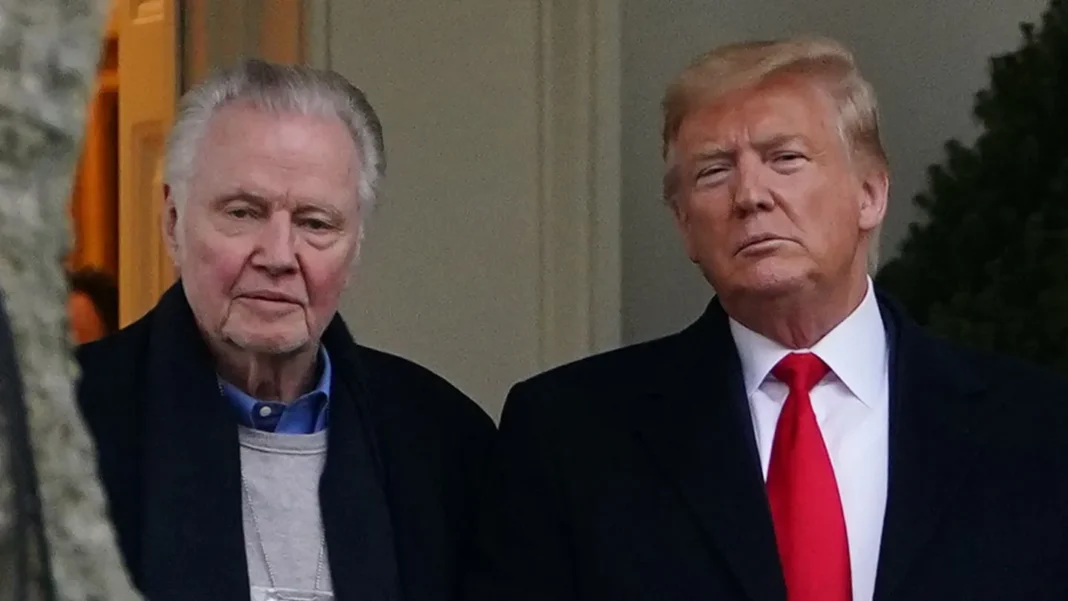
Donald Trump spent years treating Hollywood as a national emergency caused by Hollywood. Now he would like Congress to help pay for the recovery. After meeting with actor Jon Voight, one of his special ambassadors to the entertainment industry, Trump called Hollywood a ‘Complete and Total Disaster’ and urged lawmakers to create federal tax incentives for film and television production. Fox News and Washington Examiner both reported the push Monday. Trump says too much work has moved to Canada and other countries and predicts the lost revenue from tax incentives would be made back many times over. The man who made ‘let the market punish woke Hollywood’ a recurring conservative applause line has reached the moving part of the program where the market must be corrected by Washington.
There is a real economic issue underneath the comedy. Film and television production has moved among states and countries for years in response to labor costs, exchange rates, studio strategies and generous incentive packages. Canada, the United Kingdom and other production hubs offer programs designed to attract shoots. U.S. states compete too. Fox News reported that Trump and Voight are now pushing a federal layer meant to keep more entertainment work in the United States. Washington Examiner reported that the proposal under discussion could include a 20 percent labor credit and be stacked on top of state incentives. That is industrial policy, even if nobody in the Oval Office wants to put the phrase on a hat.
The target is not the idea that production jobs matter. They do. Crews, tradespeople, small vendors and local businesses feel it when projects leave. The target is the ideological flexibility that arrives when a disfavored industry finally requests the kind of government help conservatives routinely mock elsewhere. Hollywood was supposed to learn discipline from audience rejection and competition. Studios were supposed to stop complaining and make better products. Then jobs moved abroad, Jon Voight walked into the White House, and suddenly the invisible hand needed a tax-credit attachment.
Trump’s own framing makes the reversal difficult to miss. He described Hollywood as a disaster and said there is ‘no incentive’ to work there. His solution is therefore to create an incentive. That is coherent as policy. It is much less coherent as a worldview that has spent years treating targeted tax benefits as proof that government is picking winners and losers. Apparently Washington should not pick winners and losers unless the loser has good lighting and an ambassador who knows the president.
The politics could get even better if Congress takes the idea seriously. Republicans would have to explain why a federal subsidy for movie and television production is prudent economic strategy while similar industry-specific credits are wasteful meddling. Democrats from California and other production-heavy states would have to decide whether to support a Trump-branded proposal aimed directly at jobs they have spent years trying to keep. The result could be a rare bipartisan bill in which everyone votes for the opposite of something they said five years ago. Finally, unity.
There are also practical questions the glamour cannot answer. If the credit stacks on top of state incentives, some productions could receive benefits for work they would have done in the United States anyway. Congress would need to decide which costs qualify, how much domestic labor is required, whether there are caps and how to measure whether the jobs created justify the revenue forgone. Those questions are boring. They are also the difference between policy and a celebrity meeting. Once the Joint Committee on Taxation enters the room, the red carpet tends to get very quiet.
Trump’s claim that the incentive would be repaid tenfold deserves the same treatment as any sweeping prediction from a politician. It is a claim, not a settled fact. Congress would need evidence. A credit can attract production, but the public return depends on how much activity is genuinely new, how long it stays and what would have happened without the subsidy. If the entire economic case is that Canada has a program and therefore America needs a bigger program, we have not abolished the subsidy race. We have simply decided to compete harder in it.
The larger Trumpiverse pattern is access. Voight has a formal role as one of Trump’s Hollywood ambassadors and has been working on ideas to revive domestic production. That does not make the proposal illegitimate. It does show how policy can enter this administration through a very Trump-shaped door. A famous ally gets an audience. The president likes the pitch. Congress is told to act. The technical case can be built afterward. Many administrations are influenced by insiders. Trump just skips the part where anyone pretends the process began with a white paper.
Hollywood may deserve federal help. It may not. The useful test is whether the administration can explain the principle in a way that also applies outside Hollywood. If foreign subsidies justify federal intervention here, what about other industries losing work abroad? If strategically important jobs merit tax support, who decides which jobs qualify? Trump has turned a long-running conservative morality play about Hollywood into a straightforward argument for government assistance. The movies may be struggling, but irony remains fully employed. There may even be a good bill hiding inside the spectacle. If there is, Congress should be able to defend it with numbers instead of nostalgia, and with rules that apply to more than one industry whose famous supporters can get a meeting. That would be less cinematic. It would also be governing.
Once Trumpworld decides Hollywood deserves federal help because jobs moved abroad, which struggling industry gets to audition next?
Sources
Fox News: Trump calls Hollywood a ‘total disaster,’ pushes federal tax incentive for film after meeting with Jon Voight
Washington Examiner: Trump demands Congress pass tax incentives to fix Hollywood ‘disaster’