



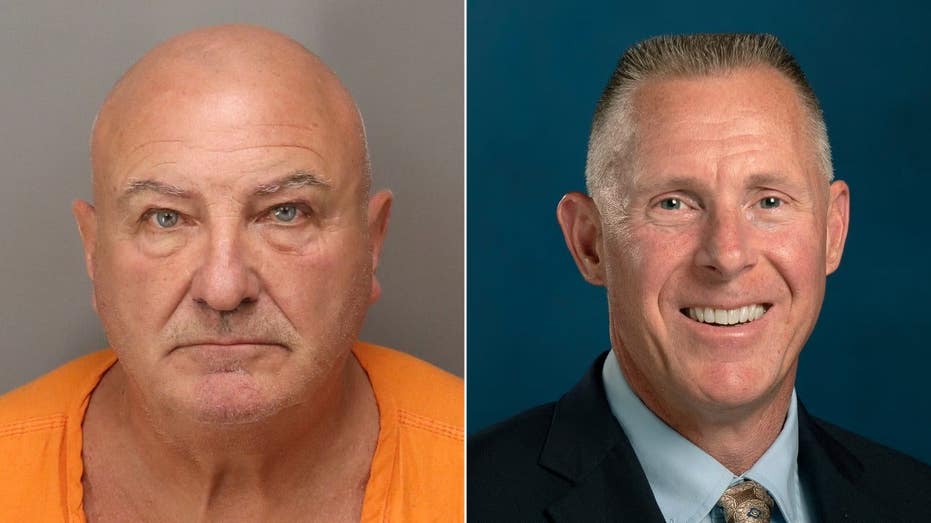
A retired NYPD sergeant was arrested in Florida after authorities linked him to a threatening Facebook comment aimed at a commissioner who backed a mosque expansion.
A Florida debate over whether a mosque should be allowed to expand has produced an alarming new subplot: a retired New York police sergeant was arrested after authorities linked him to a Facebook comment calling for a county commissioner’s head. The commissioner was a Republican who supported the land-use change. The alleged writer considered that a betrayal, according to investigators. Apparently the local zoning process was no longer dramatic enough without someone reaching for medieval execution imagery.
Rodolfo Mienert, 68, was arrested November 2 and charged with one felony count of written threats to kill, according to the Pinellas County Sheriff’s Office. The alleged target was Commissioner Brian Scott. Detectives said the threatening comment appeared in response to a local news Facebook post criticizing Scott’s vote in favor of expanding a mosque. Mienert has been accused, not convicted; a criminal case will determine what can be proved beyond the sheriff’s public account.
Investigators said the comment described Scott as a Republican turncoat and ended with the words “off with his head!” The sheriff’s office traced an IP address associated with the account to Mienert, contacted him at home and said he acknowledged that the account belonged to him. He also confirmed he had attended a recent county commission meeting. The account ownership allegation and the charge are documented; the legal meaning of the comment will be a matter for the justice system.
A zoning vote becomes a police case
The underlying dispute concerned a land-use decision permitting the planned expansion of Masjid Al Rahman, a mosque near Tarpon Springs. The issue had generated heated public debate and strong reactions at county meetings. For some residents, it was a question of development impacts and local planning; for others, the rhetoric surrounding the mosque raised concerns about hostility toward Muslims. Either way, a vote on whether a religious institution can expand does not authorize threats against officials who cast the deciding ballots.
Mienert had been among those speaking at an October 27 commission meeting, according to Fox News coverage featuring video from the meeting. He was not an anonymous figure with no connection to the debate. His presence at the public hearing was lawful political participation; the alleged online statement later drew investigators’ attention because they interpreted it as a violent threat. Those are separate forms of expression, and the difference matters.
According to detectives, Mienert described himself as outspoken and unafraid to express his political views. He said he considered Scott a turncoat because Scott identifies as a Republican but supported the proposal. That reasoning has a familiar partisan structure: somebody voted the wrong way, therefore they must no longer belong to the team. The next sentence, however, is where law enforcement says the expression crossed into potential criminal territory.
Sheriff Bob Gualtieri condemned the alleged remark, saying threats of this kind against a commissioner because of a land-use vote were intolerable. The FOX 13 Tampa Bay report details how investigators linked the online account to the suspect. The sheriff’s response emphasized enforcing the law against threats, not deciding who should win the debate over the mosque.
A retired police sergeant in the spotlight
The suspect’s background is what makes the case particularly extraordinary. The sheriff’s office says Mienert spent 22 years with the New York Police Department and retired as a sergeant. Someone with that professional history would presumably be familiar with the distinction between heated political speech and language that authorities may treat as a threat. Experience in law enforcement does not establish guilt, of course. It does make the circumstances of the accusation more striking.
Some reporting has also highlighted a bizarre Facebook profile image featuring Bugs Bunny holding a gun. The New York Post reported that detail while discussing the account. A cartoon rabbit with a weapon is not evidence that a person intended to carry out violence. It does, however, give the online persona an unusually unsettling visual backdrop when paired with an alleged threat to an actual elected official.
It’s important not to turn the case into an argument that criticism of the commission or objections to a building plan are forbidden. Residents can oppose zoning decisions, demand explanations, campaign against incumbents and express considerable anger about public policy. Those activities are part of local democracy. Allegedly threatening violence against an official is a different matter, which is why the sheriff’s office opened a criminal investigation rather than simply joining the Facebook argument.
The target’s political identity further complicates the usual partisan storytelling. Scott is a Republican, and the alleged backlash followed his support for a mosque expansion. It would be misleading to claim that this case represents the views of all conservatives, or everyone who opposed the proposal. What it illustrates is how a single local vote can become a purity test in which the offender’s own team label matters more than the specific merits of the decision.
The community still has a real issue to resolve
The Florida chapter of the Council on American-Islamic Relations welcomed the arrest and urged that disagreement over land use not turn into intimidation. In its November 3 statement, the organization tied the case to religious freedom and the right of local communities to debate proposals without violent threats. The broader issue reaches beyond one Facebook comment: public officials should be able to vote, and religious communities should be able to petition for development approvals, without fear of retaliation.
There were also disputes surrounding a person dressed in Islamic attire who appeared at the commission meeting. Mienert referred to that person when speaking to detectives, according to the sheriff. CAIR separately described an incident involving a purported anti-Muslim hoax. Neither the person’s identity nor claims about what the person intended are necessary to establish the core arrest story, so assigning a motive to that episode would go beyond what the reporting proves.
The charge is serious. Florida law can impose significant penalties for a qualifying written or electronic threat to kill, but a filed charge is not a conviction and does not by itself establish that the speaker meant to act on the language. Prosecutors will need to establish the relevant legal elements, and Mienert will have the opportunity to contest the accusation. The precise next procedural step should be checked against current court records before publication updates.
For now, a county dispute that should have been settled with testimony, zoning arguments and votes has produced a criminal allegation against a former police officer. That’s the part deserving the strongest scrutiny. Local government is already capable of turning routine land-use decisions into marathon meetings. It doesn’t need anyone adding a threat that belongs in a Shakespeare tragedy to the comment section.