



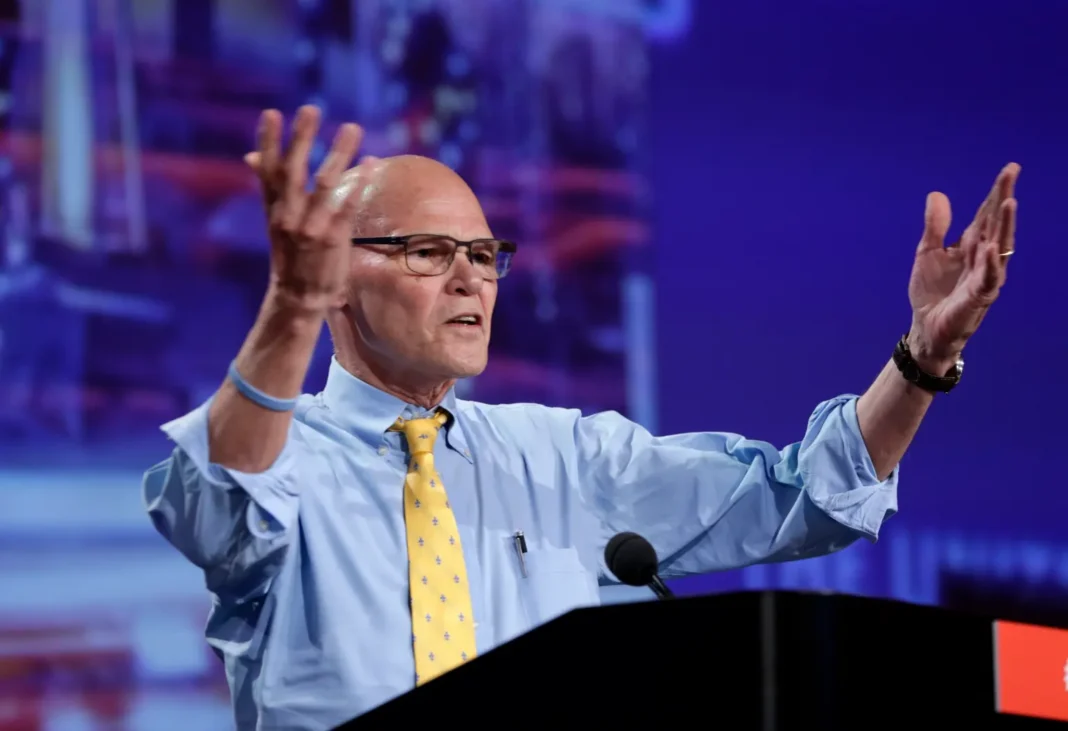
James Carville is furious that House Democratic leader Hakeem Jeffries met privately with Jared Kushner. Fox News columnist Jonathan Turley highlighted Carville’s podcast tirade Friday as an example of what he called rage politics, with the veteran Democratic strategist arguing that party leaders should not be engaging with a central figure from Donald Trump’s orbit. Apparently the resistance now includes a seating chart.
Carville is hardly a standard-issue activist. He has spent decades telling Democrats to be more pragmatic, more focused on winning and less captive to ideological fashion. That makes the outburst more revealing. Even the party’s professional apostle of electoral realism can reach a point where talking to an opponent is treated as a moral concession rather than a normal feature of governing.
Political leaders meet people they dislike all the time. Sometimes they negotiate. Sometimes they gather information. Sometimes the meeting goes nowhere. Jeffries talking to Kushner does not make Jeffries a Trump supporter any more than a labor negotiation makes management a union local. The entire point of politics is that eventually somebody has to speak to somebody who did not already applaud the opening statement.
The target is the progressive-adjacent theory that contact itself can be contamination. It is a habit that grew during years when politics became less about persuasion and more about demonstrating that one’s own side had maintained proper distance from the other. The purity test is easy to administer. Did you enter a room with the wrong person? Congratulations, the discourse has begun.
The problem is that democratic institutions cannot run on permanent social quarantine. Congress has to fund things, negotiate deadlines, respond to crises and occasionally understand what the executive branch is doing. A minority leader who refuses every private conversation with anyone near the president might produce excellent screenshots for activists. He would also be choosing ignorance as a negotiating strategy.
There are plenty of reasons to distrust Kushner or criticize Jeffries if a meeting produces a bad deal. Those are substantive arguments. Rage at the meeting itself is different. It turns politics into a system where the only acceptable interaction with the other side is a televised denunciation. That may be emotionally satisfying. It is also how a country of 340 million people ends up governed like two group chats that blocked each other.
The reason james carville wants democrats to stop talking to the wrong humans works as more than a one-day headline is that the underlying incentive does not disappear when the news cycle moves on. The people and institutions involved are being rewarded for a particular kind of behavior, whether that reward is attention, political loyalty, money, status or the comfort of avoiding a harder decision. That is the thread worth watching after the immediate controversy cools. A single episode can be dismissed as bad luck or bad optics. A repeated incentive becomes a governing or cultural habit. The useful test is not whether everyone involved can produce a defensible explanation. Most public controversies come with one. The useful test is whether the explanation would still sound reasonable if the names and teams were reversed. That is where satire earns its keep. It strips away the jersey and leaves the behavior sitting there by itself. The next development will matter because it will show whether this was an exception that embarrassed the people involved or a model they intend to keep using. If the same logic appears again, the story stops being an oddity and becomes a pattern. If the people involved change course, that is evidence too. That is why the closing question matters here: If even a private conversation with the other side counts as betrayal, how is a party supposed to govern a country where the other side keeps living here? Public life is full of arguments about motives that cannot be proved. Behavior is easier to judge. Watch what gets repeated, what gets rewarded, what gets quietly abandoned, and who is asked to absorb the cost. Those details usually tell the story more clearly than the slogans do.
The episode matters because political polarization increasingly treats access as endorsement. A photo, meeting or conversation can be clipped from its purpose and presented as proof of ideological surrender. That makes leaders more cautious about talking across lines, which in turn makes the lines harder. The public then receives the worst of both worlds. More theatrical hostility and less private communication where actual information might be exchanged.
Carville’s anger also shows how resistance politics can consume its own pragmatists. He built a career around winning elections and understanding voters who do not live inside activist language. Yet the emotional logic of the Trump era is powerful enough to make even a strategist like Carville sound suspicious of contact itself. Once politics becomes a moral identity, tactical conversation starts to feel like social betrayal.
Jeffries should be judged on what he does with whatever he learned or discussed, not on the fact that a door closed behind two people from opposing camps. If the meeting leads to a bad compromise, criticize the compromise. If it leads nowhere, fine. If it prevents a misunderstanding, even better. Democracy has enough public shouting. It can survive a private conversation.
If even a private conversation with the other side counts as betrayal, how is a party supposed to govern a country where the other side keeps living here?
Sources
Fox News: JONATHAN TURLEY: James Carville’s latest tirade reveals the left’s all-consuming politics of rage
New York Post: Democratic strategist James Carville unloads on DSA socialists: ‘Don’t use our goddamn name’