



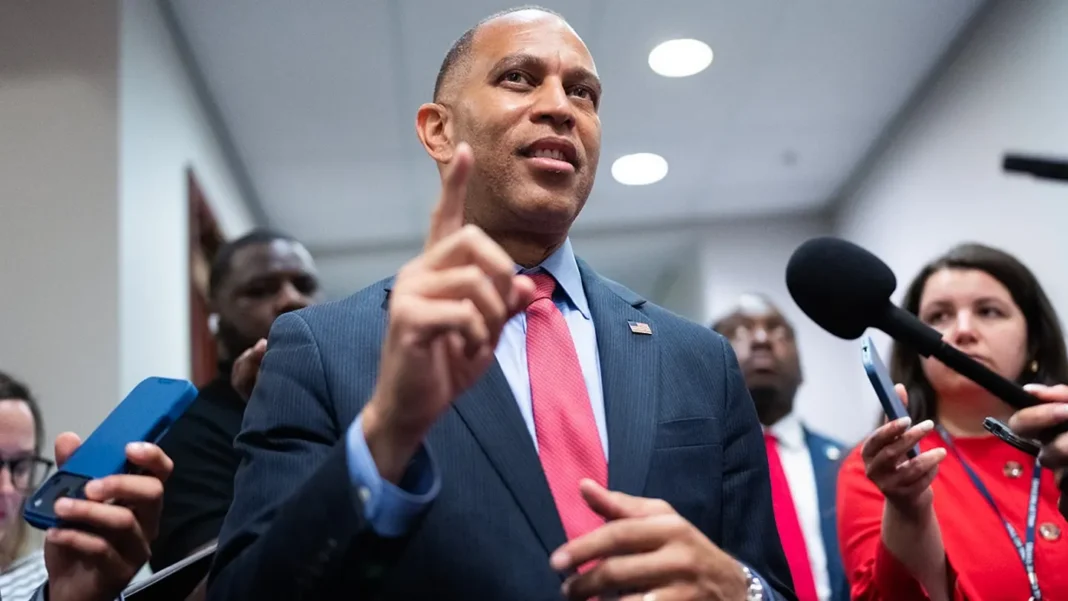
Hakeem Jeffries posted “Congratulations to our Democratic nominees” on X in June after three DSA-backed candidates won congressional primaries in New York City. Mamdani-aligned Brad Landler, Claire Valdez, and Darializa Avila Chevalier had all won their primaries. Jeffries listed them by name. He did not call them democratic socialists. He called them Democratic nominees. The distinction was noted by critics on the right and by progressives on the left, for opposite reasons. The right said he was embracing the socialist surge. The left said he was trying to normalize them without actually endorsing their agenda. Both were correct about different things.
Two months later, on Fox and Friends on Monday morning, Fox News contributor Hugh Hewitt analyzed Jeffries’s position and concluded that the House Democratic Minority Leader is “quite afraid” of his own progressive caucus. The segment, confirmed today by Fox News, covers DSA candidates now challenging moderate Democrats in Florida primaries as the socialist insurgency extends its geographic reach beyond the New York and Michigan races that defined July. Hewitt also discussed AOC attempting to rewrite her own past positions, specifically her early advocacy for policies she now characterizes as belonging to a political moment that has passed. “Woke 1.0 was crazy,” AOC said in August. The Democratic Party’s leaders are watching the DSA win primaries and trying to figure out what they believe about it publicly.
The Jeffries dilemma, as Fox News’s full analysis published in late June described it, is specific and structural. He is the House Democratic Minority Leader. If Democrats take back the House in November, he becomes Speaker. The caucus he would lead as Speaker now includes, for the first time in its history, a meaningful bloc of self-described democratic socialists, not just progressive allies but actual DSA members who ran explicitly on a socialist platform and won. More than a dozen DSA-backed candidates have won or advanced in primaries across the country this cycle. Jeffries can either lead a caucus that includes them or he can draw a public line that costs him the enthusiasm and small-dollar fundraising that the progressive base provides. He has been trying to do neither, which is the political position that produces the “quite afraid” characterization from Hugh Hewitt and the confused reading of his June post from both flanks simultaneously.
The Florida development that the Fox and Friends segment addressed today is significant because it extends the DSA’s primary challenge beyond the states where it was already established. New York’s DSA victories, driven by Mamdani’s political infrastructure, were concentrated in safe Democratic districts in New York City. Abdul El-Sayed’s Michigan Senate primary win was in a Democratic primary in a competitive state. Florida DSA candidates challenging moderate Democratic incumbents represent an expansion of the insurgency into territory where the Democratic establishment has historically been able to hold the line, because Florida’s Democratic Party is oriented around competitive statewide elections that require centrism rather than the pure-primary-base-mobilization that DSA campaigns run on.
AOC’s position in all of this is the complicated one. She is the most prominent democratic socialist in the House and arguably in the country. She was endorsed by the DSA in her initial 2018 primary win. She is a member of the Justice Democrats organization. She has appeared at rallies with El-Sayed and other DSA-backed candidates this cycle. She also said in August that “Woke 1.0 was crazy” and is attempting to position herself as a pragmatist who learned from the excesses of the 2020-2022 period. The Hewitt segment characterizes this as rewriting her political history. It is also a genuine strategic repositioning in response to documented electoral consequences of positions she previously held. Both framings can be accurate simultaneously, which is the condition that makes AOC’s political evolution a genuine story rather than just opposition research.
The midterm map for the House involves Democrats needing to flip approximately 15 seats to take back the majority from Republicans. Those 15 seats are in competitive suburban districts in Pennsylvania, Michigan, Georgia, Virginia, and a handful of other states. The candidates who can win those 15 seats are not generally DSA members. They are moderate Democrats running on healthcare, economic security, and opposition to Trump’s Iran war. The DSA candidates who are winning primaries are winning in safe Democratic districts that are already going to be Democratic regardless of who the nominee is. The House math does not change based on whether Valdez or a more moderate Democrat wins a safe New York seat. The House math changes based on whether a moderate Democrat or a Republican wins a competitive suburban district in suburban Philadelphia.
Jeffries knows this math better than anyone in the Democratic Party. He also knows that the DSA’s small-dollar fundraising infrastructure, its canvassing operation, and its base-mobilization capacity are assets he will need in November regardless of how he feels about democratic socialism as a policy platform. He congratulated their nominees in June. He is now being described as afraid of them in August. The midterms are in November.
The DSA is winning primaries. Jeffries is leading the party that is nominating them. November is three months away.
When the House Democratic leader congratulates DSA nominees in June and is described as afraid of his own progressive caucus in August and Florida primaries are the next test, what exactly is the party’s position heading into November?
Sources
Fox News Video: Jeffries distances himself from democratic socialists as party divide deepens
Fox News: Jeffries’ socialism dilemma: New York victories expose Democratic Party divide
Fox News: Jeffries welcomes democratic socialists into the fold