




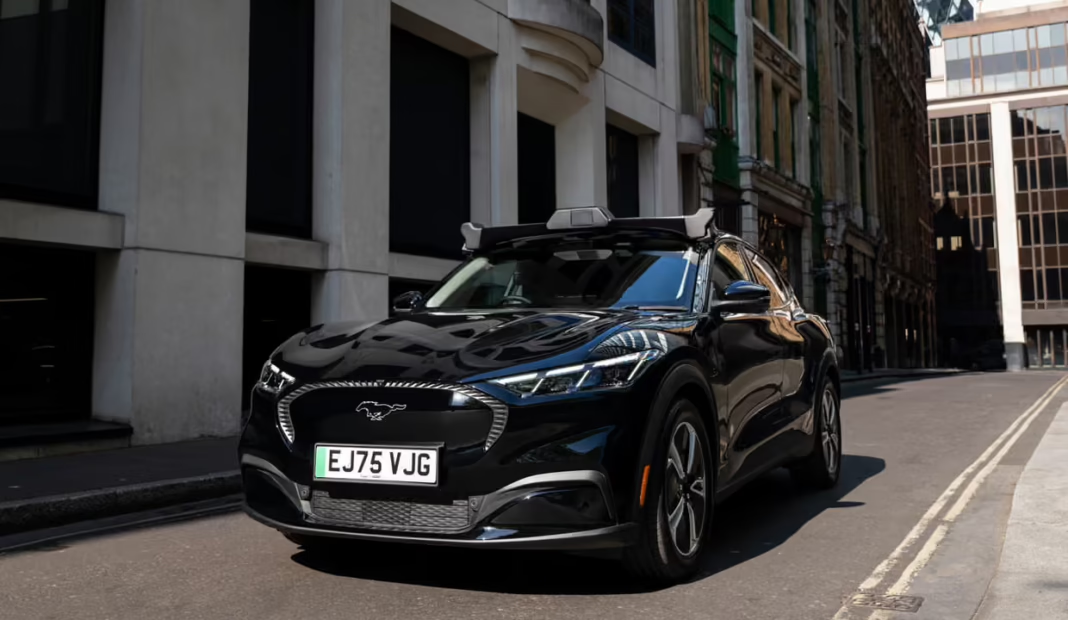
London now has robotaxis, which is exciting news for anyone who has been waiting to experience the future while sitting beside the person legally required to make sure the future does not hit a bus. Uber and British self-driving company Wayve have put 15 autonomous Ford Mustang Mach-E vehicles onto the city’s streets. Passengers can be matched with one through the Uber app. They cannot specifically request one. A human safety driver remains behind the wheel, ready to intervene. We have reached the thrilling midpoint between taxi and demonstration ride.
The Guardian and The Sun both reported Thursday on the launch. Transport for London has licensed the initial fleet, and more than 100,000 people have expressed interest in trying the service. The cars use Wayve’s autonomous-driving system and are part of a broader plan to expand the technology. Uber says fares are the same as a normal ride, and passengers do not have to tip the software. For now, however, the software comes with a licensed human sitting in the exact place where Londoners have traditionally expected the driver to be.
That does not make the launch fake. Autonomous vehicles have to be introduced in stages, and a safety driver is an obvious precaution when a system is learning one of the world’s most chaotic urban road networks. London offers cyclists, black cabs, delivery vans, buses, pedestrians, tourists staring at maps and junctions designed before anyone had imagined a turn signal. If an autonomous vehicle can survive that, Silicon Valley may eventually award the city an honorary engineering degree.
The comedy is in the language of arrival. Robotaxis have hit the streets, except there are only 15 of them, they arrive by chance, and there is a human in front. This is how technology launches now. Every pilot must be narrated as the first day of the future because saying ‘we are cautiously testing a small number of cars with supervision’ sounds suspiciously like adulthood. The press release wants Blade Runner. The licensing conditions want someone with both hands available.
There is a bigger reason for the caution. Self-driving technology has spent years alternating between astonishing technical progress and reminders that roads are not laboratories. A vehicle can perform brilliantly across millions of predictable situations and still encounter a construction worker making eye contact, a police officer waving traffic through a red light or a cyclist doing something that appears to violate Euclidean geometry. Humans are terrible drivers in many ways. We are also exceptionally good at improvising around other humans being terrible drivers.
Wayve’s bet is that machine-learning systems can handle that mess without requiring every possible scenario to be separately programmed. London is a valuable proving ground precisely because the environment is messy. If the system works, the benefits could be large. Fewer crashes, more mobility for people who cannot drive, more efficient fleets and eventually lower operating costs are all plausible. The word eventually is doing a great deal of labor there. Today, the operating model still includes a person whose job is to prevent the autonomous taxi from becoming too autonomous at the wrong moment.
Drivers have reasons to watch closely too. On the same week that London gets its first Wayve fleet, Uber is also restructuring its corporate workforce and investing heavily in automation. Robotaxis are often sold to consumers as a convenience story, but to labor they are a business-model story. A successful autonomous fleet does not merely change how a ride feels. It changes who gets paid for providing it. Uber can insist that rollout will take time and that human drivers remain central today. Human drivers are allowed to notice the direction of the capital spending.
The test therefore has to answer more than whether the car stays in its lane. Regulators need evidence about safety, responsibility, insurance, cybersecurity, accessibility and what happens when the system cannot interpret the world. Cities also have to decide whether automated vehicles reduce traffic or simply make it easier to add more cars. The technology may be extraordinary and still create ordinary policy headaches. That is usually how the future arrives. The machine is new. The parking dispute is ancient. There is a useful humility in the current setup if everyone allows it to remain humble. Fifteen supervised cars can collect data, reveal edge cases and give regulators time to watch before scale turns mistakes into a citywide problem. The temptation will be to treat every successful week as proof that the final stage has already arrived. Transportation history is full of technologies that worked beautifully right up until the operating environment became larger, messier and less forgiving than the pilot.
For passengers, the first rides will probably feel less dramatic than the marketing. A car shows up. Someone is sitting in front. The car moves. Ideally nothing memorable happens. That is actually the standard autonomous transport should want. A self-driving service succeeds when it becomes boring enough that nobody posts a shaky video titled YOU WON’T BELIEVE WHAT THE CAR DID. London is not there yet, but fifteen supervised vehicles are a reasonable place to begin.
The interesting moment will come when the safety drivers leave. That is when the pilot becomes a service and the promise becomes a public fact rather than a controlled demonstration. Until then, London can say it has robotaxis with the same technical accuracy as a restaurant can say it has contactless service while a waiter stands beside the card machine explaining where to tap.
When does a robotaxi stop being a technology demonstration and become a real transport service: when the car can drive itself, or when the human in the driver’s seat can finally go home?
Sources
The Guardian: London’s first self-driving taxis for hire hit the streets
The Sun: Brits can now order Uber robotaxis as fleet hits UK roads for the first time – but with a key difference