



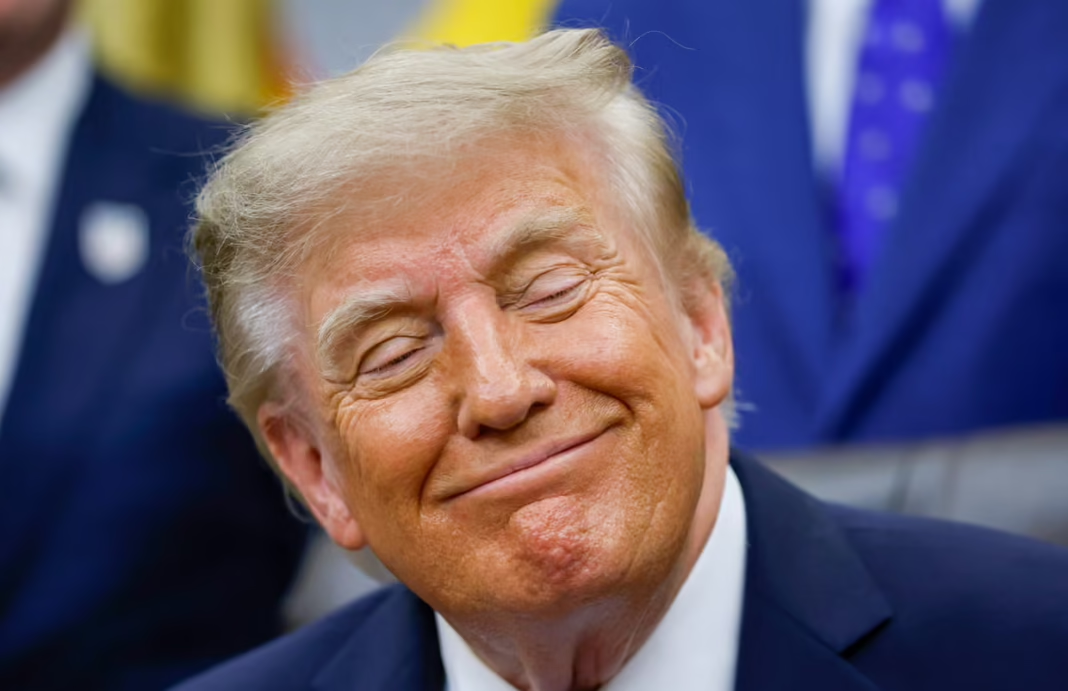
Donald Trump has released a presidential ranking in which Donald Trump is the greatest president in American history. This is efficient. Why wait for historians, elections, archives or the passage of time when the subject of the study is available to grade the paper? Trump shared a modified version of an old Life magazine ranking that placed him above Abraham Lincoln, George Washington and Franklin Roosevelt while consigning several modern presidents to the failure category. The Guardian then asked actual presidential historians what they thought. Their answer was less enthusiastic. It turns out peer review becomes awkward when the peer has already awarded himself first place.
Trump’s ranking is not a scientific survey, and nobody should pretend it is. It is a social-media post by a president who has spent decades attaching his name to buildings, products, political movements and, whenever the opportunity presents itself, history. The interesting fact is that he did not merely argue that his presidency has been successful. Politicians do that. He inserted himself at the top of the entire national pantheon and presented the result as if Mount Rushmore had finally corrected an administrative error. Lincoln preserved the Union. Washington established the republic. Trump had access to image-editing software.
The historians cited by The Guardian have not been hiding their views. The Presidential Greatness Project’s most recent survey placed Trump last among the presidents it assessed, with more than 150 scholars participating. A Siena survey also ranked him near the bottom. Those surveys have methods, biases and academic arguments of their own, and conservatives have long criticized the ideological makeup of the profession. None of that changes the comic contrast. Trump says he is number one. Large groups of people who study presidents for a living say he is almost the opposite number.
The target is Trump’s relationship with evaluation itself. Normal political vanity wants praise. Trump prefers the entire scoring system. If a poll is favorable, it is evidence. If it is unfavorable, the pollster is wrong. If historians rank him badly, historians are suspect. If history has not yet rendered a verdict, he can publish one early. This is less like campaigning than running a restaurant where the owner writes the review, awards the Michelin stars and then complains that the customers have failed to appreciate the independent process.
There is a practical reason politicians try to shape their legacies while still in office. Presidential reputations change. Truman left office deeply unpopular and later rose in historical esteem. Other presidents have fallen as new evidence, values and scholarship changed the picture. Trump is unusually unwilling to leave any of this to posterity. Posterity is slow, cannot be booked for a rally and has the irritating habit of considering facts that were not in the press release. Better to get the plaque made now.
The ranking also reveals something about the Trump brand that is easy to miss because it is so constant. His politics depends heavily on superlatives. The biggest. The best. The worst. The strongest. The most corrupt. The greatest. Superlatives turn complicated comparisons into a scoreboard, and a scoreboard removes the need for an argument. A president can be assessed on legislation, war, institutions, growth, rights, scandal and consequences. Or he can simply put himself above Lincoln and invite everyone to argue about the graphic.
That invitation worked. Historians responded. Cable shows discussed it. Supporters defended him. Critics mocked him. A social post became a national conversation about presidential greatness, which is exactly the kind of conversion Trump has always understood. The statement does not need to survive scrutiny if the scrutiny itself keeps him at the center. Lincoln now has the inconvenience of being dead and therefore unable to book a segment. Washington remains similarly weak on social media.
The larger thread is what happens when a political movement increasingly treats its leader’s self-description as a category of evidence. Every president promotes an image. Democracies rely on institutions outside the presidency to test it. Elections test popularity. Courts test legality. Congress tests power. Journalists test claims. Historians test legacy. Trump has spent years attacking most of those referees when their calls go against him. Ranking himself first is the purest version of the same instinct. Remove the referee and the winner becomes much easier to identify. The rankings are also a reminder that presidential greatness is usually measured against outcomes nobody controls alone. Wars, recessions, congressional coalitions, court decisions and crises all shape a record. Historians argue because the evidence is complicated and because values differ. A self-ranking eliminates those irritating variables. It is the cleanest possible methodology if the research question is whether Donald Trump believes Donald Trump has done an excellent job.
There is nothing dangerous about a boastful meme by itself. Presidents are allowed to be ridiculous. The question is whether the habit behind it stays ridiculous when applied to matters that carry legal or institutional force. A president who treats contrary judgment as proof that the judge is illegitimate has a harder time accepting any system he does not control. The presidential ranking is funny because the stakes are low. It is useful because the method is familiar.
History will eventually rank Trump without asking his permission. That is the only part of this competition he cannot fully manage. The archives will remain after the posts are buried, and scholars who have not yet been born will argue about his record with evidence unavailable today. Trump may be certain he already knows their answer. History has a bad habit of declining advance instructions.
If Trump will not accept a presidential ranking he did not win, what kind of judgment about his record would he ever recognize as legitimate?
Sources
The Guardian: Trump ranks himself the greatest US president ever. Historians beg to differ
Fox News: Greg Gutfeld: Historians are a ‘politically lopsided’ profession