




Welcome to Juaritos Park
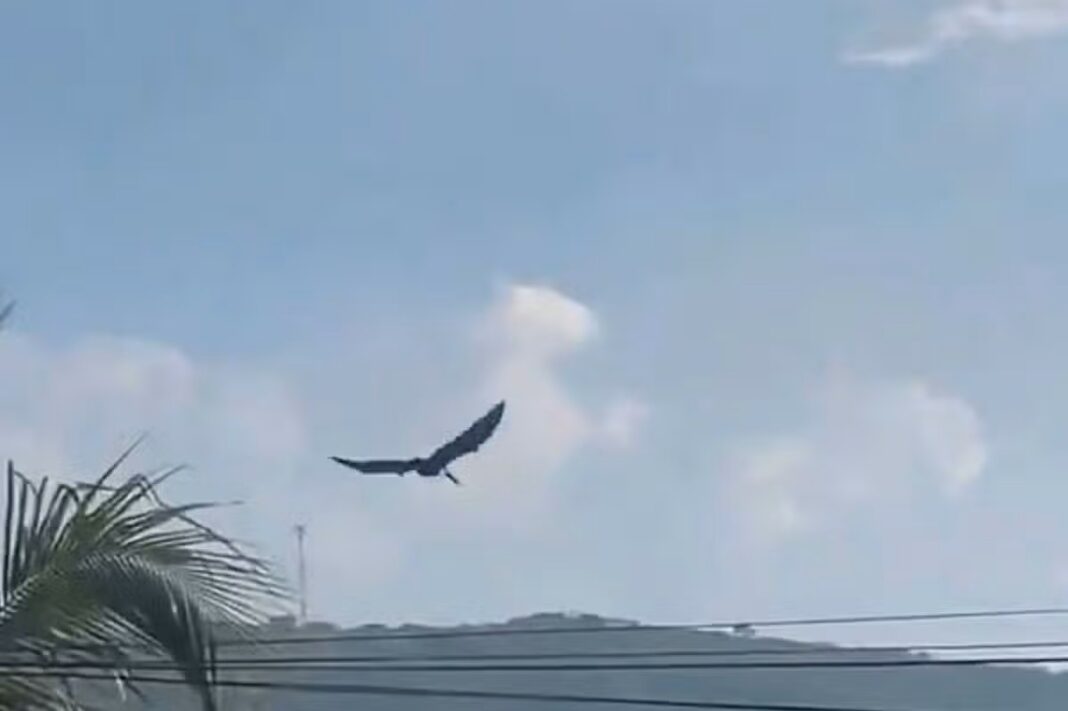
A brief, grainy video of a winged silhouette over Ciudad Juárez, Mexico, has persuaded parts of the internet to revisit a question most people assumed was settled millions of years ago: could a pterodactyl still be flying around? The answer supported by the available evidence is no. But that has not prevented the clip from generating headlines, theories about mysterious portals and a wave of memes. In an era when almost anything can be edited into convincing-looking footage, a few seconds of darkness and wings apparently remain enough to launch a prehistoric panic.
The recording circulated online in November and was promoted by broadcaster Jaime Maussan, known for his interest in unusual phenomena. Other videos and images were soon discussed alongside the original clip. That created a familiar internet problem: a collection of material with different origins began to look like a single growing body of proof, even though repeating a mysterious image does not make it more reliable.
A Creature Appears for Seconds
Mexican reports described a silhouette visible only briefly in footage attributed to the Anapra area of Ciudad Juárez. Its shape led some viewers to compare it with a pterosaur, the group of prehistoric flying reptiles that includes creatures popularly called pterodactyls. The comparison is visually understandable. It is not a biological identification.
Without a reliable measure of distance, camera angle, image quality or scale, a bird can appear far larger or stranger than it is. Dark silhouettes are especially difficult to judge because they hide the features that would help identify a species. A clip that lasts little more than a moment leaves a lot of space for imagination. Social media is exceptionally good at filling that space, preferably with something that has been extinct since the end of the Cretaceous.
Some accounts suggested that the figure could have emerged from a dimensional portal. Maussan publicly raised a question along those lines, according to Mexican reporting. No credible evidence of such a portal was presented. The theory is useful as a measure of how far the conversation traveled, not as a plausible explanation for what appeared on camera.
Local Officials Respond
Ciudad Juárez civil protection director Sergio Rodríguez dismissed the prehistoric-creature interpretation, according to ABC Noticias and other Mexican outlets. Officials described the circulating material as entertainment content and urged the public not to spread false claims. Reports also noted that a genuinely extraordinary animal discovery would attract serious scientific investigation rather than relying on a handful of social-media clips.
Some commentators suggested a large bird, such as a heron, as a possible explanation for the silhouette. That is more consistent with known wildlife than a surviving pterosaur, but it is still important not to claim every frame has been conclusively identified. The source footage is too limited to justify a confident species label from the material reviewed. A responsible conclusion is narrower and stronger: the videos do not demonstrate the existence of an extinct flying reptile.
Pterosaurs disappeared about 66 million years ago. They were not simply unusually large modern birds; they were a distinct group of flying reptiles. If a living specimen were discovered, it would represent an extraordinary scientific event requiring physical evidence and rigorous examination. A murky online video does not meet that standard.
The Memes Take Flight
El Financiero documented the online jokes that followed, including the nickname Juaritos Park, a local spin on Jurassic Park. That may be the most enduring part of the episode. The internet did not need to establish that a prehistoric creature existed to enjoy imagining what would happen if one showed up over a Mexican city.
There is a broader media lesson in the speed of the reaction. When a blurry clip is shared with an exciting label, viewers may encounter the interpretation before they encounter the footage itself. Each repost can make the story feel more established even if nobody has added a new fact. Edited or AI-enhanced imagery can further muddy the discussion when it is circulated without a clear distinction from original recordings.
That does not mean people should never be curious about unusual videos. Curiosity is a perfectly good reason to ask questions. It becomes a problem only when the most entertaining answer is presented as the most likely one. The distinction between a viral mystery and a verified discovery is the difference between a fun afternoon online and a deeply confused biology textbook.
For now, Ciudad Juárez has a viral sensation, some excellent dinosaur jokes and no confirmed prehistoric flying reptiles. The video may continue circulating, but the case for a living pterodactyl remains exactly where it began: somewhere between a shadow, a camera and an internet imagination working overtime.
The episode is also a reminder that fact-checking an extraordinary claim does not require mocking everyone who asks about it. A viewer who encounters the footage without context might reasonably wonder what the silhouette shows. The next step is to examine its provenance, quality and alternative explanations, not to leap from uncertainty to a prehistoric animal. Local reporting and official responses provide a useful starting point, while the scientific history of pterosaurs supplies an important reality check. In this case, the evidence has not grown stronger as the number of posts has increased. What has grown is the collection of jokes, edited images and speculative captions surrounding the original recording. That is an internet phenomenon worth covering in its own right, even without a living dinosaur to photograph.