



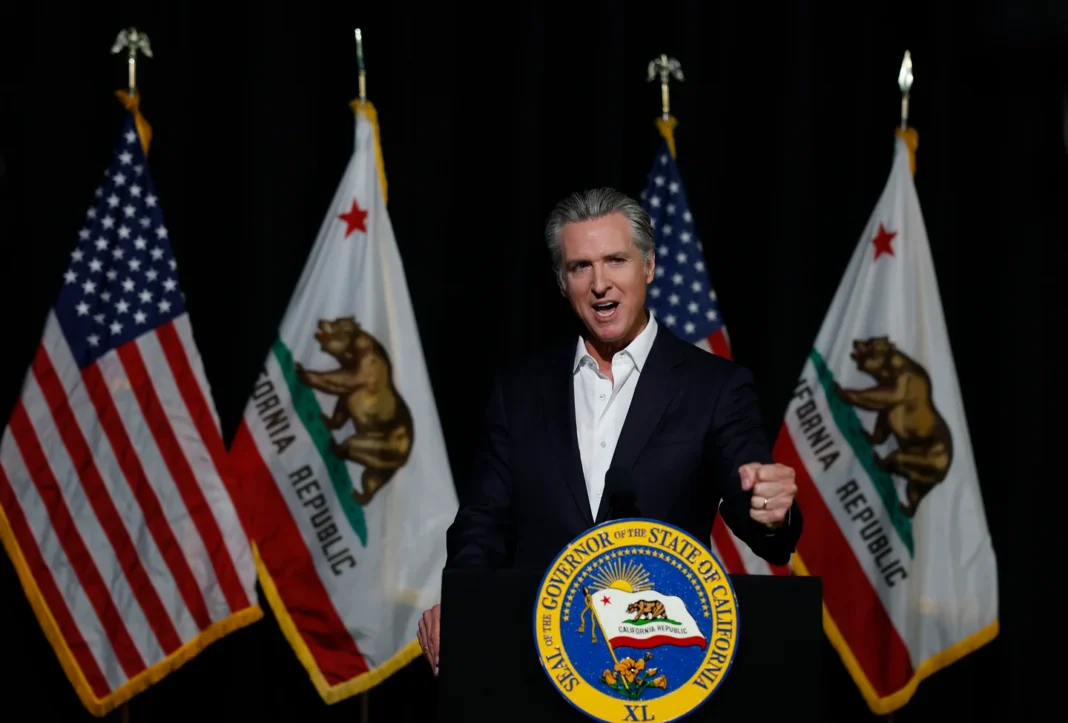
Gavin Newsom is calling himself an insurgent. He has been the governor of California since January 2019. Before that, he was the lieutenant governor of California from 2011 to 2019. Before that, he was the mayor of San Francisco from 2004 to 2011. He has held continuous elected office in California for 22 consecutive years, making him one of the most tenured and recognizable Democratic politicians in the country, a figure who debated Ron DeSantis in prime time in 2024, who has appeared at virtually every major Democratic Party event and fundraiser since at least 2022, and who has been discussed as a presidential candidate in essentially every major publication since at least 2021. He is positioning himself as an insurgent against the political establishment.
Fox News anchor Trace Gallagher addressed this positioning on Fox News At Night on Monday with the observation that Newsom “doesn’t quite understand the definition of insurgent,” which is correct in the specific sense that an insurgent is someone rising against an established authority, and Newsom is the established authority in the most populous state in the country. Fox News commentator Katie Zacharia described his gubernatorial record as a “railroad of failures,” a phrase that contains a specific list: the homeless population, the corporate flight, and the fires.
California’s homeless population is the largest of any state in the country and has been for Newsom’s entire tenure as governor. San Francisco’s homelessness crisis became a defining national political image during his mayoral years. As governor, he launched the California Interagency Council on Homelessness, allocated billions in state funding toward housing and services, declared homelessness a state emergency in 2023, and signed legislation allowing cities to clear encampments over the objections of encampment residents. The population has not declined to reflect those investments in a way that shows up in the statistics that national media use when discussing the issue. San Francisco remains the shorthand for progressive urban policy’s failure that Republicans deploy in every competitive cycle.
The Fortune 500 data point is equally specific. Texas surpassed California in the number of Fortune 500 headquarters this year, 57 to 56, a reversal from a position California held for decades. The companies that left include ExxonMobil, Chevron, SpaceX, X, and Samsung’s American arm, all of which departed for Texas, which has no state income tax and lighter regulatory requirements. Newsom spent years arguing that the departures were overstated, that the companies leaving were outliers, and that California’s quality of life and talent pool made it irreplaceable as a business location. He was making these arguments while the companies were leaving. The Fortune 500 count this year made the outcome visible in a single data point.
The January 2025 Palisades and Eaton fires, which Newsom was governing through, were the most destructive wildfires in California’s recorded history, burning more than 50,000 structures across Los Angeles County, killing at least 25 people, and displacing tens of thousands. The fires generated sustained criticism of the state’s emergency preparedness, water pressure infrastructure, and fire prevention investment under Newsom’s administration. He was in California for the fires, unlike Karen Bass, whose absence in Ghana during the initial days of the Palisades fire became the defining image of her reelection collapse. But the fires happened during his governorship, with his state agencies, under his emergency management framework, and with his budget allocations.
The insurgent branding is designed for a 2028 Democratic presidential primary whose shape is being actively contested. James Carville declared democratic socialists a “bridge too far” for the party this week. Bernie Sanders told Carville to start his own party. AOC said Woke 1.0 was crazy and then defended its underlying values. El-Sayed won Michigan. Francesca Hong is leading in Wisconsin’s Democratic gubernatorial primary today. The Democratic Party’s internal argument about what kind of candidate can win in November against Republicans is the loudest it has been since 2020, and Newsom is watching all of it and concluding that a different kind of Democratic politician needs to enter the 2028 field.
The pitch Newsom is constructing is: I have governed at scale, I have fought Trump directly and publicly, I am younger than Biden was, and I represent the responsible executive wing of the party rather than the DSA wing or the Carvillite wing. All of those arguments are real. None of them require the word insurgent. An insurgent is someone who hasn’t won before. Newsom has won repeatedly. The word he is reaching for is “alternative,” or “contrast,” or “pragmatist.” Insurgent is the word his pollsters told him resonates with the 2028 electorate. It may. It also produces the Fox News segment where the anchor notes he doesn’t understand its definition, which is the counternarrative his campaign will spend the next two years managing.
He has been in office for 22 years. The insurgency is a branding strategy. California’s homeless population, its fires, and its corporate departures are the record he is running from while calling himself the person who will change things.
When the seven-year governor of California brands himself an insurgent and opponents catalog three defining failures of his tenure in the same breath, what exactly is the 2028 pitch?
Sources
HuffPost: Gavin Newsom Admits Next Political Ambition… As If It Weren’t Obvious Enough
HuffPost: ’25th Amendment Moment’: Gavin Newsom Urges Action Against ‘Mad King’ Trump
Raw Story: Georgia senator could dismantle the MAGA machine: CNN analyst