



Men have apparently reached the stage of modern equality where aging is no longer allowed to happen quietly. Fox News reported Sunday that more men are seeking aesthetic treatments as the stigma around male cosmetic work fades and pressure grows to keep appearance aligned with how youthful people feel. The story cited American Society of Plastic Surgeons data saying men account for roughly 15% of cosmetic procedures. The cultural development is straightforward. After generations of selling women an endless maintenance contract with the mirror, the beauty economy has discovered another half of the population with pores.
This is not appearing from nowhere. The Guardian reported in March on what it called the relentless rise of impossible male beauty standards, describing more sculpted, managed male faces and a growth in cosmetic interventions. Another Guardian report visited a Manhattan clinic called Alpha Male Plastic Surgery, where procedures marketed to men include everything from torso work to injectable donor fat for pec enhancement. The specifics can get extreme, but the broader direction is mundane. Male appearance has become a category that can be optimized, measured, sold back and optimized again.
Fox’s Sunday piece described ‘looksmaxxing’ as a social-media term for intensified efforts to improve appearance and said motives can include competition in youth-focused workplaces and dissatisfaction with signs of aging such as under-eye circles or a softer jawline. The Guardian has separately traced looksmaxxing from online male subcultures into a wider vocabulary of beauty optimization. The important word is optimization. Grooming used to mean getting a haircut and owning a shirt without a team logo on it. Optimization suggests a project plan.
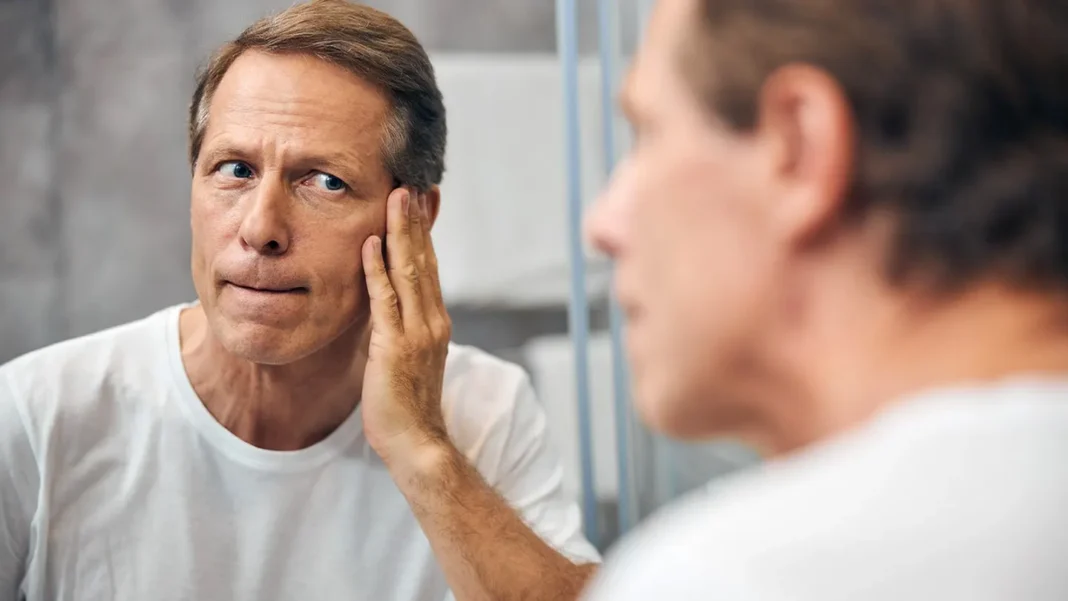
The Zeitgeist target is the industry, not men who want to look good. Wanting to like your reflection is among the least mysterious human impulses available. The absurdity begins when a normal discomfort with aging becomes a technical failure requiring a branded intervention. A face is no longer getting older. It is experiencing a jawline-definition problem. Hair is not thinning. It has entered an early-intervention window. The mirror has been promoted to diagnostic equipment.
This is also why the trend feels familiar. Women have lived with commercial beauty pressure for decades, including the implication that each visible year represents insufficient effort. The male version arrives wearing slightly different packaging. It talks about performance, confidence, competitiveness, longevity and optimization. That sounds less like vanity and more like a quarterly earnings call for your cheekbones. The product changes. The sales pitch remains remarkably durable. You are not insecure. You are under-managed.
There is a sensible version of all this. Fox’s medical sources emphasized basics before surgery, including avoiding nicotine, using sun protection, maintaining a healthy weight, exercising and addressing hair loss early if it matters to the patient. Cosmetic procedures are personal decisions, and many are routine. The satire is not that Botox exists. The satire is that an entire cultural vocabulary is forming around the proposition that a middle-aged man should not merely be healthy, employed and reasonably pleasant. He should also maintain market-ready facial architecture.
The darker edge is visible in the more extreme looksmaxxing culture. Guardian reporting has described young men pursuing aggressive or risky methods in the name of facial improvement. That is not the same thing as an older man getting a conservative treatment from a qualified physician, and it should not be collapsed into one category. But both exist inside a culture increasingly willing to treat appearance as a performance metric. Once the metric exists, there is always a more committed person online showing you how badly you are losing.
There is money in turning ordinary change into a maintenance problem. Gray hair becomes a treatment category. A softer jawline becomes a contour issue. Looking tired after decades of being awake becomes an aesthetic mismatch. None of these descriptions is necessarily false, but they create a useful commercial assumption: the baseline human face is unfinished. Once that assumption settles in, the customer is never really done. The procedure can be subtle, tasteful and medically responsible, and the business model can still depend on the idea that time has committed an error requiring correction.
Men may even be unusually vulnerable to the optimization pitch because it can avoid the language of beauty altogether. The product does not have to promise prettiness. It can promise edge, vitality, competitiveness or congruence between how a person feels and how he looks. That vocabulary turns appearance into performance. It also gives vanity a respectable spreadsheet. The client is not chasing youth. He is aligning external presentation with internal capacity. Somewhere between the retinol and the jawline consultation, getting older has acquired key performance indicators.
The trend is also a reminder that equality can arrive in strange forms. Men gaining freedom to care openly about skincare or cosmetic work is not inherently bad. The old rule that men should ignore their appearance was not especially enlightened. The catch is that freedom to participate can become pressure to participate very quickly when workplaces, dating apps and social media reward a narrower look. Removing shame from grooming is progress. Replacing that shame with a new obligation to keep optimizing until your face looks permanently employable is a less convincing victory. For the beauty business, that tension is ideal. It can present itself as liberating men from an old taboo while simultaneously expanding the list of things they are supposed to notice about themselves. The customer gains permission and a new insecurity in the same transaction. That is an efficient market. The face was there all along. What changed was the number of industries now prepared to grade it.
Now that male aging has become another optimization problem, how long before looking perfectly normal starts to feel like falling behind?
Sources
Fox News: Men face new pressure to stay ‘hot’ as they age — and it’s not just about living longer
The Guardian: ‘There is no shame in being vain’: the relentless rise of impossible male beauty standards
The Guardian: ‘He can say he went to the gym’: people are pumping themselves with fat from corpses to perk up their pecs, boobs and butts