




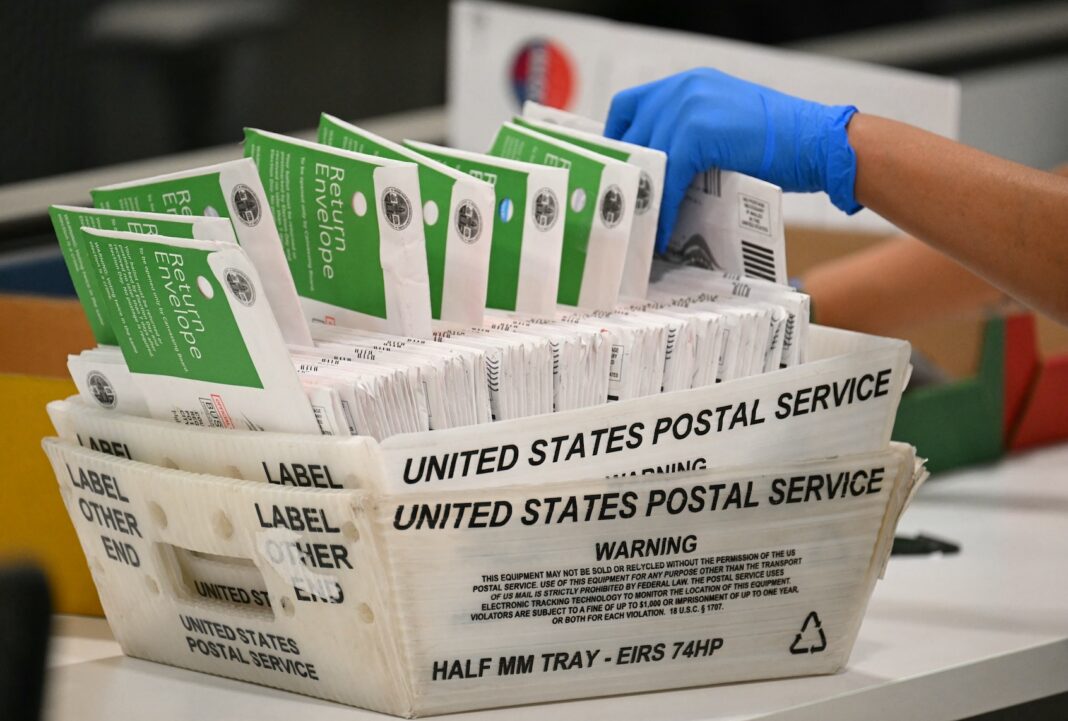
The Trump administration wants tighter controls on mail voting, and the Postal Service has been building a system to support them. According to reporting republished by Salon, people inside USPS warned that the design could delay or reject enormous batches of ballots because of a problem with a single barcode. The Guardian separately reported Democratic alarm over the rushed system and a whistleblower’s concerns. This is an ambitious approach to election security. If one suspicious envelope is the problem, the proposed solution is apparently to make thousands of perfectly ordinary envelopes share its afternoon.
The rule grew out of Trump’s push for new verification around mailed ballots. The details matter because election mail moves in bulk. Counties can send tens of thousands or millions of ballots at once. The Salon report says officials discussed a system in which one failed verification within a batch could cause the whole batch to be rejected and returned. The Postal Service says the rule should not prevent a single eligible voter from voting by mail and has emphasized that it is working within court orders. That defense deserves to be included because the system is contested, not convicted.
The timeline is another problem. A whistleblower said employees were working under a compressed schedule to create tracking and verification tools that would normally require much longer development. Officials reportedly raised concerns about the complexity and the potential for unintended consequences. The White House responded that USPS already handles sophisticated barcode systems and that the work is not uniquely complex. Perhaps. The soothing phrase ‘not uniquely complex’ becomes less soothing when attached to millions of ballots and a deadline measured in weeks.
The target is the Republican tendency to treat election administration as if stricter automatically means safer. A rule can require more verification and still make the election less reliable if it blocks lawful ballots. Security is not measured by the number of things rejected. Airport security would be excellent by that standard if no passengers were allowed onto the plane. The job is to identify bad ballots without interfering with good ones, which is harder and less satisfying than announcing a crackdown.
Trump has spent years arguing that mail voting is vulnerable to fraud, despite repeatedly overstating the evidence for widespread fraud. His supporters say new checks are necessary to restore confidence. Confidence matters. So does competence. A security system that risks delaying an entire county’s mailing because one barcode misbehaves could produce exactly the chaos that election skeptics claim to fear. The anti-fraud machine should not become the most efficient source of election-night conspiracy content.
The Postal Service is in an unusually delicate position because it is not supposed to decide elections. Its job is to move the mail. Election offices decide eligibility under state law. A federal verification layer that can interrupt bulk mailings risks blurring those roles, which is why courts and election officials are watching closely. The more Washington tries to standardize the process through executive action, the more likely it is to collide with fifty different systems that were not designed around the same spreadsheet.
There is a legitimate case for better tracking. Voters should know where ballots are. Election officials should be able to detect errors early. Barcodes can improve accountability. The issue is whether the rule has been tested against the boring reality of election operations. A good system catches mistakes without magnifying them. A bad system turns one bad data point into a countywide event. Technology does not become neutral simply because it beeps. That is particularly important because election administration has almost no margin for a do-over. A retailer can patch a checkout system next Tuesday. A ballot delayed past a legal deadline does not get a software update and another chance. Reliability is the whole product. Election systems earn trust by becoming invisible, not innovative at the deadline.
Republicans should be especially cautious because their voters increasingly use mail ballots too. Trump’s own party has spent recent cycles trying to reverse the damage caused when he discouraged supporters from voting by mail. A system that disrupts mailed ballots does not ask party registration before creating the headache. The safeguard can hit the people who demanded the safeguard. Mail voting is especially unforgiving because small administrative failures can scale quickly. A barcode rule that works perfectly in testing can become a serious problem if large batches are processed under election deadlines and one error affects many envelopes at once. That is why the internal warnings matter even if the worst case never happens. Competent administration is partly the art of fixing boring failure modes before millions of citizens discover them simultaneously on television.
The administration may modify the process, courts may keep parts of it from taking effect, and USPS may resolve the technical concerns before ballots move at scale. Those possibilities matter. The correct response to a warning is not to declare disaster in advance. It is to test the system hard enough that the disaster remains hypothetical.
Election rules should become more boring as Election Day approaches, not more experimental. The country already has enough people prepared to interpret any delay as evidence of a plot. It does not need a rushed federal system manufacturing fresh material for them.
If the purpose of the new mail-voting rules is to increase confidence, what happens if the verification system itself becomes the reason lawful ballots are delayed?
Sources
Salon: New mail voting rules moved forward despite USPS officials’ concerns about mass disenfranchisement
The Guardian: ‘Dangerous power grab’: top Democrats decry USPS system that could thwart mail-in voting – as it happened