



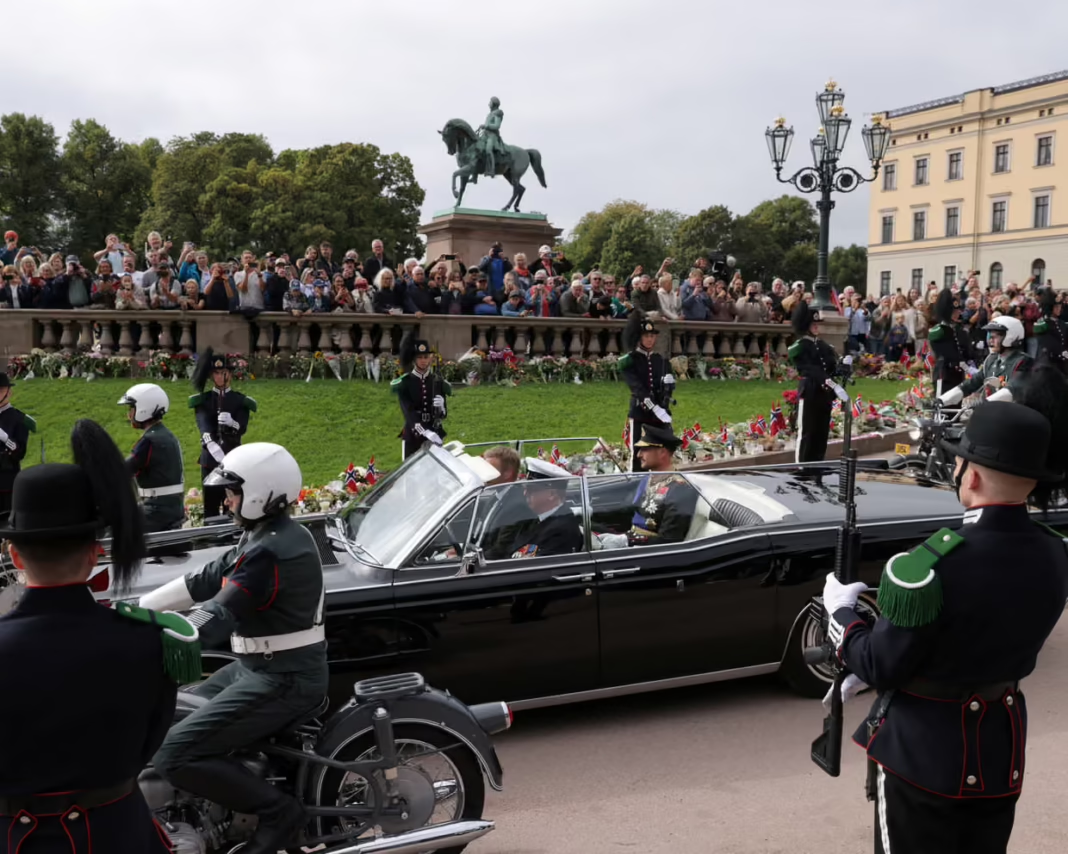
Norway has a new king, and the transition managed to be both solemn and extremely modern in the way only a twenty-first-century monarchy can manage. King Haakon VIII swore his oath before parliament this week after the death of his father, King Harald V, ending one reign and beginning another without a coronation, a carriage marathon or a week of ceremonial furniture being moved through Oslo. His 22-year-old daughter and heir, Crown Princess Ingrid Alexandra, stood beside him. His wife, Queen Mette-Marit, was absent because of complications following a lung transplant. The crown changed hands with constitutional restraint, family vulnerability and just enough unresolved scandal waiting nearby to make the institution feel fully operational.
Haakon inherits one of Europe’s most popular monarchies, which is useful because he is also inheriting several years of reasons for Norwegians to ask themselves how much patience a popular monarchy gets. The Guardian reported that support for the institution had risen to 72 percent in a recent poll, up from 54 percent in May. That is an impressive rebound for any brand, especially one whose product line includes hereditary office. King Harald’s death clearly produced a wave of national affection, and the late king had earned much of it through a reputation for humility and steadiness. Norway mourned a monarch who had spent 35 years making royalty look less like a command structure and more like an unusually well-funded civic duty.
The awkward part is that Haakon now gets to test whether that affection transfers automatically. Monarchy loves continuity because continuity is what monarchy sells. The whole arrangement is built around the comforting promise that somebody has already been selected for the next vacancy, possibly before they learned to read. But continuity works best when the family itself is boring. Haakon’s household has not had that luxury. Mette-Marit has faced scrutiny over past contacts with Jeffrey Epstein, while her son Marius Borg Høiby was convicted this year of serious crimes. Those are not reasons to mock private suffering or family identity. They are reasons to notice that an institution built on public symbolism cannot simply declare the private lives surrounding the symbol irrelevant whenever the symbolism gets complicated.
Haakon’s first major act was admirably restrained. He pledged to uphold Norway’s constitution and took the oath in parliament, where elected officials rather than hereditary ones make the laws. Norway no longer crowns its monarchs, which is probably wise. Nothing clarifies the limited political power of a modern king quite like deciding not to place a giant jeweled hat on him while everyone watches. The new king’s motto remains the familiar ‘Everything for Norway,’ a phrase that sounds stirring until you remember that the constitutional job mostly requires him to avoid doing too much of anything at all.
That tension is the useful thing about modern monarchy. The sovereign must be visible but not political, important but not powerful, emotionally available but personally mysterious. The family must generate enough warmth to justify the institution while avoiding enough drama to make taxpayers wonder why they are financing a hereditary reality show. Harald was unusually good at this. He made monarchy feel modest, which is a remarkable trick for a system that begins with one family receiving a permanent national job description.
Haakon has spent decades preparing for the role, and nobody can reasonably claim he arrived as an untrained surprise. Yet his first week shows how little preparation can control the actual job. His father’s popularity, his wife’s health, his stepfamily’s controversies and his daughter’s future are all now part of the monarchy’s public meaning whether he wants them to be or not. The institution insists the crown is bigger than the person wearing it. The public tends to judge the crown through the people standing around it. That is a difficult circle to square, even with palace staff.
There is also something refreshingly Norwegian about the lack of theatrical panic. Britain can turn a royal seating chart into a constitutional seminar. Norway changed sovereigns and moved on to parliament. No coronation is planned. A ceremonial consecration remains possible, but the state itself does not require one. The message is almost aggressively sensible. Yes, there is a king. No, we do not need three days of explaining which spoon proves it.
That restraint may be Haakon’s strongest inheritance. Harald modernized the monarchy by making it seem less grand, not more. Haakon now has to do the same while dealing with a media environment that rewards every family complication with global attention. The obvious temptation will be to manage the image harder, explain more, stage more and protect the institution through tighter control. Royal families almost always discover that tighter control is the exact moment everyone starts asking what is being controlled.
For now, Norway has done the constitutional part cleanly. The king took the oath. The heir stood beside him. The country mourned one monarch and accepted another. The harder work begins when the ceremony ends and the institution has to prove that a hereditary symbol can remain useful in a society that otherwise expects public authority to explain itself. Haakon does not need to become a celebrity king. He needs to keep the monarchy from becoming interesting for the wrong reasons.
Harald’s great achievement was making the crown feel ordinary enough to survive. Haakon’s challenge is harder because the family around the crown is already more complicated than the office would prefer. A monarchy can absorb scandal, illness and generational change. It has been doing that for centuries. The real question is whether it can keep asking the public to separate the institution from the people who make the institution visible every day.
If Norway’s monarchy survives by looking increasingly ordinary, how much family drama can it absorb before ordinary stops being reassuring?
Sources
The Guardian: Norway’s new king swears oath of allegiance with daughter at his side
The Guardian: Norway’s King Harald dies aged 89
The Sun: King Charles pays tribute to ‘dear cousin’ King Harald V as Norway’s monarch dies aged 89 after long health battle